
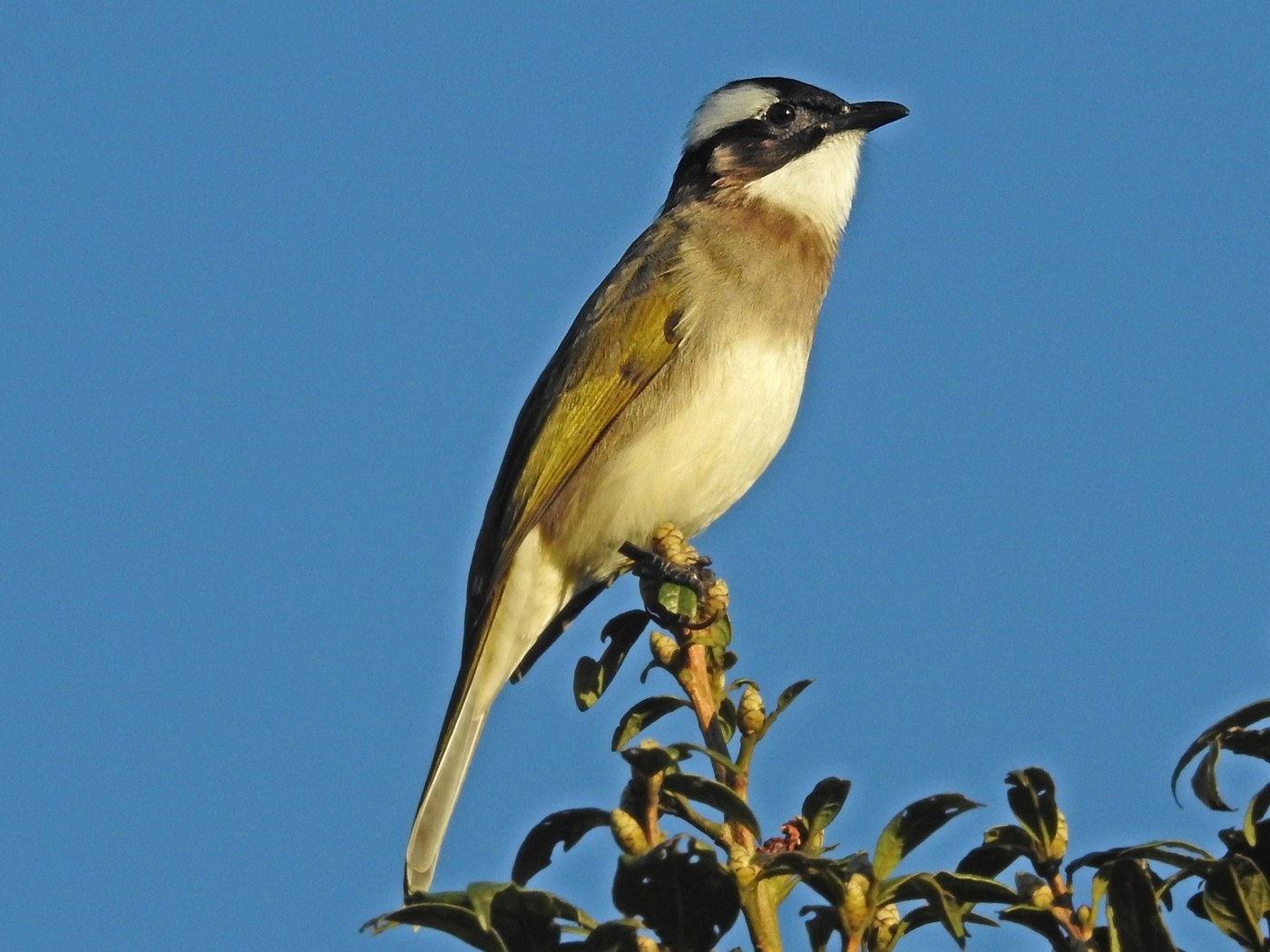
Chinese Bulbul
Pycnonotus sinensis
A widespread East Asian bulbul with an olive-green body, a black-and-white patterned head, and a distinctive white patch behind the eye.
- Size
- 17-19 cm (6.7-7.5 in) long
- Habitat
- gardens, parks, scrub, woodland edge, and farmland
- Type
- songbird
Spotted a bird like this?
Identify any bird from a photo, free.
Overview
The Chinese Bulbul, more formally known as the Light-vented Bulbul, is an olive-green songbird with a black crown, a white patch extending back from the eye toward the nape, and a whitish throat. The underparts are pale grey-white with olive shading on the flanks, and a small, slightly ragged crest is sometimes raised on the crown.
One of the most common and conspicuous garden and park birds across much of southern and eastern China and Taiwan, it thrives alongside people, readily nesting in ornamental shrubs and visiting fruiting and flowering trees in urban and suburban settings.
How to identify it
Key field marks
- Olive-green back, wings, and tail
- Black crown with a bold white patch behind and below the eye
- Whitish throat and pale grey underparts
- Small, often raised crest
Similar species
- Brown-eared Bulbul is larger, greyer overall, and has a chestnut ear patch rather than a white one.
- Sooty-headed Bulbul and other regional bulbuls differ in head pattern and range; the white post-ocular patch is a reliable mark for this species.
Habitat & range
Habitat
Common in gardens, parks, scrubland, woodland edges, farmland, and other lightly wooded or human-modified habitats.
Range
Widespread across southern and eastern China, Taiwan, and Hainan, with populations that have also become established in parts of Hong Kong and beyond through both natural spread and introduction.
Migration
Mostly resident, with some local seasonal movement.
Behavior & voice
Behavior
Bold, active, and often conspicuous, perching in the open and calling frequently; readily adapts to gardens and urban parks, sometimes forming small flocks outside the breeding season.
Voice
A cheerful, varied series of whistled and chattering notes, often given from a prominent perch.
Feeding
Eats a wide variety of fruit and berries, insects, and nectar, adjusting its diet seasonally and readily visiting flowering and fruiting garden plants.
Nesting
Builds a cup nest of grass, twigs, and roots in a dense shrub or small tree; lays 2-4 pinkish eggs with reddish speckling.
Frequently asked questions
How do you identify a Chinese Bulbul?
Look for an olive-green body, a black crown with a white patch behind the eye, and a pale grey-white throat and underparts.
What is the difference between the Chinese Bulbul and the Light-vented Bulbul?
They are the same species; "Chinese Bulbul" is a common alternate name for the Light-vented Bulbul, Pycnonotus sinensis.
What does a Chinese Bulbul eat?
A mix of fruit, berries, insects, and flower nectar, which it readily finds in gardens and parks.
Where does the Chinese Bulbul live?
Across southern and eastern China, Taiwan, and Hainan, commonly in gardens, parks, and scrubby habitats.
Chinese Bulbul guides
In-depth guides for identifying, finding, and understanding Chinese Bulbul.
Other birds you may enjoy

Black Redstart
13-14.5 cm (5.1-5.7 in) long, 23-26 cm wingspan

Black-throated Sparrow
12-14 cm (4.7-5.5 in) long, about 19-20 cm (7.5-8 in) wingspan

Greater Bird-of-paradise
Body about 43 cm; males with additional flank plumes up to 50 cm and long tail wires

Blue Tit
11-12 cm (4.3-4.7 in) long, 17-20 cm wingspan

Red-billed Quelea
11.5–13 cm long, wingspan about 20–22 cm
White-plumed Antbird
13-14 cm (5-5.5 in) long

Pyrrhuloxia
19-22 cm (7.5-8.7 in) long, 30 cm wingspan

Blue-gray Tanager
16-18 cm (6-7 in) long

Blackburnian Warbler
11-13 cm (4.3-5.1 in) long, 20-22 cm wingspan

Bluethroat
13-14 cm (5.1-5.5 in) long, 20-22 cm wingspan

Eurasian Nuthatch
12-14.5 cm (4.7-5.7 in) long, 22.5-27 cm wingspan

Wood Thrush
19-21 cm (7.5-8.3 in) long, about 33 cm (13 in) wingspan