
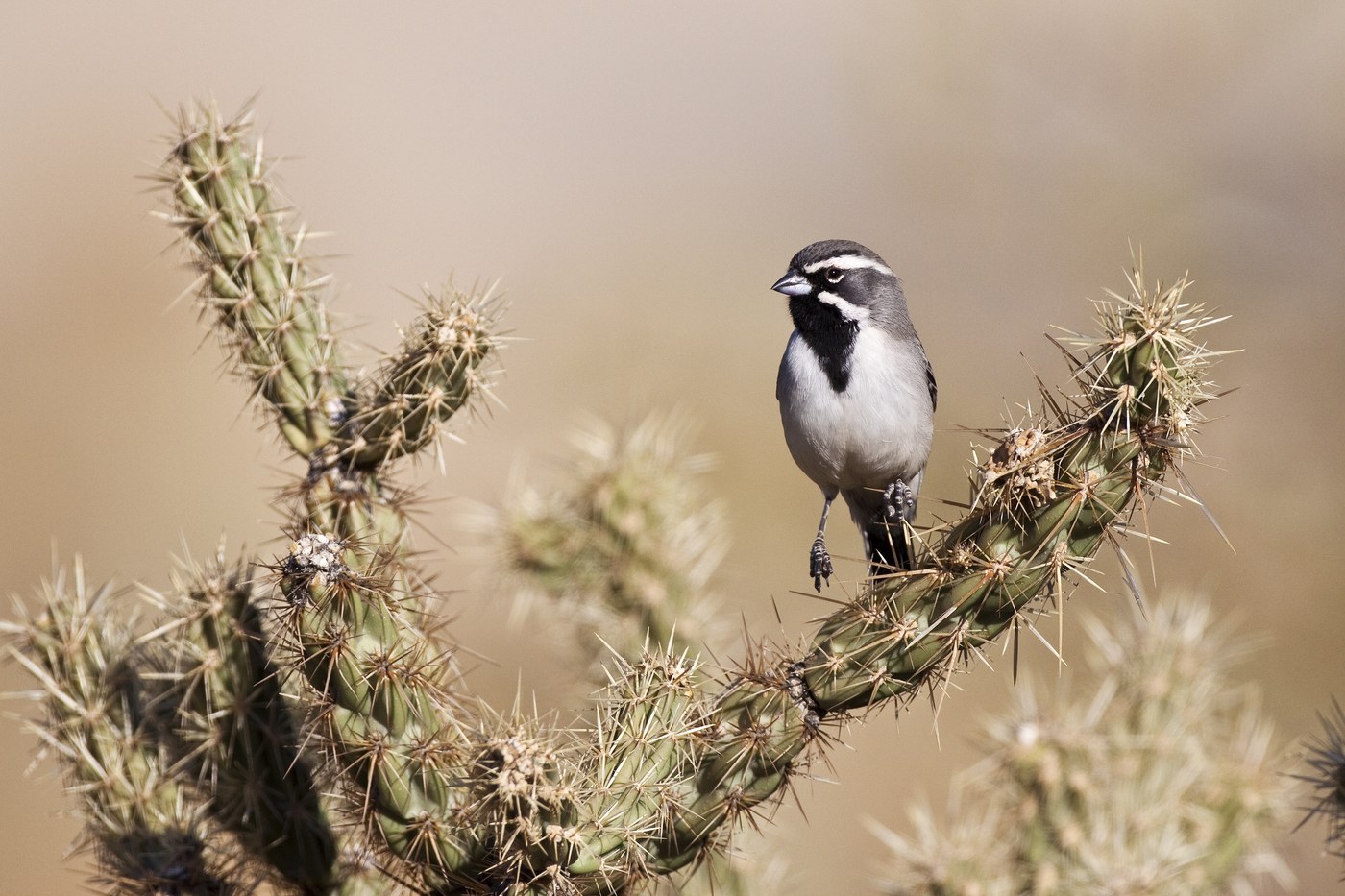
Black-throated Sparrow
Amphispiza bilineata
A striking desert sparrow with a bold black throat framed by crisp white eyebrow and whisker stripes.
- Size
- 12-14 cm (4.7-5.5 in) long, about 19-20 cm (7.5-8 in) wingspan
- Habitat
- arid desert scrub, rocky slopes, and chaparral
- Type
- songbird
Spotted a bird like this?
Identify any bird from a photo, free.
Overview
The Black-throated Sparrow is one of the most handsome and easily recognized sparrows of the American desert, nicknamed the 'desert sparrow' for its ability to thrive in some of the hottest, driest terrain in North America, often far from any standing water.
Adults have a clean gray head and back with a jet-black triangular throat patch bordered dramatically by a bold white eyebrow stripe above and a white submoustachial stripe below, creating a striking two-tone facial pattern. The belly is clean white and the wings and tail are plain brownish-gray. Juveniles look quite different, lacking the black throat and instead showing fine streaking on a paler breast.
This sparrow is a classic sight perched atop a creosote bush or cactus, singing its sweet tinkling song across open desert flats.
How to identify it
Key Field Marks
- Bold black triangular throat patch, unmistakable on adults
- Crisp white eyebrow (supercilium) and white submoustachial stripe framing the black throat
- Plain gray head and nape, brownish-gray back
- Clean white belly, unmarked
- Juveniles lack the black throat and show streaked underparts instead
Similar Species
No other North American sparrow shows this precise combination of a solid black throat with clean white facial stripes, making adults essentially unmistakable. Juveniles can be confused with other streaky desert sparrows but usually accompany adults, which aids identification.
Habitat & range
This species is a true desert specialist, found across the arid Southwest in the Mojave, Sonoran, and Chihuahuan Deserts of the United States and Mexico, favoring rocky slopes, desert scrub, and washes dominated by creosote bush, cactus, and other xeric shrubs. It also occurs in dry chaparral and arid grassland with scattered shrubs.
Many populations are permanent residents, though northern and higher-elevation breeders move to lower, warmer desert in winter. The species is remarkably tolerant of heat and aridity and can persist in areas with little or no free water, deriving much of its moisture from seeds and insects.
Behavior & voice
Behavior
Black-throated Sparrows forage on the ground and in low shrubs, often in pairs or small family groups, hopping between patches of cover in short bursts.
Voice
The song is a sweet, bell-like series of clear notes followed by a trill, often rendered as 'tsee-tsee-titi-trrrr,' delivered from an exposed perch such as the top of a shrub or cactus.
Feeding
Diet is mostly seeds, supplemented by insects, especially during the breeding season when protein-rich food is needed for nestlings.
Nesting and Breeding
Nests are built low in a shrub or cactus, a compact cup of grasses and plant down. Clutches typically contain 2-4 pale bluish-white eggs, and pairs may attempt multiple broods, particularly after summer monsoon rains boost food supply.
Frequently asked questions
How do you identify a Black-throated Sparrow?
Look for a gray-headed sparrow with a bold black triangular throat patch bordered by crisp white eyebrow and mustache stripes, and a clean white belly.
Where does the Black-throated Sparrow live?
It lives year-round in arid deserts of the southwestern United States and Mexico, including the Mojave, Sonoran, and Chihuahuan Deserts.
Can Black-throated Sparrows survive without water?
Yes, they are highly adapted to arid environments and can go long periods without drinking free water, getting moisture from their food.
Do juvenile Black-throated Sparrows have a black throat?
No, juveniles lack the black throat and instead have fine streaking on a paler breast until they molt into adult plumage.
What does the Black-throated Sparrow's song sound like?
It is a sweet, tinkling series of clear notes ending in a trill, often sung from the top of a shrub or cactus.
Black-throated Sparrow guides
In-depth guides for identifying, finding, and understanding Black-throated Sparrow.

Other birds you may enjoy

Black Redstart
13-14.5 cm (5.1-5.7 in) long, 23-26 cm wingspan

Greater Bird-of-paradise
Body about 43 cm; males with additional flank plumes up to 50 cm and long tail wires

Blue Tit
11-12 cm (4.3-4.7 in) long, 17-20 cm wingspan

Red-billed Quelea
11.5–13 cm long, wingspan about 20–22 cm
White-plumed Antbird
13-14 cm (5-5.5 in) long

Pyrrhuloxia
19-22 cm (7.5-8.7 in) long, 30 cm wingspan

Blue-gray Tanager
16-18 cm (6-7 in) long

Blackburnian Warbler
11-13 cm (4.3-5.1 in) long, 20-22 cm wingspan

Bluethroat
13-14 cm (5.1-5.5 in) long, 20-22 cm wingspan

Eurasian Nuthatch
12-14.5 cm (4.7-5.7 in) long, 22.5-27 cm wingspan

Wood Thrush
19-21 cm (7.5-8.3 in) long, about 33 cm (13 in) wingspan
Blue-headed Vireo
12-14 cm (5-5.5 in) long, 21-25 cm wingspan