
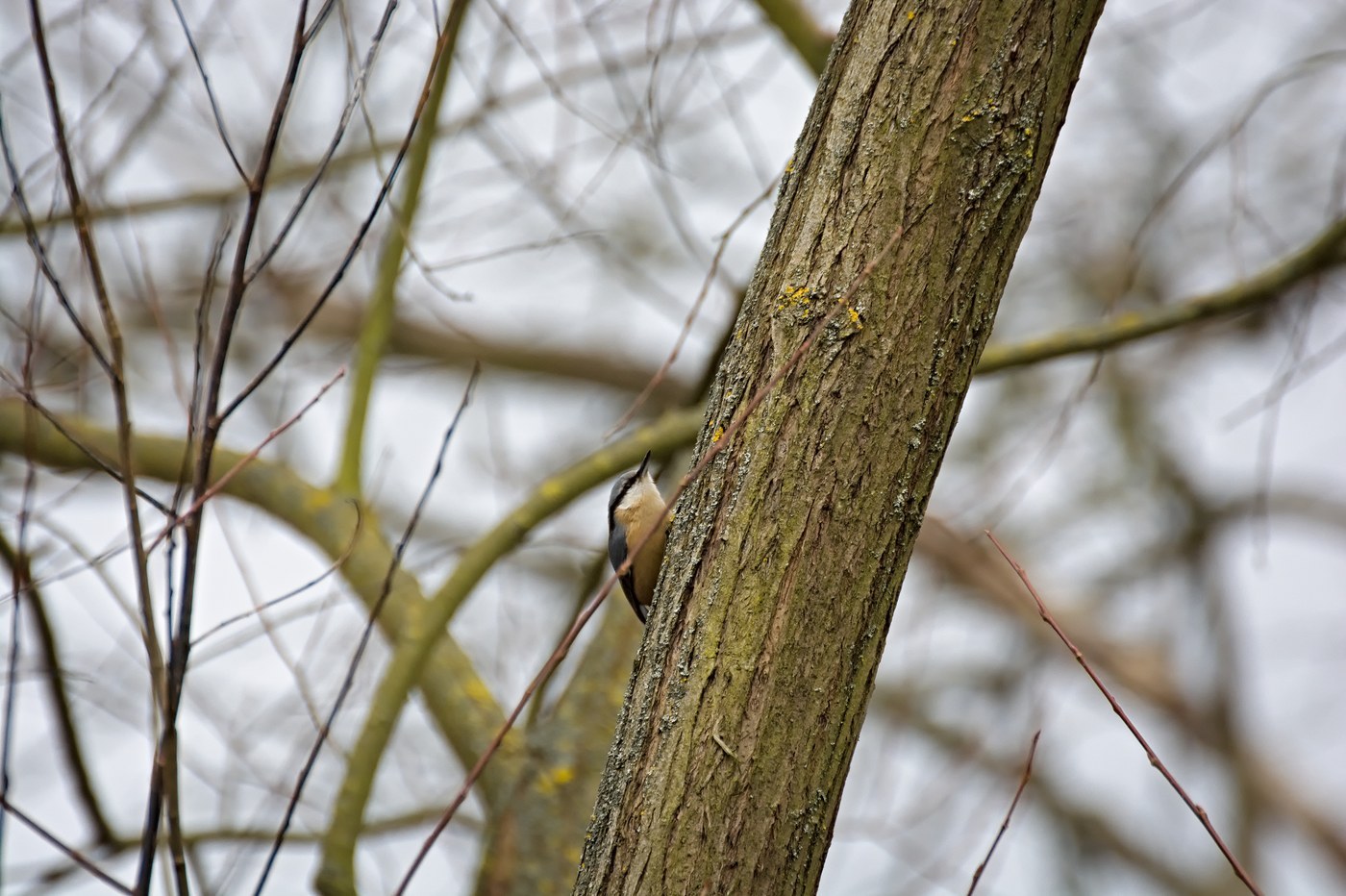
Eurasian Nuthatch
Sitta europaea
A compact, blue-grey woodland bird famous for its ability to climb head-first down tree trunks, and for wedging nuts into bark crevices to hammer them open.
- Size
- 12-14.5 cm (4.7-5.7 in) long, 22.5-27 cm wingspan
- Habitat
- mature deciduous and mixed woodland, parks, and gardens with large trees
- Type
- songbird
Spotted a bird like this?
Identify any bird from a photo, free.
Overview
The Eurasian Nuthatch is a compact, stocky bird with smooth blue-grey upperparts, a bold black eyestripe running through the eye, and warm orange-buff underparts that deepen to chestnut on the flanks and undertail. Its short tail, strong feet, and powerful, dagger-like bill are all adaptations for its specialised woodland lifestyle.
It is best known for a remarkable ability shared by few other birds: climbing down tree trunks head-first, using its strong claws to grip the bark while descending, in addition to the more typical upward climbing shown by treecreepers and woodpeckers.
Nuthatches are also well known for wedging nuts and large seeds into cracks in bark and hammering them open with repeated blows of the bill, a behaviour that gives the family its common name.
How to identify it
Key field marks
- Smooth blue-grey upperparts with no streaking
- Bold black eyestripe running through the eye
- Orange-buff underparts, deepening to chestnut on the flanks
- Short tail and strong, dagger-shaped bill
- Distinctive head-first descent down tree trunks
Similar species
- Treecreepers: streaked brown, camouflaged bark-like plumage, thin downcurved bill, and always climb upward, spiralling around trunks, never head-first downward like the Nuthatch.
- Woodpeckers: larger, with stiff tail feathers used as a prop and generally black-and-white or barred plumage, quite different from the Nuthatch's smooth blue-grey tones.
- No other common European woodland bird shares the Nuthatch's combination of blue-grey back, black eyestripe, and orange underparts.
Habitat & range
Eurasian Nuthatches are widespread across much of Europe and temperate Asia, favouring mature deciduous and mixed woodland with large trees offering suitable nest holes and abundant bark crevices for foraging and food storage. They also readily use parks, large gardens, and orchards with mature trees.
The species is largely non-migratory and sedentary, with pairs typically holding permanent territories year-round, and rarely straying far from their natal woodland.
Nuthatches cache food, particularly seeds and nuts, in bark crevices during autumn for retrieval later in the year, an important behaviour that helps them survive winter food shortages.
Behavior & voice
Voice
Nuthatches are vocal birds with a range of loud calls, including a ringing, repeated "pwit-pwit-pwit" or "chwit-chwit" and a loud, whistling song of clear, repeated notes, often delivered from a high perch and carrying well through woodland.
Feeding
Insects and spiders gleaned from bark make up much of the summer diet, while nuts and large seeds, including hazelnuts and beech mast, become increasingly important in autumn and winter. Nuthatches famously wedge these into bark crevices and hammer them open with the bill.
Nesting and breeding
Nuthatches nest in tree cavities, often old woodpecker holes, and are known for plastering mud around the entrance to reduce its size, protecting the nest from larger competitors. Clutches typically contain six to nine eggs.
Frequently asked questions
How do you identify a Eurasian Nuthatch?
Look for a compact bird with smooth blue-grey upperparts, a bold black eyestripe, and orange-buff underparts, often seen climbing head-first down a tree trunk.
Why can Nuthatches climb down trees head-first?
Their strong feet and claws allow them to grip bark securely while descending head-first, a technique not used by treecreepers or woodpeckers, which only climb upward.
What does a Nuthatch eat?
It feeds on insects and spiders in summer, switching to nuts and seeds in autumn and winter, often wedging them into bark crevices and hammering them open.
Do Nuthatches use nest boxes?
Yes, they will use nest boxes as well as natural tree cavities and old woodpecker holes, often plastering mud around the entrance to reduce its size.
Do Eurasian Nuthatches migrate?
No, they are largely sedentary birds that hold permanent territories year-round and rarely move far from their home woodland.
Eurasian Nuthatch guides
In-depth guides for identifying, finding, and understanding Eurasian Nuthatch.

Other birds you may enjoy

Black Redstart
13-14.5 cm (5.1-5.7 in) long, 23-26 cm wingspan

Black-throated Sparrow
12-14 cm (4.7-5.5 in) long, about 19-20 cm (7.5-8 in) wingspan

Greater Bird-of-paradise
Body about 43 cm; males with additional flank plumes up to 50 cm and long tail wires

Blue Tit
11-12 cm (4.3-4.7 in) long, 17-20 cm wingspan

Red-billed Quelea
11.5–13 cm long, wingspan about 20–22 cm
White-plumed Antbird
13-14 cm (5-5.5 in) long

Pyrrhuloxia
19-22 cm (7.5-8.7 in) long, 30 cm wingspan

Blue-gray Tanager
16-18 cm (6-7 in) long

Blackburnian Warbler
11-13 cm (4.3-5.1 in) long, 20-22 cm wingspan

Bluethroat
13-14 cm (5.1-5.5 in) long, 20-22 cm wingspan

Wood Thrush
19-21 cm (7.5-8.3 in) long, about 33 cm (13 in) wingspan
Blue-headed Vireo
12-14 cm (5-5.5 in) long, 21-25 cm wingspan