
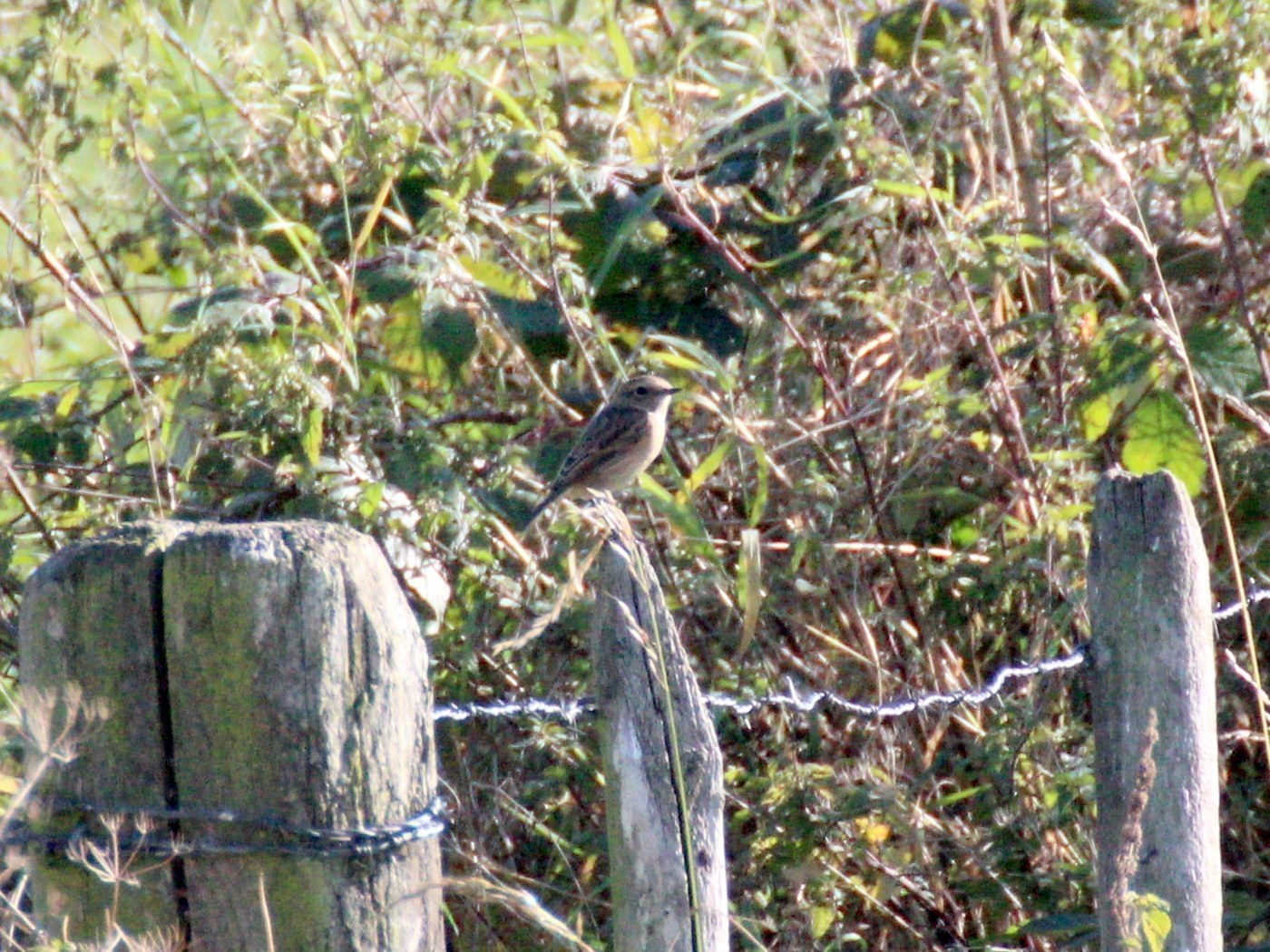
Whinchat
Saxicola rubetra
A migratory chat of rough grassland and moorland edges, identified by its bold white eyebrow stripe and orange-buff breast.
- Size
- 12-13.5 cm (4.7-5.3 in) long, 21-24 cm wingspan
- Habitat
- rough grassland, moorland edges, and farmland with scattered bushes and tall vegetation
- Type
- songbird
Spotted a bird like this?
Identify any bird from a photo, free.
Overview
The Whinchat is a small, migratory chat of open grassland and rough farmland, closely related to the more sedentary Stonechat but distinguished by its bold facial pattern and its long-distance migratory habits, breeding across much of Europe and wintering in Africa.
Appearance
Both sexes show a prominent, bold whitish supercilium (eyebrow stripe) bordering a dark cheek patch, over streaked brown upperparts and an orange-buff wash to the breast. Males in breeding plumage are brighter and more contrastingly marked than females, but the strong eyebrow stripe is present in both sexes and all ages.
How to identify it
Key Field Marks
- Bold white supercilium bordering a dark cheek patch
- Streaked brown upperparts, orange-buff breast wash
- White patches at the base of the tail (visible in flight or when perched)
- Perches prominently on tall grass stems, fence posts, and low bushes
Similar Species
Stonechat lacks any pale supercilium, with males showing an entirely black head; female Stonechats are also less strongly face-striped than Whinchats. Northern Wheatear is larger with a grey back, black mask, and a conspicuous white rump rather than the Whinchat's streaked brown back and pale eyebrow.
Habitat & range
Habitat
Whinchats favor open, unimproved grassland with tussocky vegetation, moorland fringes, and rough farmland with scattered bushes, bracken, or tall herbs that provide song and lookout perches — habitats that have declined with agricultural intensification in parts of Europe.
Range and Migration
The species breeds across much of Europe and into western Asia, and is a long-distance migrant, wintering in the savanna zones of sub-Saharan Africa. It arrives on European breeding grounds in spring and departs again by early autumn, and populations in several countries have declined significantly, largely linked to loss of rough grassland habitat and earlier hay-cutting.
Behavior & voice
Behavior
Whinchats perch prominently on tall grass stems, fence posts, or low bushes, from where they scan for insect prey, dropping down to the ground to catch food before returning to a perch — a hunting style sometimes called "perch and pounce."
Voice
The call is a short, hard "tic-tic," while the song is a short, scratchy warble mixing musical and harsh notes, often delivered from an exposed perch or briefly in flight.
Nesting and Breeding
The nest is built on the ground, well hidden in tussocky grass or low vegetation, a cup of grass and moss lined with finer material. The female lays 5-6 pale blue eggs and incubates them for about 13 days; because nests are on the ground in grassland, they are vulnerable to disturbance from agricultural mowing.
Frequently asked questions
How do you tell a Whinchat from a Stonechat?
The Whinchat has a bold, obvious white eyebrow stripe (supercilium) that the Stonechat lacks; male Stonechats instead have a solidly black head with no pale eyebrow.
Why have Whinchat populations declined?
Loss of unimproved, tussocky rough grassland habitat and earlier, more frequent hay-cutting on farmland — which can destroy ground nests — have contributed to declines across parts of Europe.
Where do Whinchats spend the winter?
They migrate long distances to winter in the savanna regions of sub-Saharan Africa, unlike the largely resident Stonechat.
Where do Whinchats build their nests?
On the ground, well concealed within tussocky grass or other low, dense vegetation in open rough grassland or moorland-edge habitat.
Whinchat guides
In-depth guides for identifying, finding, and understanding Whinchat.
Other birds you may enjoy

Black Redstart
13-14.5 cm (5.1-5.7 in) long, 23-26 cm wingspan

Black-throated Sparrow
12-14 cm (4.7-5.5 in) long, about 19-20 cm (7.5-8 in) wingspan

Greater Bird-of-paradise
Body about 43 cm; males with additional flank plumes up to 50 cm and long tail wires

Blue Tit
11-12 cm (4.3-4.7 in) long, 17-20 cm wingspan

Red-billed Quelea
11.5–13 cm long, wingspan about 20–22 cm
White-plumed Antbird
13-14 cm (5-5.5 in) long

Pyrrhuloxia
19-22 cm (7.5-8.7 in) long, 30 cm wingspan

Blue-gray Tanager
16-18 cm (6-7 in) long

Blackburnian Warbler
11-13 cm (4.3-5.1 in) long, 20-22 cm wingspan

Bluethroat
13-14 cm (5.1-5.5 in) long, 20-22 cm wingspan

Eurasian Nuthatch
12-14.5 cm (4.7-5.7 in) long, 22.5-27 cm wingspan

Wood Thrush
19-21 cm (7.5-8.3 in) long, about 33 cm (13 in) wingspan