
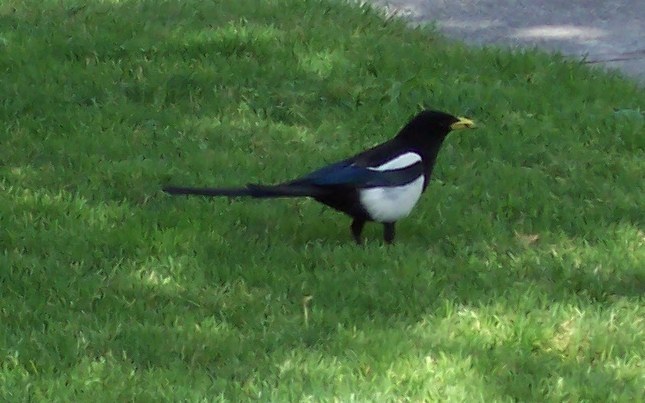
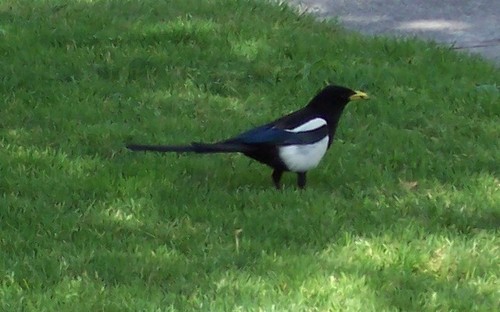
Yellow-billed Magpie
Pica nuttalli
A California endemic magpie nearly identical to the Black-billed Magpie but distinguished by its bright yellow bill.
- Size
- 43-48 cm (17-19 in) long, 56-61 cm wingspan
- Habitat
- oak savanna and open grassland with scattered trees in California's Central Valley
- Type
- songbird
Spotted a bird like this?
Identify any bird from a photo, free.
Overview
The Yellow-billed Magpie is a strikingly bold black-and-white corvid, essentially a California-endemic counterpart to the Black-billed Magpie, sharing the same long tail and black-and-white pattern but distinguished by a bright yellow bill and a patch of bare yellow skin around the eye.
This species has one of the most restricted ranges of any North American bird, found only in the Central Valley and surrounding foothills of California, nowhere else in the world. Its population suffered a severe crash in the early 2000s due to West Nile virus, from which it is still recovering.
How to identify it
Key Field Marks
- Bold black-and-white pattern identical in layout to Black-billed Magpie
- Bright yellow bill (diagnostic)
- Bare yellow skin patch around the eye
- Long, iridescent black tail
Similar Species
- Black-billed Magpie is essentially identical apart from its black bill and lack of bare yellow eye skin; the two species do not overlap in range, as the Yellow-billed Magpie is restricted to California's Central Valley region.
Habitat & range
Habitat
Yellow-billed Magpies favor open oak savanna, grassland with scattered valley oaks, orchards, and agricultural areas with nearby trees for nesting.
Range
This species is endemic to California, found only in the Central Valley and adjacent foothills of the Coast Ranges and Sierra Nevada, making it one of the most range-restricted birds in North America.
Migration
Yellow-billed Magpies are non-migratory and highly sedentary, often remaining within a few miles of their birthplace for life.
Behavior & voice
Behavior
Yellow-billed Magpies are social birds that often forage and roost in groups, and are known to form cooperative colonies with several nests clustered in the same or nearby trees, an unusual trait among magpies.
Voice
Calls are similar to the Black-billed Magpie, including a nasal, chattering mag-mag-mag and various harsh notes.
Feeding
Diet includes insects, acorns, small vertebrates such as lizards, and fruit; they often forage on the ground in open fields.
Nesting
Pairs build a large, domed stick nest, sometimes in loose colonies of several nests in nearby trees; the female incubates 5-8 greenish, spotted eggs.
Frequently asked questions
Where can you find a Yellow-billed Magpie?
It is found only in California's Central Valley and nearby foothills, making it endemic to the state and found nowhere else in the world.
How do you tell a Yellow-billed Magpie from a Black-billed Magpie?
The Yellow-billed Magpie has a bright yellow bill and yellow skin around the eye, while the Black-billed Magpie has an all-black bill; their ranges also do not overlap.
Why is the Yellow-billed Magpie population of concern?
The species suffered major population declines from West Nile virus outbreaks in the early 2000s and remains vulnerable due to its small, restricted range.
Do Yellow-billed Magpies nest in colonies?
They sometimes nest in loose colonies with several nests clustered in the same or nearby trees, unusual behavior among magpies.
Yellow-billed Magpie guides
In-depth guides for identifying, finding, and understanding Yellow-billed Magpie.
Other birds you may enjoy

Black Redstart
13-14.5 cm (5.1-5.7 in) long, 23-26 cm wingspan

Black-throated Sparrow
12-14 cm (4.7-5.5 in) long, about 19-20 cm (7.5-8 in) wingspan

Greater Bird-of-paradise
Body about 43 cm; males with additional flank plumes up to 50 cm and long tail wires

Blue Tit
11-12 cm (4.3-4.7 in) long, 17-20 cm wingspan

Red-billed Quelea
11.5–13 cm long, wingspan about 20–22 cm
White-plumed Antbird
13-14 cm (5-5.5 in) long

Pyrrhuloxia
19-22 cm (7.5-8.7 in) long, 30 cm wingspan

Blue-gray Tanager
16-18 cm (6-7 in) long

Blackburnian Warbler
11-13 cm (4.3-5.1 in) long, 20-22 cm wingspan

Bluethroat
13-14 cm (5.1-5.5 in) long, 20-22 cm wingspan

Eurasian Nuthatch
12-14.5 cm (4.7-5.7 in) long, 22.5-27 cm wingspan

Wood Thrush
19-21 cm (7.5-8.3 in) long, about 33 cm (13 in) wingspan