
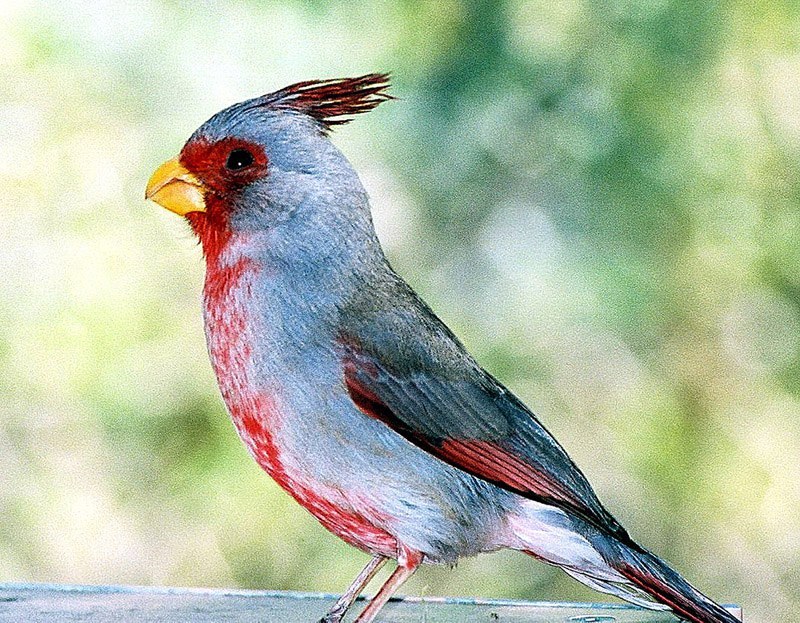
Pyrrhuloxia
Cardinalis sinuatus
A close desert relative of the Northern Cardinal, gray overall with red highlights and a stubby, parrot-like yellow bill, common in arid brushland of the Southwest.
- Size
- 19-22 cm (7.5-8.7 in) long, 30 cm wingspan
- Habitat
- desert scrub, mesquite thickets, and arid brushland of the southwestern borderlands
- Type
- songbird
Spotted a bird like this?
Identify any bird from a photo, free.
Overview
The Pyrrhuloxia, sometimes called the "desert cardinal," is a close relative of the Northern Cardinal adapted to arid brush and desert habitats of the southwestern United States and Mexico. Adult males are mostly soft gray with a red face, crest, breast, and tail, while females are more uniformly buffy-gray with a smaller amount of red restricted mainly to the crest and wings. Both sexes share a distinctive stubby, strongly curved, pale yellow bill, quite different from the straight, orange-red bill of the Northern Cardinal.
The unusual name "Pyrrhuloxia" derives from Greek and Latin roots referencing its bullfinch-like, curved bill shape, and the bird is well adapted to the hot, dry conditions of Sonoran and Chihuahuan desert scrub.
How to identify it
Key Field Marks
- Overall soft gray plumage with red highlights on face, crest, breast, wings, and tail (more extensive in males)
- Distinctive stubby, strongly curved, pale yellow bill, unlike the straight red bill of Northern Cardinal
- Prominent pointed crest
- Female duller and grayer with less red than the male
Similar Species
- Northern Cardinal male is almost entirely red with a straight orange-red bill, while the Pyrrhuloxia is mostly gray with a curved yellow bill; female Northern Cardinals are warmer brown overall compared to the grayer female Pyrrhuloxia.
- Ranges overlap broadly in the southwestern deserts, where both species can occur together at feeders.
Habitat & range
Habitat
Favors arid desert scrub, mesquite thickets, thorn brush, and desert washes, generally in drier habitat than the Northern Cardinal.
Range
Resident across the desert Southwest of the United States (Arizona, New Mexico, Texas) and northern Mexico.
Migration
Non-migratory (resident) year-round throughout its range, though birds may make local movements in response to food and water availability.
Behavior & voice
Behavior
Pyrrhuloxias forage in pairs or small flocks, especially outside the breeding season, and are somewhat less strictly territorial than Northern Cardinals, sometimes gathering in loose winter flocks.
Voice
The song is a clear, whistled series similar to the Northern Cardinal's but often described as thinner and more slurred; the call is a sharp, metallic "chink" note.
Feeding
Feeds on seeds, insects, and cactus fruit, using its stout curved bill to crack open seeds; readily visits backyard seed feeders within its desert range.
Nesting & Breeding
The female builds a cup nest of twigs and grass in a dense desert shrub or low tree, often a thorny species offering protection. She incubates 2-4 eggs, and pairs may raise more than one brood during the summer rainy season.
Frequently asked questions
What is the difference between a Pyrrhuloxia and a Northern Cardinal?
The Pyrrhuloxia is mostly gray with red highlights and a curved, pale yellow bill, while the Northern Cardinal male is almost entirely red with a straight orange-red bill; the two species overlap in southwestern desert habitats.
Why is it called a Pyrrhuloxia?
The name combines Greek and Latin roots referring to its bullfinch-like appearance and curved bill shape.
Where do Pyrrhuloxias live?
They are year-round residents of arid desert scrub and mesquite thickets in the southwestern United States and northern Mexico.
What does a Pyrrhuloxia eat?
It feeds on seeds, insects, and cactus fruit, using its stout, curved bill to crack open hard seeds.
Pyrrhuloxia guides
In-depth guides for identifying, finding, and understanding Pyrrhuloxia.

Other birds you may enjoy

Black Redstart
13-14.5 cm (5.1-5.7 in) long, 23-26 cm wingspan

Black-throated Sparrow
12-14 cm (4.7-5.5 in) long, about 19-20 cm (7.5-8 in) wingspan

Greater Bird-of-paradise
Body about 43 cm; males with additional flank plumes up to 50 cm and long tail wires

Blue Tit
11-12 cm (4.3-4.7 in) long, 17-20 cm wingspan

Red-billed Quelea
11.5–13 cm long, wingspan about 20–22 cm
White-plumed Antbird
13-14 cm (5-5.5 in) long

Blue-gray Tanager
16-18 cm (6-7 in) long

Blackburnian Warbler
11-13 cm (4.3-5.1 in) long, 20-22 cm wingspan

Bluethroat
13-14 cm (5.1-5.5 in) long, 20-22 cm wingspan

Eurasian Nuthatch
12-14.5 cm (4.7-5.7 in) long, 22.5-27 cm wingspan

Wood Thrush
19-21 cm (7.5-8.3 in) long, about 33 cm (13 in) wingspan
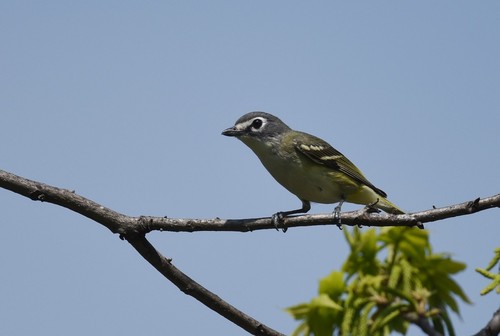
Blue-headed Vireo
12-14 cm (5-5.5 in) long, 21-25 cm wingspan