
Pyrrhuloxia Identification Guide
A desert cardinal relative of the American Southwest and northern Mexico, gray overall with red highlights and a distinctive stubby, curved, parrot-like yellow bill.
Read the full Pyrrhuloxia encyclopedia entry →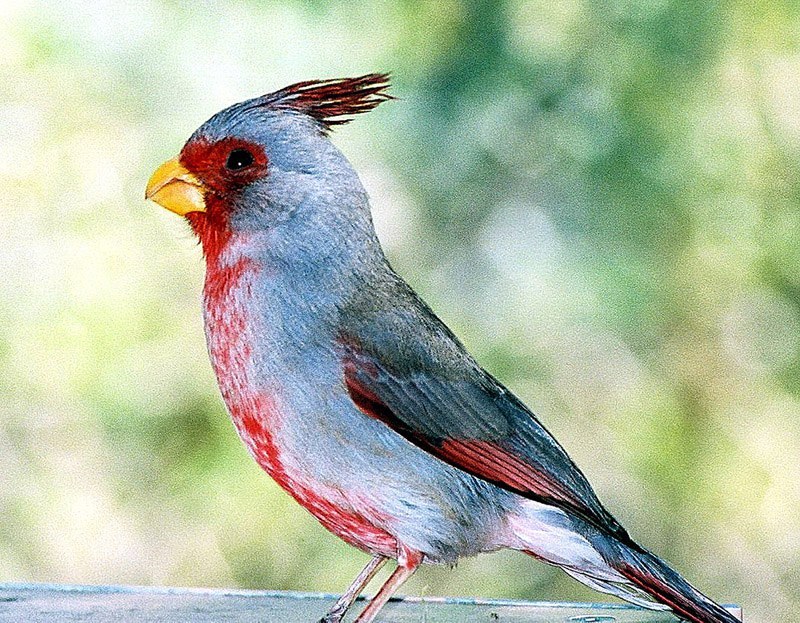
Key Field Marks
- Size & shape: Similar size and shape to a Northern Cardinal (20–22 cm / 8–9 in), with a prominent crest, but overall slimmer-billed impression offset by a uniquely shaped bill.
- Bill: Short, thick, strongly curved (parrot-like) bill that is pale yellowish — the single best field mark distinguishing it from all cardinal species.
- Male plumage: Mostly gray body with red confined to the face, crest tip, central breast/belly stripe, wings, and tail — giving a "gray cardinal with red highlights" look rather than the cardinal's all-red body.
- Female plumage: Grayish-brown overall with just a touch of red in the crest and wings, and the same distinctive curved pale bill; much subtler than a female Northern Cardinal.
- Behavior: Often forms small flocks outside the breeding season, especially in winter, and forages on the ground and in low desert shrubs for seeds.
Separating from Similar Species
- Northern Cardinal: Male Cardinal is entirely bright red with a black face mask and a straight, conical red-orange bill; Pyrrhuloxia's gray body and curved yellow bill are unmistakable by comparison, even though the two species overlap in range and sometimes flock together.
- Female Northern Cardinal: Female Cardinal is warmer buffy-brown with more extensive reddish tones on crest, wings, and tail, and has a straight red-orange bill rather than Pyrrhuloxia's stubby curved yellow bill.
- Juveniles: Best separated by bill shape and color alone when plumage is ambiguous — Pyrrhuloxia's bill is always more curved and yellow-based than any cardinal's.
Where & When to See It
- Habitat: Arid thornscrub, mesquite grassland, desert washes, and brushy desert edges; more strictly tied to true desert habitat than the more habitat-generalist Northern Cardinal.
- Range: Resident in the southwestern U.S. (southern Arizona, New Mexico, and Texas) south through northern and central Mexico.
- Season: Non-migratory and present year-round, though winter flocks may be more conspicuous as birds gather at feeders and seed-rich patches.
Voice & Behavior Cues
- Song is a clear, whistled series similar to Northern Cardinal's but typically thinner, sharper, and more metallic — described as a "quink, quink, quink" or sharp whistled "what-cheer" variant.
- Listen for a sharp, metallic "chip" call note, and watch mixed flocks with Northern Cardinals in winter thornscrub for the telltale gray body and curved yellow bill.
Frequently asked questions
What is the single best way to identify a Pyrrhuloxia?
Look at the bill: Pyrrhuloxia has a short, strongly curved, pale yellowish bill, unlike the straight, conical, reddish-orange bill of a Northern Cardinal, and this holds true across all ages and both sexes.
How does a male Pyrrhuloxia differ from a male Northern Cardinal?
Male Pyrrhuloxia is mostly gray with red restricted to the face, crest, chest stripe, wings, and tail, while male Northern Cardinal is entirely bright red with a black face mask.
Where do Pyrrhuloxias live?
They are desert specialists found in arid thornscrub, mesquite grassland, and desert washes across the southwestern U.S. and northern/central Mexico, year-round residents throughout their range.
Do Pyrrhuloxias and Northern Cardinals ever occur together?
Yes, their ranges overlap broadly in the Southwest and they can be seen in the same thornscrub habitat or even at the same feeders, making direct bill and plumage comparison possible.