
Whinchat Identification Guide
A small, upright grassland songbird with a bold white eyebrow and orange-buff breast, always perched prominently on the tops of tall vegetation.
Read the full Whinchat encyclopedia entry →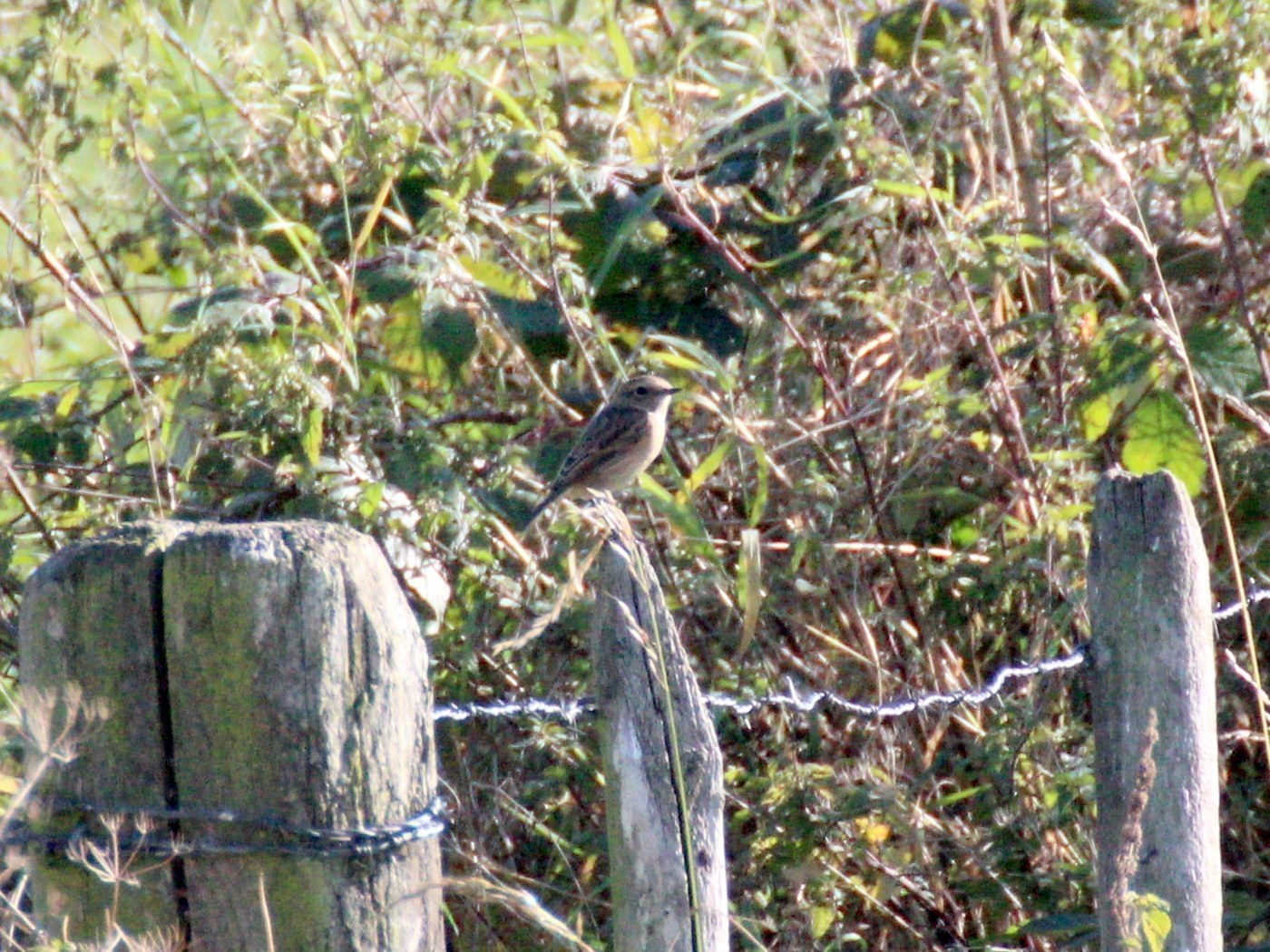
Key Field Marks
- Small, plump songbird, about 12-13 cm (5 in), with an upright stance and a habit of perching on the very tops of grass stems, fence posts, and low bushes.
- Breeding male: bold white supercilium (eyebrow stripe), dark cheek patch, streaked brown back, and an orange-buff wash across the breast.
- White patches at the base of the tail and on the wing (visible as a small white flash) are useful in flight.
- Females and nonbreeding birds are duller and more buffy overall but retain a paler, less bold version of the eyebrow stripe.
Separating It From Similar Species
- European Stonechat: Male Stonechat has a solid black head with no white supercilium and shows much less white in the tail; female Stonechat also lacks the Whinchat's bold pale eyebrow.
- Common Redstart: Has a rusty-red tail that is constantly quivered, a very different shape and coloration from the Whinchat, and does not share the prominent white supercilium.
Habitat, Range & Season
- Breeds in open grassland, hay meadows, moorland edges, and rough pasture with scattered bushes, bracken, or tall herbage for perching.
- Breeds across Europe into western Asia; present on breeding grounds roughly April through September.
- A long-distance migrant that winters in sub-Saharan Africa, in savanna and grassland habitats.
Voice
- Song is a short, scratchy, warbling phrase that frequently incorporates mimicry of other bird species.
- Call is a hard, clicking "tic-tic," often combined into a "u-tic" alarm note.
Behavior
- Perches conspicuously atop grass stems or low bushes, scanning for prey, then sallies or drops to the ground to catch insects before returning to a perch.
- Frequently flicks its wings and tail while perched, adding to its alert, restless appearance.
Frequently asked questions
How do I tell a Whinchat from a Stonechat?
The Whinchat has a bold white eyebrow stripe and more white in the tail, while the male Stonechat has a solid black head with no white eyebrow at all.
Where does the Whinchat like to perch?
It favors the very tops of grass stems, bracken, fence posts, and low bushes in open grassland and meadow habitat, giving it good visibility to hunt insects.
When and where can I see a Whinchat?
Look for it in open grassy habitats across Europe and western Asia from April to September; it winters in sub-Saharan African savanna and grassland.
What does a Whinchat sound like?
Its song is a short, scratchy warble that often mimics other birds, and its call is a hard clicking "tic-tic."