
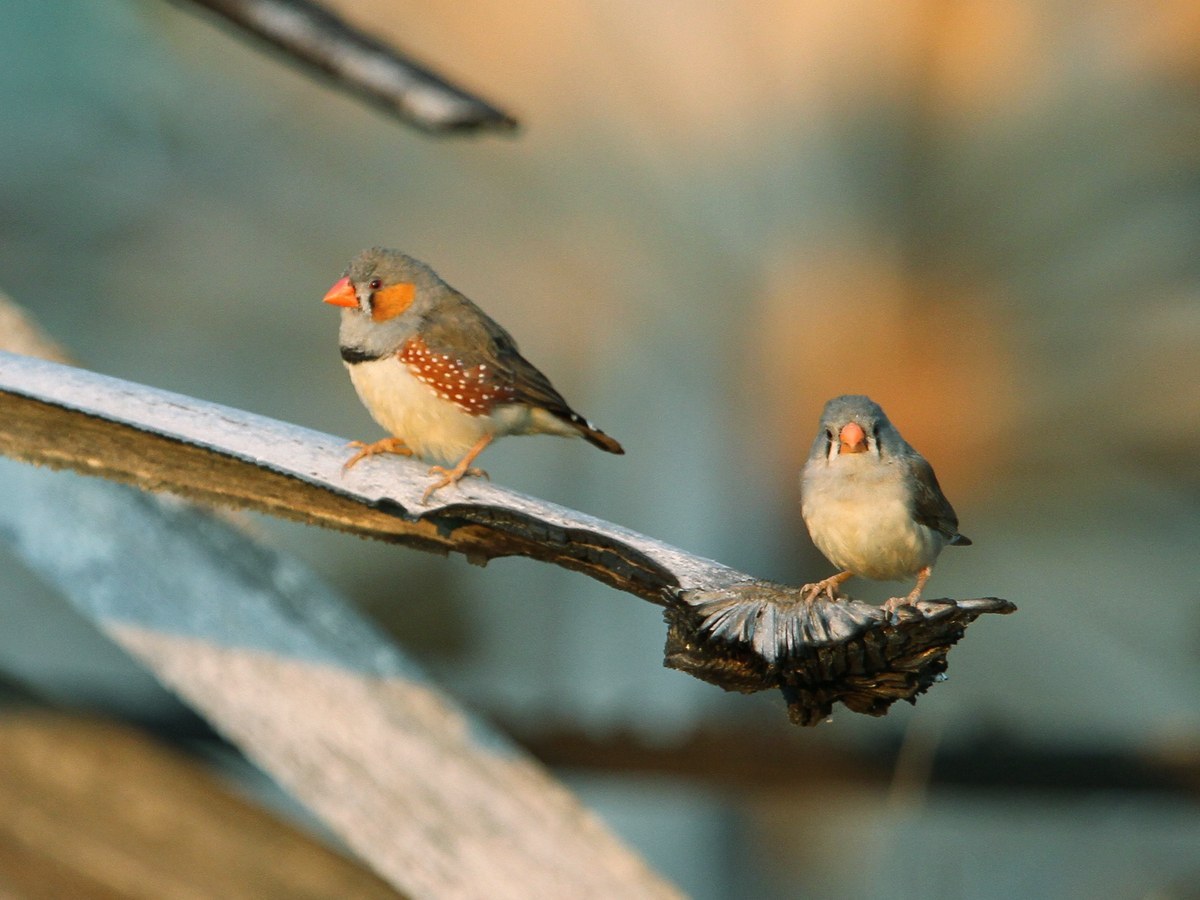
Zebra Finch
Taeniopygia guttata
A tiny, boldly patterned Australian finch famous for its orange cheek patch, fine barring, and near-constant chattering calls.
- Size
- About 10 cm (4 in) long
- Habitat
- Arid and semi-arid grassland, scrub, and open woodland across most of mainland Australia
- Type
- songbird
Spotted a bird like this?
Identify any bird from a photo, free.
Overview
The Zebra Finch is a small, common estrildid finch native to the dry interior of Australia, and one of the most intensively studied songbirds in the world for research on vocal learning and behavior. Wild populations are found across most of the Australian mainland, avoiding only the wettest coastal forests.
Males are strikingly patterned, with fine black-and-white barring on the throat and upper breast, a bright orange cheek patch bordered in black and white, chestnut flanks spotted with white, and a red-orange bill. Females are plainer overall, lacking the chestnut flanks and orange cheek patch, with gray-brown upperparts and an orange bill.
Plumage
- Male: black-and-white barred throat/breast, orange cheek patch, chestnut flanks with white spots
- Female: plain gray-brown, orange bill, no barring or cheek patch
- Both sexes: black tail with white barring, red-orange bill
How to identify it
Key field marks
- Very small finch with a red-orange bill
- Male: fine black-and-white barring on the upper breast, orange cheek patch, chestnut side patches with white spots
- Female: plain gray-brown body without barring or cheek patch, but same red-orange bill shape
- Black tail with fine white bars, visible in flight or when perched
Similar species
No other Australian finch shares the male's combination of barred breast and orange cheek patch, making adult males unmistakable. Females can be confused with other plain brown estrildid finches, but the orange bill and small size are useful clues.
Habitat & range
Range
The Zebra Finch is found across most of mainland Australia, particularly the arid and semi-arid interior, and is largely absent from the wet tropical and temperate coastal fringes. A separate subspecies occurs on Lesser Sunda islands in Indonesia.
Habitat
It inhabits open grassland, scrub, spinifex country, and dry woodland, usually near water. It is highly nomadic and opportunistic, moving in response to rainfall and can breed rapidly whenever conditions are favorable.
Behavior & voice
Behavior
Zebra Finches are highly social, gregarious birds usually seen in flocks that forage together on the ground and gather at waterholes, sometimes in large numbers in arid regions.
Voice
The song is a short, distinctive series of nasal, trumpet-like and buzzing notes; the contact call is a loud, repeated "tya" often heard from flocks in flight.
Feeding
They feed mainly on small grass seeds gathered on the ground, and take insects opportunistically, particularly to feed nestlings.
Nesting
Zebra Finches build bulky, domed grass nests in shrubs, tree hollows, or other cavities, and can breed opportunistically at almost any time of year when conditions allow, laying clutches of around 4-6 eggs.
Frequently asked questions
How do you tell a male from a female Zebra Finch?
Males have fine black-and-white barring on the breast, an orange cheek patch, and chestnut flanks, while females are plain gray-brown without these markings.
Where do Zebra Finches live in the wild?
They are native to the arid and semi-arid interior of Australia, occurring across most of the mainland in grassland, scrub, and dry woodland near water.
Why are Zebra Finches used in scientific research?
Their song-learning behavior, fast breeding cycle, and adaptability make them a leading model species for studying vocal learning and behavior in songbirds.
What do wild Zebra Finches eat?
They eat mainly small grass seeds gathered on the ground, supplemented with insects when breeding.
How can you recognize a Zebra Finch's call?
It gives a loud, nasal, repeated "tya" contact call, along with a short buzzing, trumpet-like song from males.
Zebra Finch guides
In-depth guides for identifying, finding, and understanding Zebra Finch.
Zebra Finch identified by the community
Real birds identified with Bird Identifier.

Other birds you may enjoy

Black Redstart
13-14.5 cm (5.1-5.7 in) long, 23-26 cm wingspan

Black-throated Sparrow
12-14 cm (4.7-5.5 in) long, about 19-20 cm (7.5-8 in) wingspan

Greater Bird-of-paradise
Body about 43 cm; males with additional flank plumes up to 50 cm and long tail wires

Blue Tit
11-12 cm (4.3-4.7 in) long, 17-20 cm wingspan

Red-billed Quelea
11.5–13 cm long, wingspan about 20–22 cm
White-plumed Antbird
13-14 cm (5-5.5 in) long

Pyrrhuloxia
19-22 cm (7.5-8.7 in) long, 30 cm wingspan

Blue-gray Tanager
16-18 cm (6-7 in) long

Blackburnian Warbler
11-13 cm (4.3-5.1 in) long, 20-22 cm wingspan

Bluethroat
13-14 cm (5.1-5.5 in) long, 20-22 cm wingspan

Eurasian Nuthatch
12-14.5 cm (4.7-5.7 in) long, 22.5-27 cm wingspan

Wood Thrush
19-21 cm (7.5-8.3 in) long, about 33 cm (13 in) wingspan