
Zebra Finch Identification Guide
A small, boldly patterned Australian finch with a bright orange-red bill, black-and-white barred throat, and chestnut ear patches in males.
Read the full Zebra Finch encyclopedia entry →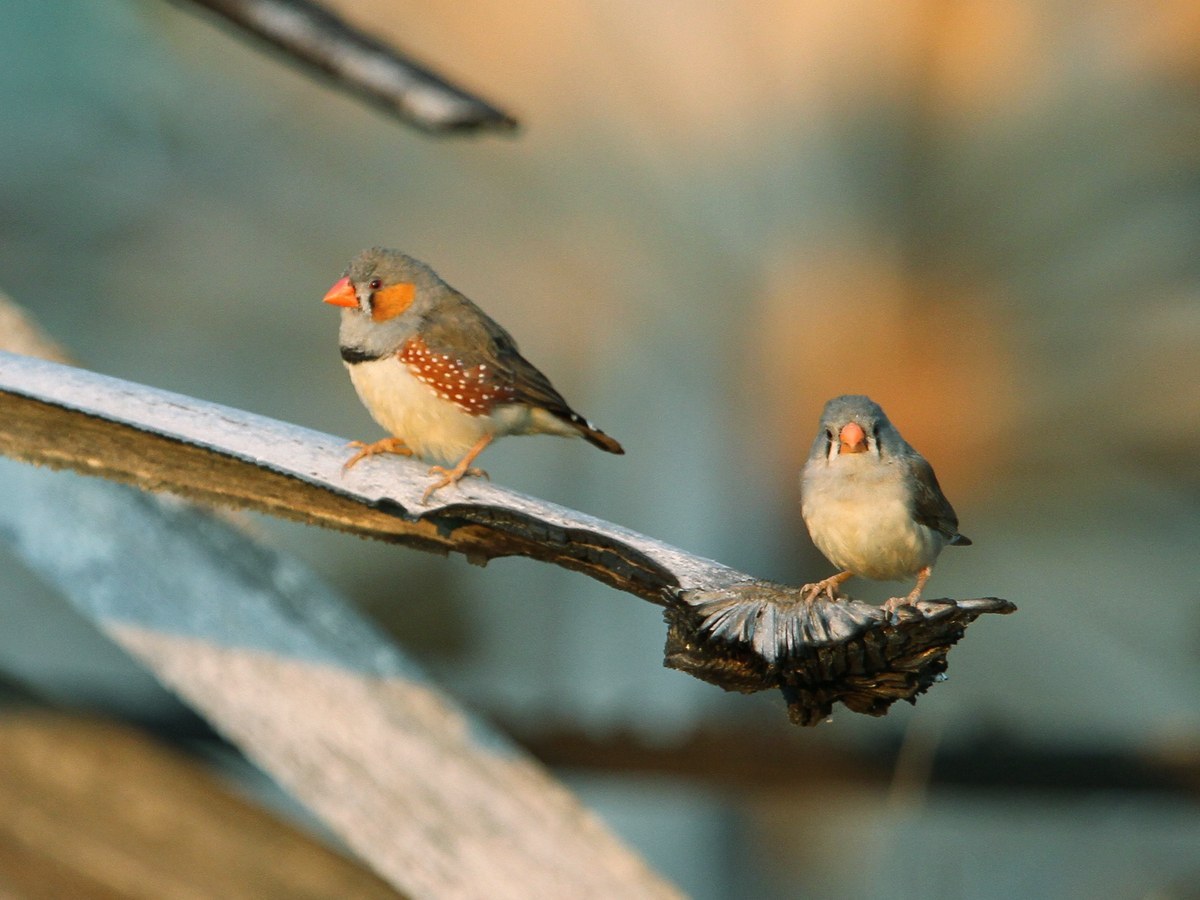
Key Field Marks
- Size & shape: A tiny, compact finch around 4 inches long, with a short tail and a stout, conical bill adapted for cracking small seeds.
- Bill & legs: Bright orange-red bill in adults (bill is duller orange or blackish in juveniles), a key field mark visible at a distance; orange legs.
- Male plumage: Gray head and back, fine black-and-white barring on the throat and upper breast forming a distinctive "zebra" pattern, a black tear-drop-shaped stripe through the eye, chestnut-orange cheek patches, and chestnut flanks spotted with white; the tail shows black-and-white barring.
- Female plumage: Much plainer gray-brown overall, lacking the chestnut cheek patch and barred breast, but retaining the orange-red bill and the black eye stripe, which helps separate females from other small brown finches.
- Behavior: Highly social, usually seen in flocks; feeds mostly on the ground on grass seeds, hops and moves briskly, and is often found near water sources in arid country.
Separating It From Similar Species
- Double-barred Finch: Has a white face with a black facial border and barred flanks, but lacks the chestnut cheek patch and the black-and-white barred throat pattern of male Zebra Finch.
- Star Finch: Shows a red face and green body, quite different from the gray-and-chestnut pattern of the Zebra Finch.
- Female Zebra Finch vs. other brown finches: The bright orange-red bill and black teardrop eye stripe are the most reliable marks distinguishing a female Zebra Finch from similarly plain brown finch species.
- Overall: No other widespread Australian finch combines the orange bill, chestnut ear patch, and zebra-barred throat of the male.
Where & When to See It
- Habitat: Dry grasslands, scrub, arid and semi-arid woodland, and areas near waterholes across the Australian interior; highly adapted to arid conditions and often seen drinking at dawn and dusk.
- Range: Native and widespread across mainland Australia, particularly the arid interior and drier regions; also established as feral populations in parts of Indonesia (Lesser Sundas) and introduced small populations exist elsewhere due to the species' popularity in aviculture.
- Season: Present year-round in its native range; breeding is opportunistic and tied to rainfall rather than a strict season, allowing multiple broods when conditions are favorable.
Voice & Song Cues
- Song is a short, nasal, buzzy series of notes, often described as a nasal "beep" or trumpet-like honk repeated in a simple pattern — distinctive and easy to learn.
- Call is a loud, nasal "tya" or honking contact note, frequently given by flocking birds to stay in touch.
- Vocalizations are relatively simple compared to many songbirds, and captive/feral flocks are highly vocal and constantly chattering.
Frequently asked questions
What is the easiest way to identify a Zebra Finch?
Look for a tiny finch with a bright orange-red bill; males add a black-and-white barred throat, chestnut ear patches, and chestnut flanks spotted with white.
How do you tell a male from a female Zebra Finch?
Males have chestnut cheek patches, black-and-white zebra barring on the throat, and chestnut spotted flanks, while females are plain gray-brown but still show the orange-red bill and black eye stripe.
Where are Zebra Finches found in the wild?
They are native to the dry grasslands, scrub, and arid interior of mainland Australia, typically near water sources, with feral populations also established in parts of Indonesia.
What does a Zebra Finch sound like?
It gives a short, nasal, buzzy honking call and song, often repeated in simple patterns, and flocks are frequently heard chattering with nasal contact calls.
Do Zebra Finches breed on a fixed schedule?
No, in their native arid range breeding is opportunistic and triggered by rainfall rather than a fixed season, allowing them to nest multiple times when conditions are good.
Zebra Finch identified by the community
Recent Zebra Finch sightings identified with Bird Identifier.
