
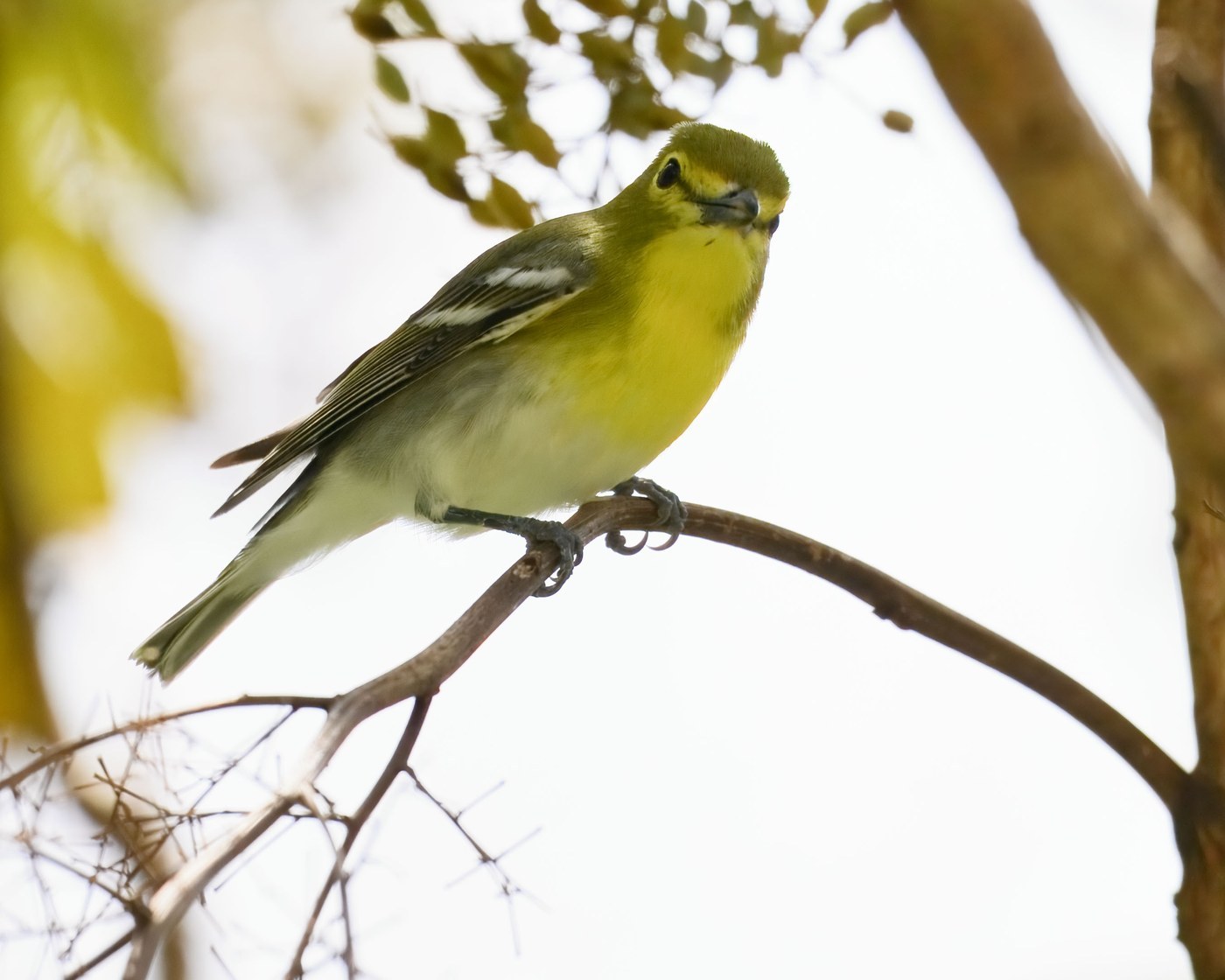
Yellow-throated Vireo
Vireo flavifrons
A canopy-dwelling eastern vireo with a bright yellow throat and spectacles, olive back, and a slow, burry song.
- Size
- 13-14 cm (5-5.5 in) long, 23-25 cm wingspan
- Habitat
- deciduous forest canopy in the eastern United States
- Type
- songbird
Spotted a bird like this?
Identify any bird from a photo, free.
Overview
The Yellow-throated Vireo is a strikingly colorful vireo, with a bright yellow throat and breast, yellow spectacles around the eye, an olive-green back, a contrasting gray rump, and a white belly. Two bold white wing bars complete the pattern. It is among the most vividly marked of the North American vireos.
It spends most of its time high in the deciduous forest canopy, foraging deliberately and singing a distinctive, slow, burry song that carries well through the treetops.
How to identify it
Key field marks
- Bright yellow throat and breast
- Yellow spectacles, olive-green back, gray rump
- White belly, two bold white wing bars
Similar species
- Pine Warbler: also yellow-throated but slimmer-billed, streaked flanks, lacks bold spectacles and wing bar pattern combination.
- White-eyed Vireo: much duller yellow overall, has a pale iris, favors dense low thickets rather than canopy.
- Blue-headed Vireo: white (not yellow) throat, blue-gray head.
Habitat & range
Range and habitat
Yellow-throated Vireo breeds across the eastern United States and adjacent southern Canada, in mature deciduous and mixed forests, favoring the upper canopy of large trees, forest edges, and open woodlands.
Migration
A long-distance migrant, wintering from Mexico south through Central America to northern South America.
Behavior & voice
Behavior
Forages slowly and deliberately in the high canopy, often difficult to see well against the leaves despite its bright coloring.
Voice
A slow, burry, two- or three-note phrase repeated with pauses, lower and hoarser than the similar phrasing of Red-eyed Vireo, often rendered as "three-eight... three-eight."
Feeding
Mostly caterpillars and other insects gleaned from canopy foliage; eats berries and small fruit outside the breeding season.
Nesting and breeding
Builds a well-camouflaged hanging cup nest high in a deciduous tree, often decorated with lichen on the outside. The female incubates 3-5 eggs for about 2 weeks.
Frequently asked questions
What does a Yellow-throated Vireo look like?
It has a bright yellow throat and breast, yellow spectacles, an olive back, gray rump, white belly, and two white wing bars.
How do you tell a Yellow-throated Vireo from a Pine Warbler?
Yellow-throated Vireo has a heavier bill, bold yellow spectacles, and a gray rump, while Pine Warbler has a thinner bill, streaked flanks, and lacks the spectacled face pattern.
Where does the Yellow-throated Vireo live?
It breeds in mature deciduous forest canopy across the eastern United States and winters from Mexico to northern South America.
What does the Yellow-throated Vireo's song sound like?
A slow, burry, low-pitched series of short phrases repeated with pauses, hoarser than a Red-eyed Vireo's song.
Yellow-throated Vireo guides
In-depth guides for identifying, finding, and understanding Yellow-throated Vireo.
Other birds you may enjoy

Black Redstart
13-14.5 cm (5.1-5.7 in) long, 23-26 cm wingspan

Black-throated Sparrow
12-14 cm (4.7-5.5 in) long, about 19-20 cm (7.5-8 in) wingspan

Greater Bird-of-paradise
Body about 43 cm; males with additional flank plumes up to 50 cm and long tail wires

Blue Tit
11-12 cm (4.3-4.7 in) long, 17-20 cm wingspan

Red-billed Quelea
11.5–13 cm long, wingspan about 20–22 cm
White-plumed Antbird
13-14 cm (5-5.5 in) long

Pyrrhuloxia
19-22 cm (7.5-8.7 in) long, 30 cm wingspan

Blue-gray Tanager
16-18 cm (6-7 in) long

Blackburnian Warbler
11-13 cm (4.3-5.1 in) long, 20-22 cm wingspan

Bluethroat
13-14 cm (5.1-5.5 in) long, 20-22 cm wingspan

Eurasian Nuthatch
12-14.5 cm (4.7-5.7 in) long, 22.5-27 cm wingspan

Wood Thrush
19-21 cm (7.5-8.3 in) long, about 33 cm (13 in) wingspan