
Yellow-throated Vireo Identification Guide
A stocky, slow-moving canopy bird known by its bright yellow throat and spectacles, olive back, and rich burry song.
Read the full Yellow-throated Vireo encyclopedia entry →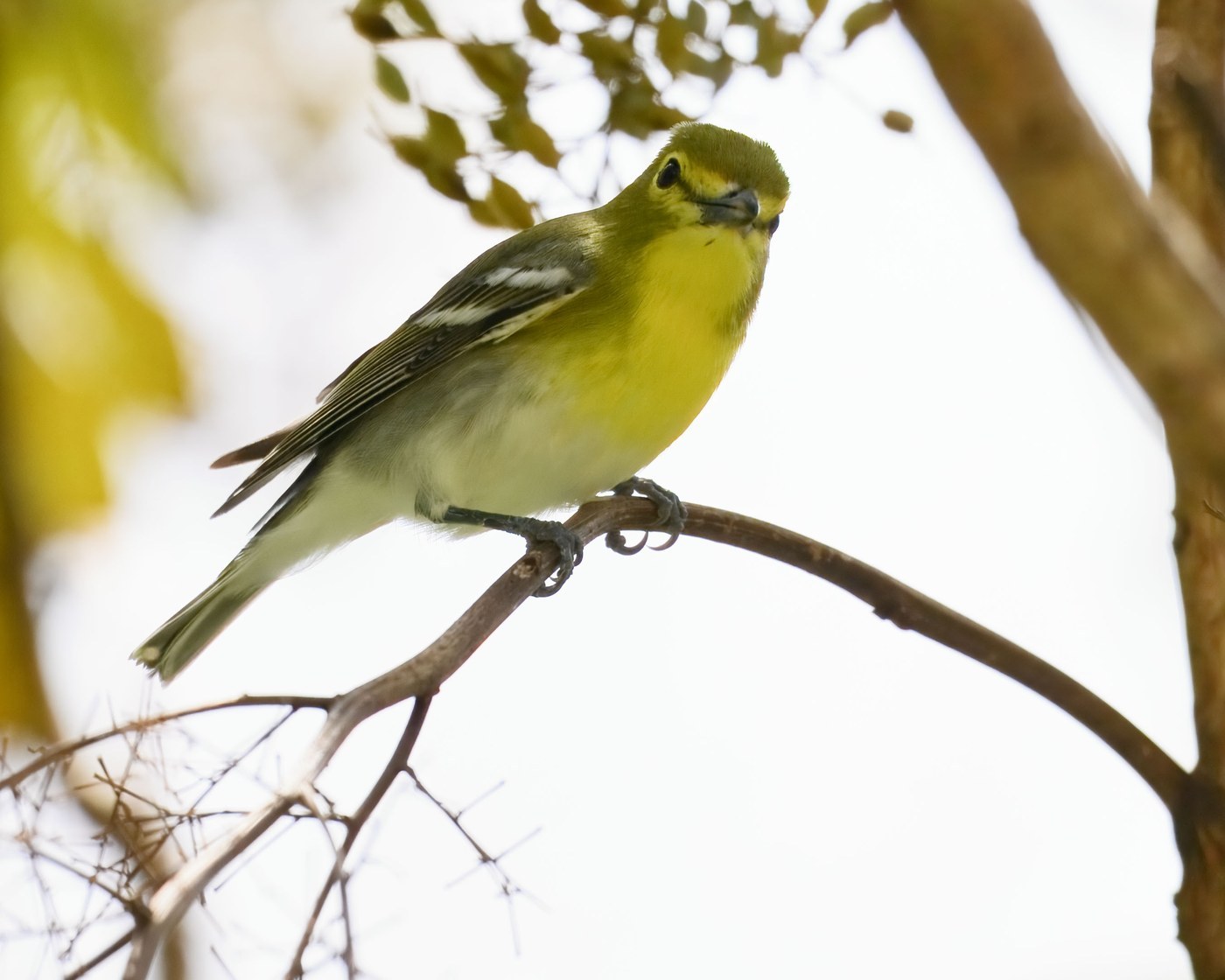
Key Field Marks
- Size & shape: A chunky, big-headed vireo, roughly 5.5 inches long, with a thick, slightly hooked bill and a short, stout body — heavier-bodied than most warblers it associates with.
- Plumage: Bright yellow throat and breast contrasting with a white belly; olive-green back and nape; bold yellow "spectacles" (eyering plus lores) that give it a wide-eyed look.
- Wings: Blue-gray wings with two crisp white wingbars, which help separate it from similar yellow-throated songbirds.
- Bill & legs: Thick, slightly hooked gray bill typical of vireos (unlike the thin, pointed bills of warblers); blue-gray legs.
- Behavior: Deliberate and methodical forager, moving slowly through the mid-to-upper canopy gleaning insects from leaves and twigs — much slower and more purposeful than the flitting, quick movements of warblers.
Separating It From Similar Species
- Pine Warbler: Also yellow below with white wingbars, but Pine Warbler lacks the bold yellow spectacles and has a thin warbler bill, plus streakier flanks and a more olive (less crisply yellow) throat.
- Blue-headed Vireo: Shares white wingbars and spectacles, but has a blue-gray head and white (not yellow) throat and breast.
- Pine Siskin / American Goldfinch (nonbreeding): Finch bills are conical and seed-cracking, quite different from the vireo's hooked bill; behavior (flocking, undulating flight) also differs sharply.
- Overall build: The combination of thick hooked bill + slow canopy gleaning + yellow spectacles is diagnostic among eastern songbirds.
Where & When to See It
- Habitat: Mature deciduous and mixed forests with tall trees, favoring forest edges, riparian corridors, and open woodlands; stays high in the canopy, making it more often heard than seen.
- Range: Breeds across the eastern and central United States and southeastern Canada; winters from Mexico through Central America to northern South America.
- Season: A neotropical migrant — arrives on breeding grounds in spring (April–May) and departs by early fall (September); look and listen for it during spring and summer in leafy woodlands.
Voice & Song Cues
- Song is a slow, deliberate series of burry, two- or three-note phrases delivered with pauses between them, often rendered as "three-eight, three-eight" — slower and huskier than the similar-sounding Red-eyed Vireo.
- Call note is a nasal, scratchy "eh-eh-eh" or a harsh chatter, useful for locating the bird when it's hidden in dense foliage.
- Because it forages high and stays hidden, learning the song is often the fastest way to confirm its presence.
Frequently asked questions
What is the easiest way to identify a Yellow-throated Vireo?
Look for a chunky bird with a bright yellow throat and breast, bold yellow spectacles around the eyes, and two white wingbars on blue-gray wings, moving slowly and deliberately through the treetops.
How do I tell a Yellow-throated Vireo from a Pine Warbler?
The vireo has a thick, hooked bill and bold yellow spectacles, while the Pine Warbler has a thin, pointed warbler bill and lacks the strong spectacled look; the vireo also moves more slowly and deliberately.
Where do Yellow-throated Vireos live?
They breed in mature deciduous and mixed forests across the eastern and central U.S. and southeastern Canada, favoring tall canopy trees, and winter in Mexico, Central America, and northern South America.
What does a Yellow-throated Vireo sound like?
Its song is a slow, burry, husky series of short phrases with distinct pauses, slower and rougher than the similar song of the Red-eyed Vireo.
When is the best time to see a Yellow-throated Vireo?
Spring through summer (roughly April to September) in leafy deciduous forests is best, since it's a neotropical migrant absent from North America in winter.