
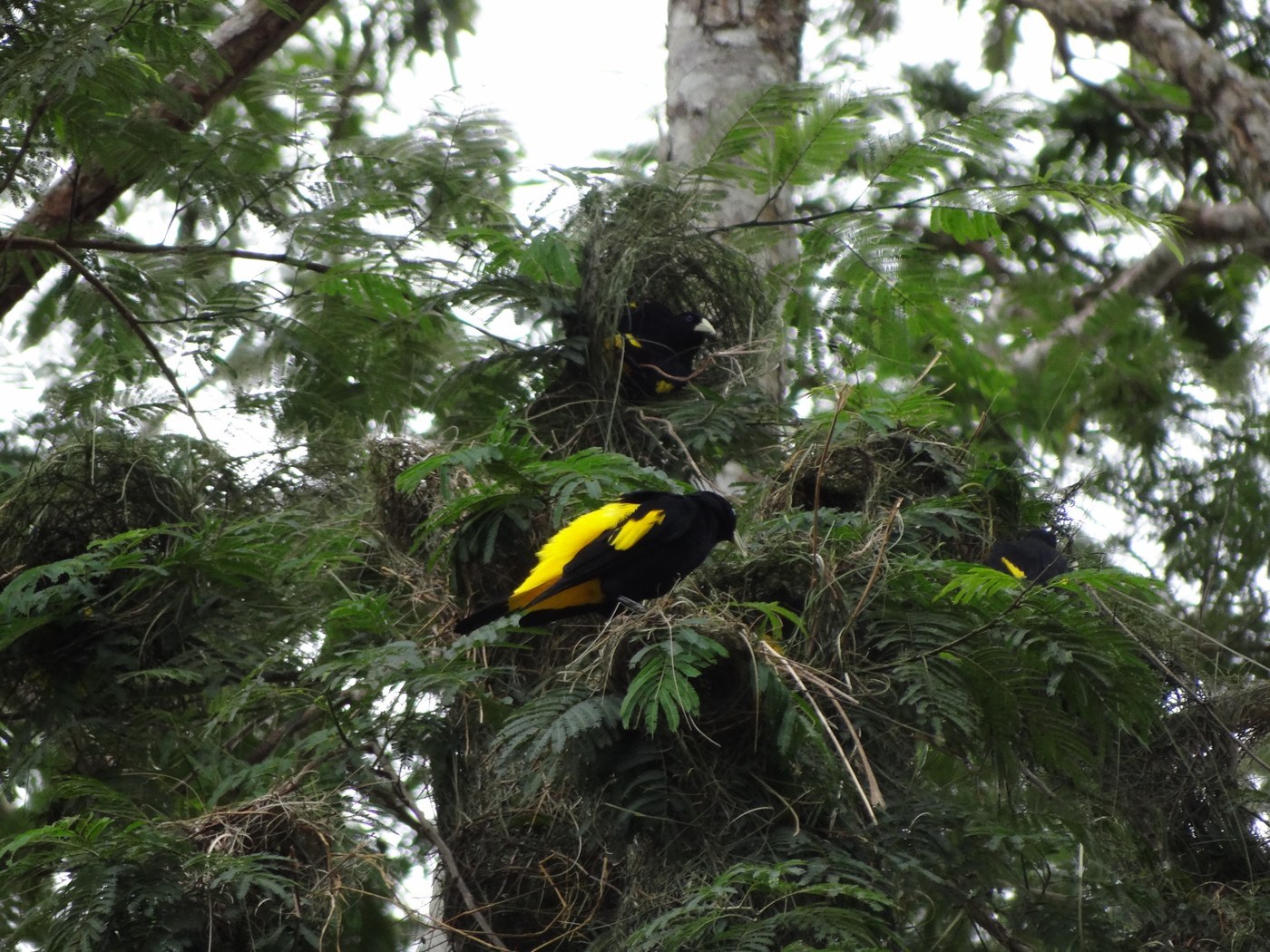
Yellow-rumped Cacique
Cacicus cela
A noisy, colonial black-and-yellow icterid with a bright yellow rump and wing patch, often nesting near wasp colonies for protection.
- Size
- 24-28 cm (9.5-11 in) long
- Habitat
- forest edge, clearings, gardens, and Amazonian lowland forest
- Type
- songbird
Spotted a bird like this?
Identify any bird from a photo, free.
Overview
The Yellow-rumped Cacique is a conspicuous, highly social icterid of tropical South America, patterned in bold black and yellow: a mostly black body set off by a bright yellow rump and lower back, and a matching yellow patch on the wing. Pale, ice-blue eyes stand out against the black head, and the bill is long, sharply pointed, and pale, well suited to probing and piercing fruit.
Colonies of dozens of pairs build their long, woven, sock-like nests together in a single tree, frequently choosing sites near active wasp nests, a strategy thought to deter predators and nest parasites. The constant chatter, whistles, and mimicked sounds from a nesting colony make it one of the more distinctive auditory experiences of the Amazonian forest edge.
How to identify it
Key field marks
- Mostly black body with a bright yellow rump and lower back
- Yellow patch on the wing coverts
- Pale, ice-blue eyes
- Long, pointed, pale bill
- Often seen in noisy colonies with hanging woven nests
Similar species
- Yellow-billed Cacique, Solitary Cacique, and other caciques differ in bill color and lack the combination of yellow rump and wing patch.
- Oropendolas are considerably larger with different bill and body proportions.
Habitat & range
Habitat
Inhabits forest edge, clearings, plantations, and gardens, generally avoiding unbroken forest interior.
Range
Widespread across the Amazon basin and adjacent lowlands, including Colombia, Venezuela, the Guianas, Ecuador, Peru, Bolivia, and Brazil.
Migration
Resident and non-migratory throughout its range.
Behavior & voice
Behavior
Highly social and vocal, nesting and foraging in noisy colonies; capable of mimicking the calls of other bird species and various environmental sounds.
Voice
A varied mix of liquid whistles, harsh chattering, and mimicked sounds, often given constantly around an active nesting colony.
Feeding
Feeds on fruit, insects, and nectar, foraging both in the canopy and at forest edges.
Nesting
Builds long, woven, pendulous nests hanging in colonies of a dozen to over a hundred pairs in a single tree, frequently near active wasp nests for protection against predators and botflies.
Frequently asked questions
How do you identify a Yellow-rumped Cacique?
Look for a mostly black bird with a bright yellow rump, a yellow patch on the wing, pale blue eyes, and a long pointed pale bill, usually in a noisy colony.
Why do Yellow-rumped Caciques nest near wasps?
Nesting colonies are often placed near active wasp nests, which is thought to help deter predators and reduce parasitism of the nestlings by botflies.
Can Yellow-rumped Caciques mimic sounds?
Yes, they are accomplished vocal mimics, capable of incorporating the calls of other birds and various environmental sounds into their own vocal repertoire.
What does a Yellow-rumped Cacique eat?
A mix of fruit, insects, and nectar, foraged in the canopy and at forest edges.
Yellow-rumped Cacique guides
In-depth guides for identifying, finding, and understanding Yellow-rumped Cacique.
Other birds you may enjoy

Black Redstart
13-14.5 cm (5.1-5.7 in) long, 23-26 cm wingspan

Black-throated Sparrow
12-14 cm (4.7-5.5 in) long, about 19-20 cm (7.5-8 in) wingspan

Greater Bird-of-paradise
Body about 43 cm; males with additional flank plumes up to 50 cm and long tail wires

Blue Tit
11-12 cm (4.3-4.7 in) long, 17-20 cm wingspan

Red-billed Quelea
11.5–13 cm long, wingspan about 20–22 cm
White-plumed Antbird
13-14 cm (5-5.5 in) long

Pyrrhuloxia
19-22 cm (7.5-8.7 in) long, 30 cm wingspan

Blue-gray Tanager
16-18 cm (6-7 in) long

Blackburnian Warbler
11-13 cm (4.3-5.1 in) long, 20-22 cm wingspan

Bluethroat
13-14 cm (5.1-5.5 in) long, 20-22 cm wingspan

Eurasian Nuthatch
12-14.5 cm (4.7-5.7 in) long, 22.5-27 cm wingspan

Wood Thrush
19-21 cm (7.5-8.3 in) long, about 33 cm (13 in) wingspan