
Yellow-rumped Cacique Identification Guide
A glossy black South American icterid with a bright yellow rump, wing patch, and tail sides, pale eyes, and a habit of nesting in noisy colonies of woven hanging nests.
Read the full Yellow-rumped Cacique encyclopedia entry →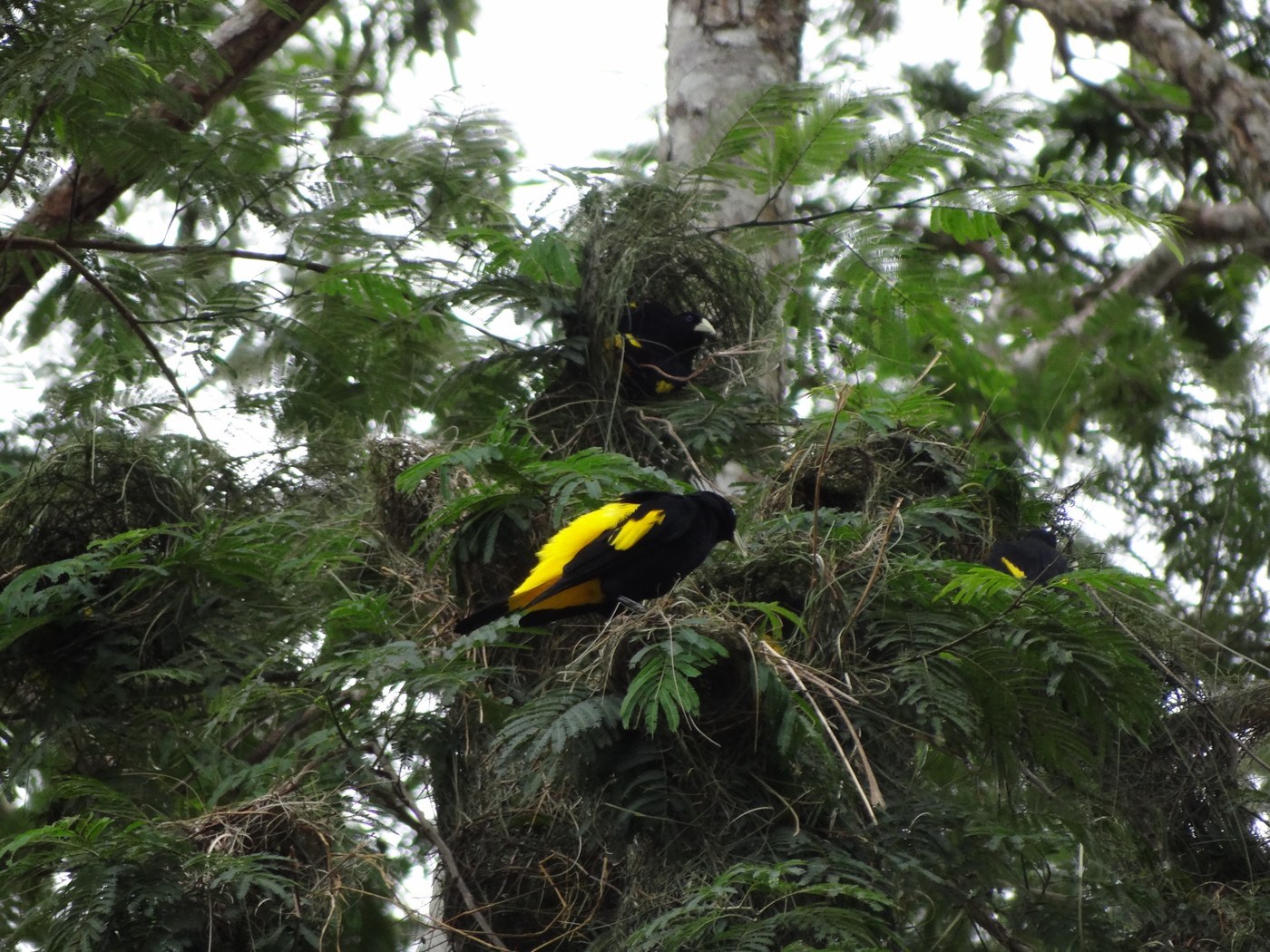
Key Field Marks
- Size and shape: A medium-large icterid around 10-11 inches long, with a slender build, longish tail, and a stout, pointed, pale bill.
- Plumage: Mostly glossy black, with bright yellow lower back and rump, a yellow patch on the upper wing coverts, and yellow at the base and edges of the outer tail feathers, all contrasting sharply with the black body.
- Bare parts: Pale bluish-white to whitish eyes stand out clearly against the black head, and the bill is pale, whitish to pinkish.
- Behavior: Highly social, nesting in dense colonies where dozens of long, woven, sock-like hanging nests dangle from a single tree, often over water or near wasp nests for protection from predators; noisy and active, frequently seen in canopy flocks.
Similar Species
- Other caciques and oropendolas can show yellow in the plumage, but the combination of extensive glossy black body, yellow rump/wing patch/tail-sides, pale eye, and colonial hanging-nest habit is distinctive for Yellow-rumped Cacique within its range.
- Size is notably smaller than the large oropendolas, which also have longer, more pointed bills and often blue or pale bare facial skin.
Habitat, Range & Season
- Found in lowland tropical forest edge, secondary growth, river edges, and clearings across much of the Amazon basin and northern South America, including Colombia, Venezuela, the Guianas, Ecuador, Peru, Bolivia, and Brazil.
- Non-migratory resident, with colonies often reused or relocated seasonally within the same general area.
Voice
- Highly vocal, giving an eclectic mix of liquid whistles, gurgles, chattering, and mimicked sounds, often delivered in a noisy chorus from active colony trees.
- Colony sites are frequently located by their constant background chatter and the sight of birds streaming to and from the hanging nests.
Frequently asked questions
What are the key marks of a Yellow-rumped Cacique?
A glossy black body with a contrasting bright yellow rump, wing patch, and outer tail feathers, plus a pale bluish-white eye and pale bill.
Why are Yellow-rumped Caciques often found near wasp nests?
Colonies frequently build their hanging woven nests near active wasp or bee nests, which appears to deter nest predators such as monkeys and toucans.
How is Yellow-rumped Cacique different from an oropendola?
Caciques are noticeably smaller than oropendolas, with proportionally shorter, straighter bills, though both build similar hanging colonial nests.
Where does the Yellow-rumped Cacique live?
It is widespread across lowland tropical forest edges and clearings in the Amazon basin and northern South America, including Colombia, Venezuela, Ecuador, Peru, Bolivia, and Brazil.