
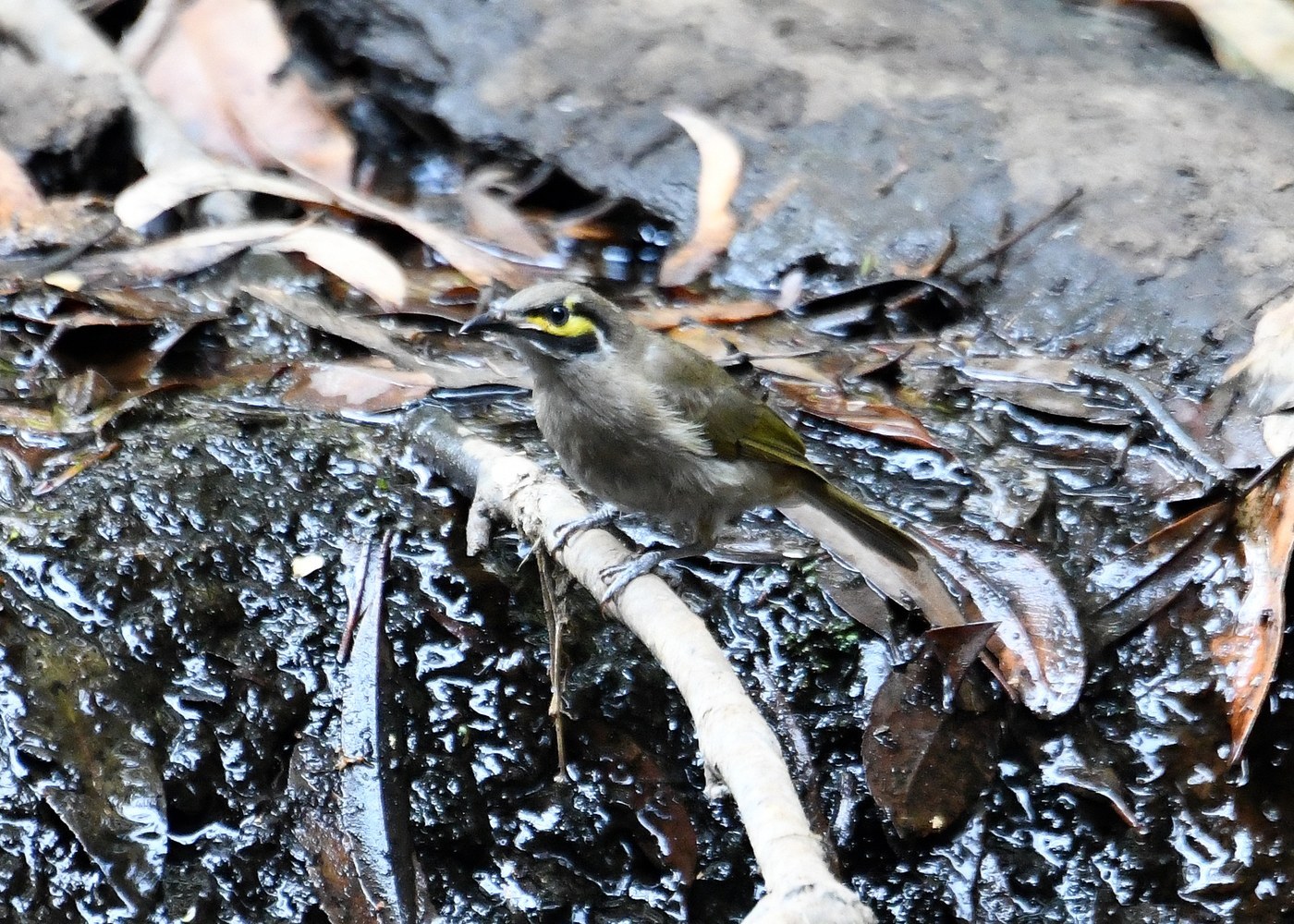
Yellow-faced Honeyeater
Caligavis chrysops
A plain olive-grey honeyeater with a bold black-and-yellow stripe across the face, best known for forming huge migratory flocks along the east coast each autumn.
- Size
- 15-17 cm (6-6.7 in) long, 20-24 cm wingspan
- Habitat
- eucalypt forests, woodlands, and heathland
- Type
- songbird
Spotted a bird like this?
Identify any bird from a photo, free.
Overview
The Yellow-faced Honeyeater is a medium-small honeyeater, olive-grey above and paler grey below, distinguished by a bold facial pattern of black stripes bordering a bright yellow band that runs from the base of the bill back beneath the eye. Otherwise fairly plain, this facial stripe is the bird's most reliable and eye-catching feature.
The species is famous among birdwatchers for its spectacular autumn migration, when large flocks numbering in the thousands funnel along the east coast of Australia, particularly through coastal lookouts in New South Wales, on their way to wintering grounds further north.
How to identify it
Key field marks
- Olive-grey upperparts and pale grey underparts
- Bold black-and-yellow striped facial pattern running back from the bill
- Slim build and relatively plain body plumage
- Often seen in active, loosely associated flocks, especially on migration
Similar species
- White-eared Honeyeater has a solid white ear patch rather than a yellow-and-black facial stripe.
- White-naped Honeyeater shows a red eye-crescent and a white nape patch, lacking the yellow facial stripe.
Habitat & range
Habitat
Inhabits eucalypt forests and woodlands, coastal heath, and forest edges, favoring areas with a shrubby understorey.
Range
Widespread along eastern and southeastern Australia, from Cape York in Queensland south through New South Wales and Victoria to southeastern South Australia, extending inland along the Great Dividing Range.
Migration
Strongly migratory in the southeast, with large flocks moving north along the coast in autumn and returning south in spring, forming one of Australia's most visible bird migrations; northern populations are more sedentary.
Behavior & voice
Behavior
Often forages and moves in loose flocks, especially during migration, when large numbers can be seen streaming past coastal headlands; active and agile among foliage.
Voice
A cheerful, repeated "chick-up" call and various other short, sharp notes, frequently given in flight during migration.
Feeding
Feeds on nectar from eucalypts and other flowering plants, and gleans insects from foliage and bark.
Nesting
Builds a small, neat cup nest of bark and grass bound with spider web, usually low in a shrub or small tree; lays 2 pale pinkish eggs with reddish-brown spotting.
Frequently asked questions
How do you identify a Yellow-faced Honeyeater?
Look for an olive-grey honeyeater with a bold black-and-yellow striped pattern running from the bill back beneath the eye.
Why is the Yellow-faced Honeyeater famous for migration?
It forms some of Australia's largest and most visible bird migrations, with flocks of thousands moving along the east coast each autumn, often watched from coastal lookouts.
What does a Yellow-faced Honeyeater eat?
Nectar from eucalypts and other flowering plants, plus insects gleaned from foliage and bark.
Where does the Yellow-faced Honeyeater live?
Along eastern Australia from Cape York in Queensland south to Victoria and southeastern South Australia, in forests, woodlands, and heath.
Yellow-faced Honeyeater guides
In-depth guides for identifying, finding, and understanding Yellow-faced Honeyeater.
Other birds you may enjoy

Black Redstart
13-14.5 cm (5.1-5.7 in) long, 23-26 cm wingspan

Black-throated Sparrow
12-14 cm (4.7-5.5 in) long, about 19-20 cm (7.5-8 in) wingspan

Greater Bird-of-paradise
Body about 43 cm; males with additional flank plumes up to 50 cm and long tail wires

Blue Tit
11-12 cm (4.3-4.7 in) long, 17-20 cm wingspan

Red-billed Quelea
11.5–13 cm long, wingspan about 20–22 cm
White-plumed Antbird
13-14 cm (5-5.5 in) long

Pyrrhuloxia
19-22 cm (7.5-8.7 in) long, 30 cm wingspan

Blue-gray Tanager
16-18 cm (6-7 in) long

Blackburnian Warbler
11-13 cm (4.3-5.1 in) long, 20-22 cm wingspan

Bluethroat
13-14 cm (5.1-5.5 in) long, 20-22 cm wingspan

Eurasian Nuthatch
12-14.5 cm (4.7-5.7 in) long, 22.5-27 cm wingspan

Wood Thrush
19-21 cm (7.5-8.3 in) long, about 33 cm (13 in) wingspan