
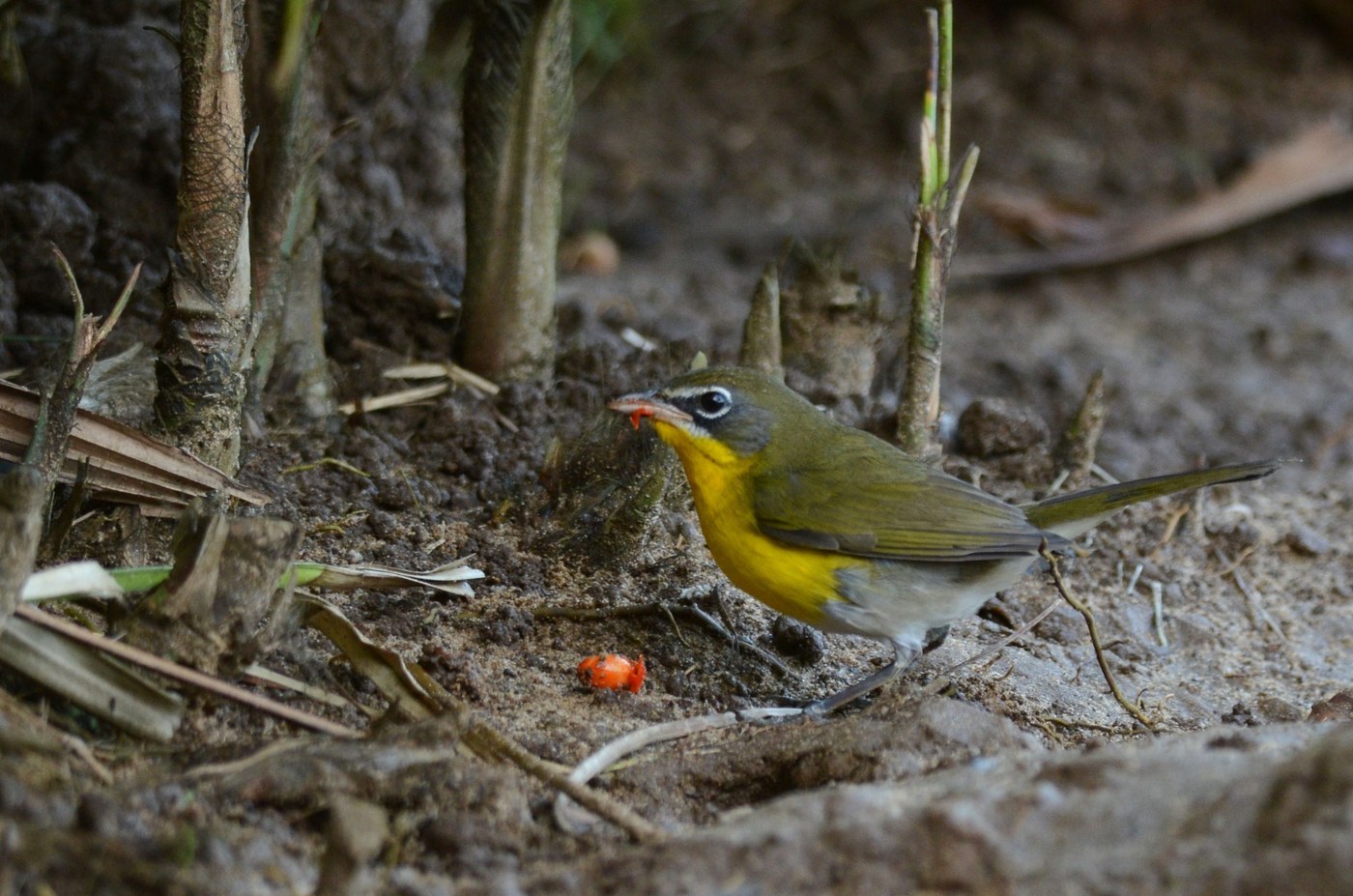
Yellow-breasted Chat
Icteria virens
A large, oddly proportioned warbler relative with a bright yellow breast and a bizarre, varied song of whistles, cackles, and mimicry.
- Size
- 18-19 cm (7-7.5 in) long, stocky build
- Habitat
- dense shrubby thickets, brushy edges, and streamside tangles
- Type
- songbird
Spotted a bird like this?
Identify any bird from a photo, free.
Overview
The Yellow-breasted Chat is an unusual bird, so distinctive in size, shape, and behavior that taxonomists now place it in its own family separate from the true wood-warblers it was long grouped with. It is by far the largest and bulkiest of North America's warbler-like birds, with a thick bill and a long tail that give it an almost mockingbird-like silhouette.
Plumage is fairly simple but handsome: olive-green upperparts, a bright yellow throat and breast, a white belly, and bold white spectacles around the eyes. Chats are notorious skulkers, spending most of their time buried in dense brush, but their loud, eccentric songs betray their presence even when they stay out of sight.
How to identify it
Key field marks
- Large size and heavy build compared to other warblers
- Bright yellow throat and breast, white belly
- Olive-green upperparts
- White spectacles (broken eyering plus supraloral line)
- Thick, slightly downcurved bill and long tail
Similar species
No other North American warbler approaches the chat's size and bulk. Common Yellowthroat is much smaller with a black mask on males and lacks the chat's thick bill and long tail. Overall shape and odd vocalizations make chats readily distinguishable once you notice the sheer size and behavior.
Habitat & range
Habitat
Yellow-breasted Chats favor dense, tangled shrubby growth, including overgrown fields, forest edges, streamside thickets, and regenerating clear-cuts, always with thick low cover.
Range
The species breeds across much of the United States and southern Canada, from coast to coast, though it is patchily distributed depending on availability of suitable brushy habitat. It winters from Mexico south through Central America.
Migration
Chats are medium- to long-distance migrants, arriving on breeding grounds in late April or May and departing by September, wintering in brushy and forest-edge habitats from Mexico to Panama.
Behavior & voice
Behavior
Chats are notorious skulkers, staying low and hidden in dense brush for most of their activity, but males become conspicuous during the breeding season when they sing from exposed perches or perform a distinctive, floppy song-flight with dangling legs.
Voice
The song is a bizarre, almost mechanical jumble of whistles, cackles, rattles, grunts, and mimicked sounds, often delivered continuously for long stretches, including at night, unlike almost any other North American songbird.
Nesting
Nests are bulky open cups built low in dense shrubs or briar tangles, well hidden from view. Females typically lay 3-5 eggs, and the species is a frequent host of Brown-headed Cowbird brood parasitism.
Frequently asked questions
Why does the Yellow-breasted Chat sound so strange?
Its song is a bizarre mix of whistles, cackles, rattles, and mimicked sounds, quite unlike the more musical songs of typical warblers, and it is sometimes sung at night.
Is the Yellow-breasted Chat a warbler?
It was long classified with the wood-warblers but is now placed in its own family, Icteriidae, due to its distinct size, shape, and genetics.
Where do Yellow-breasted Chats live?
They favor dense, tangled shrubby habitat such as overgrown fields, thickets, and forest edges across much of the US and southern Canada in summer.
What does a Yellow-breasted Chat eat?
It eats insects and spiders, along with berries and fruit, especially later in the season.
Yellow-breasted Chat guides
In-depth guides for identifying, finding, and understanding Yellow-breasted Chat.
Other birds you may enjoy

Black Redstart
13-14.5 cm (5.1-5.7 in) long, 23-26 cm wingspan

Black-throated Sparrow
12-14 cm (4.7-5.5 in) long, about 19-20 cm (7.5-8 in) wingspan

Greater Bird-of-paradise
Body about 43 cm; males with additional flank plumes up to 50 cm and long tail wires

Blue Tit
11-12 cm (4.3-4.7 in) long, 17-20 cm wingspan

Red-billed Quelea
11.5–13 cm long, wingspan about 20–22 cm
White-plumed Antbird
13-14 cm (5-5.5 in) long

Pyrrhuloxia
19-22 cm (7.5-8.7 in) long, 30 cm wingspan

Blue-gray Tanager
16-18 cm (6-7 in) long

Blackburnian Warbler
11-13 cm (4.3-5.1 in) long, 20-22 cm wingspan

Bluethroat
13-14 cm (5.1-5.5 in) long, 20-22 cm wingspan

Eurasian Nuthatch
12-14.5 cm (4.7-5.7 in) long, 22.5-27 cm wingspan

Wood Thrush
19-21 cm (7.5-8.3 in) long, about 33 cm (13 in) wingspan