
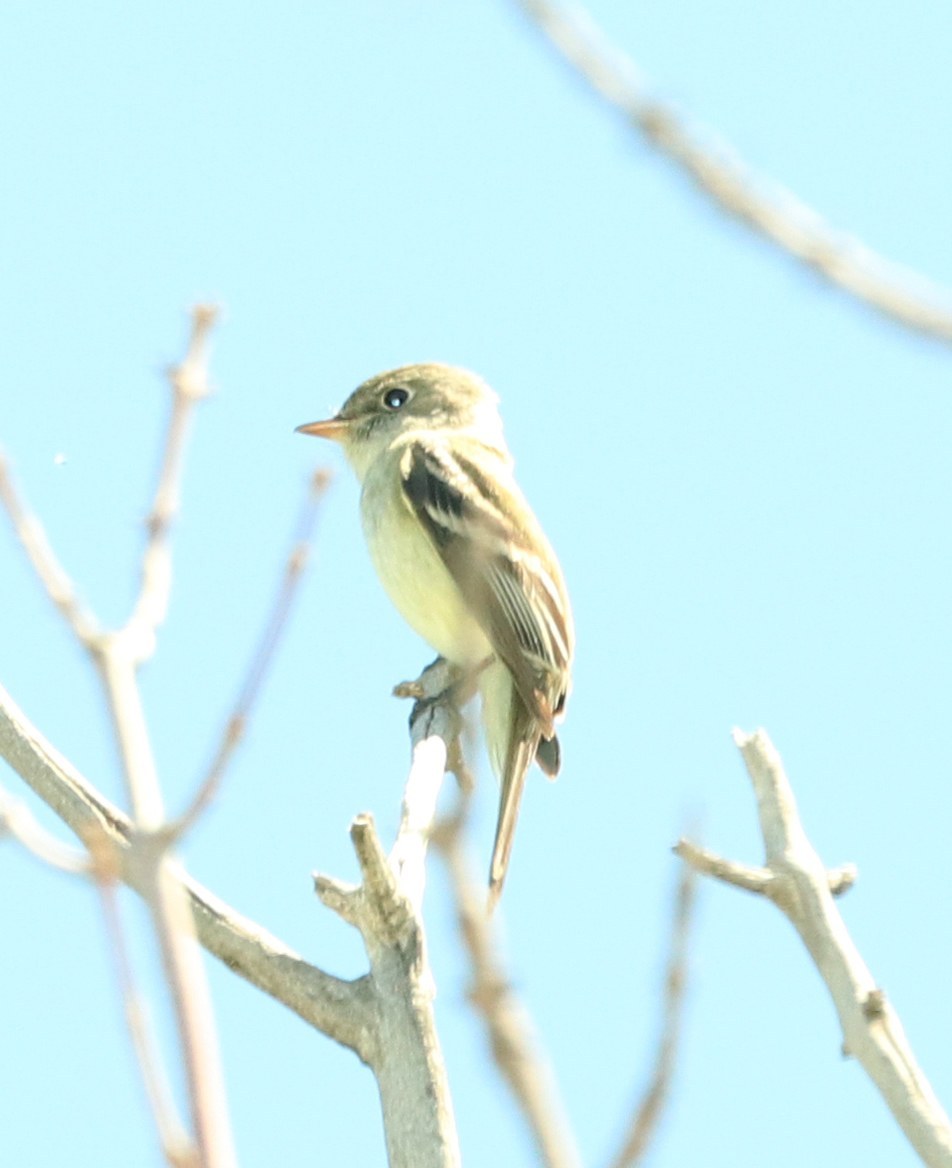
Yellow-bellied Flycatcher
Empidonax flaviventris
The brightest and most yellow of the eastern Empidonax flycatchers, breeding in boggy boreal forest and giving a soft, plaintive whistled call.
- Size
- 13-14 cm (5-5.5 in) long, 19-21 cm wingspan
- Habitat
- boreal coniferous forest bogs and wet woodlands of northern North America
- Type
- songbird
Spotted a bird like this?
Identify any bird from a photo, free.
Overview
The Yellow-bellied Flycatcher is the most vividly yellow-toned member of the eastern Empidonax flycatchers, showing bright olive-green upperparts and a strikingly yellow throat, breast, and belly, with a bold, complete yellowish eye-ring that gives it a somewhat wide-eyed expression. It breeds in cool, boggy coniferous forest across the boreal zone of Canada, a habitat shared with relatively few other songbirds, and is among the more secretive and quietly-voiced Empidonax species.
Its soft, understated calls and preference for dense, wet forest understory mean it is often detected first by careful listening rather than by sight, especially during migration when it can occur in a wider range of wooded habitats.
How to identify it
Key Field Marks
- Bright olive-green upperparts and vividly yellow throat, breast, and belly, more saturated yellow than other Empidonax species
- Bold, complete yellowish eye-ring
- Two prominent yellowish-white wing bars
- Overall rounder-headed, compact appearance
Similar Species
- Acadian Flycatcher is less uniformly yellow below and has a broader bill, breeding in deciduous rather than boreal coniferous forest.
- Least Flycatcher shows a whiter, less yellow throat and breast, and a different, sharply repeated call.
- The combination of extensive yellow underparts and bold, complete eye-ring is diagnostic within its range.
Habitat & range
Yellow-bellied Flycatchers breed across the boreal forest zone of Canada and parts of the extreme northern United States, favoring cool, mossy, boggy coniferous forest, particularly areas with spruce, fir, and abundant sphagnum moss on the forest floor.
The species winters in Mexico and Central America, migrating through the eastern United States each spring and fall, where it can occur in a broader variety of wooded habitats during passage.
Behavior & voice
Voice
Gives a soft, plaintive, whistled chu-wee or per-wee call, along with a simple song, both quieter and less emphatic than many other Empidonax species.
Feeding
Forages low in dense, shaded forest understory and bog vegetation, sallying out to catch flying insects and gleaning prey from foliage and moss.
Nesting
Builds its nest on or very near the ground, often tucked into a mossy hummock, upturned root mass, or low shrub in boggy coniferous forest, a ground-nesting habit unusual among Empidonax flycatchers.
Frequently asked questions
How do I identify a Yellow-bellied Flycatcher?
Look for a small, compact Empidonax flycatcher with vividly yellow underparts, bright olive-green upperparts, and a bold, complete yellowish eye-ring, typically in boggy boreal forest.
Where does the Yellow-bellied Flycatcher breed?
It breeds in cool, boggy coniferous forest across the boreal zone of Canada and the extreme northern United States.
How does the Yellow-bellied Flycatcher differ from other Empidonax species?
It is the most extensively and vividly yellow of the eastern Empidonax flycatchers, and unusually for the genus, it nests on or near the ground rather than in a shrub or tree.
Where do Yellow-bellied Flycatchers spend the winter?
They migrate to winter in Mexico and Central America.
Yellow-bellied Flycatcher guides
In-depth guides for identifying, finding, and understanding Yellow-bellied Flycatcher.
Other birds you may enjoy

Black Redstart
13-14.5 cm (5.1-5.7 in) long, 23-26 cm wingspan

Black-throated Sparrow
12-14 cm (4.7-5.5 in) long, about 19-20 cm (7.5-8 in) wingspan

Greater Bird-of-paradise
Body about 43 cm; males with additional flank plumes up to 50 cm and long tail wires

Blue Tit
11-12 cm (4.3-4.7 in) long, 17-20 cm wingspan

Red-billed Quelea
11.5–13 cm long, wingspan about 20–22 cm
White-plumed Antbird
13-14 cm (5-5.5 in) long

Pyrrhuloxia
19-22 cm (7.5-8.7 in) long, 30 cm wingspan

Blue-gray Tanager
16-18 cm (6-7 in) long

Blackburnian Warbler
11-13 cm (4.3-5.1 in) long, 20-22 cm wingspan

Bluethroat
13-14 cm (5.1-5.5 in) long, 20-22 cm wingspan

Eurasian Nuthatch
12-14.5 cm (4.7-5.7 in) long, 22.5-27 cm wingspan

Wood Thrush
19-21 cm (7.5-8.3 in) long, about 33 cm (13 in) wingspan