
Yellow-bellied Flycatcher Identification Guide
The most yellow of the Empidonax flycatchers, a plump boreal-bog breeder with a bold teardrop eye-ring and a soft, whistled call.
Read the full Yellow-bellied Flycatcher encyclopedia entry →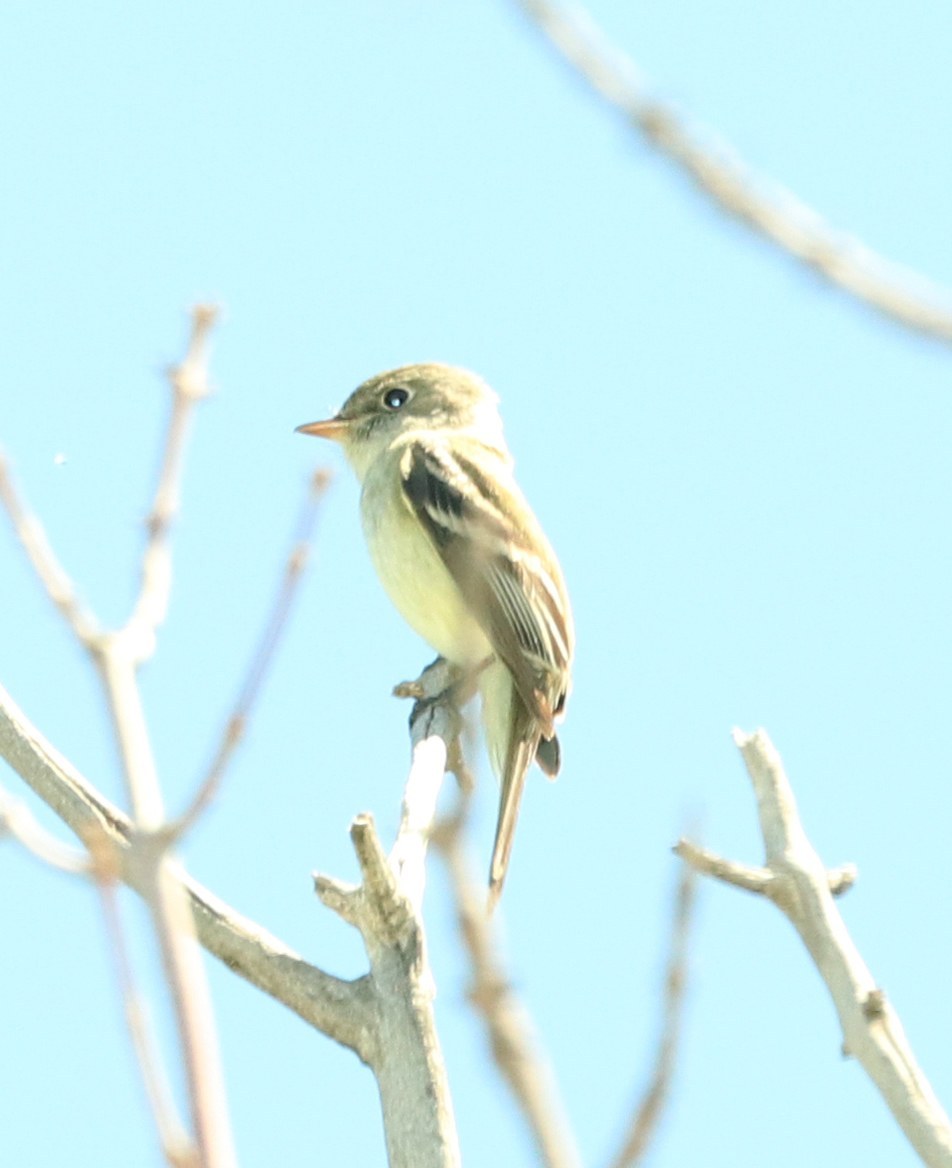
Key Field Marks
- Size & shape: A small, round-headed, plump Empidonax flycatcher with a short tail and a relatively short, wide bill for the genus.
- Plumage: Olive-green upperparts and notably yellow underparts — more saturated yellow, even on the throat, than any other Empidonax.
- Eye-ring & wing bars: A bold, often teardrop-shaped whitish-to-yellowish eye-ring and two crisp whitish or yellow-tinged wing bars.
- Bill: Fairly small with a pale, often orangish lower mandible.
- Posture & behavior: Sits upright with wings often slightly drooped and tail held still or gently flicked; stays low in dense, shaded understory rather than perching in the open.
Separating It From Similar Species
- Acadian Flycatcher: Larger overall, with a longer bill, greener (less yellow) underparts, and a preference for shady deciduous forest rather than boggy conifers.
- Least Flycatcher: Grayer overall with a whitish (not yellow) throat and belly, a bold white eye-ring, and a much more open, active habitat preference; also gives a distinctive "che-bek" song unlike Yellow-bellied's softer notes.
- Alder/Willow Flycatcher: Larger, longer-tailed, and much less yellow below, with different, buzzier songs.
- In general, Yellow-bellied is the plumpest, roundest-headed, and most consistently yellow-bellied of the confusing Empidonax group, and its damp, mossy, coniferous bog habitat is also a strong clue.
Habitat, Range & Season
- Breeds across the boreal forest of Canada and the northernmost United States, with a strong affinity for cool, mossy, coniferous bogs and wet spruce-fir forest with a dense shrub layer.
- Winters in Central America, from southern Mexico to Panama, in the shaded understory of humid lowland and foothill forest.
- Present on breeding grounds roughly late May through August; a somewhat late spring migrant and an early fall migrant compared to many other flycatchers.
Voice
- Song is a sharp, quick "che-lek" or "chi-bec," less emphatic and lower-energy than Least Flycatcher's song.
- Call is a soft, plaintive, rising whistle often rendered as "per-wee" or "chu-wee," quite different from the calls of other Empidonax and often the best clue to its presence in dense cover.
Frequently asked questions
How do I tell Yellow-bellied Flycatcher from other Empidonax flycatchers?
It is the yellowest of the group, with a bright yellow throat and belly, a bold teardrop eye-ring, and a plump, round-headed shape, and it favors damp coniferous bogs rather than open habitats.
What is the call of the Yellow-bellied Flycatcher?
A soft, whistled, rising call often described as 'per-wee' or 'chu-wee,' distinct from the sharper calls of Least or Acadian Flycatcher.
Where does the Yellow-bellied Flycatcher breed?
In cool boreal bogs and wet spruce-fir forest across Canada and the northern edge of the United States.
Where does it spend the winter?
In the shaded forest understory of Central America, from southern Mexico south to Panama.