
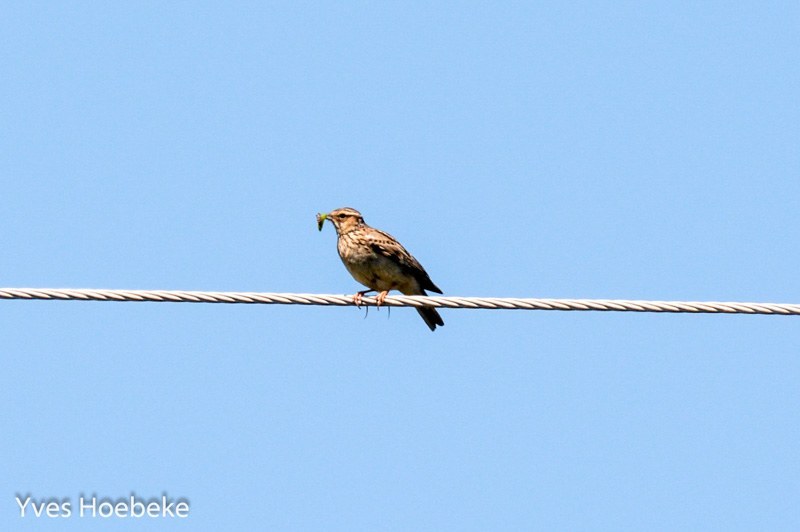
Woodlark
Lullula arborea
A short-tailed lark of heathland and woodland edge known for its rich, melancholy, fluting song.
- Size
- 15 cm long; wingspan around 27-30 cm
- Habitat
- Open woodland edges, heathland, and lightly wooded farmland with bare or short-cropped ground
- Type
- songbird
Spotted a bird like this?
Identify any bird from a photo, free.
Overview
The Woodlark is a small, compact lark closely related to the Eurasian Skylark but noticeably smaller, shorter-tailed, and more subtly marked. Its plumage is warm brown above with dark streaking and buffy underparts with fine streaks confined mostly to the breast.
A distinctive facial pattern helps set it apart: a strong pale supercilium (eyebrow stripe) extends behind the eye on each side and the two stripes nearly meet across the back of the head, creating a distinctive pale collar-like effect. It has a short crest that is less prominent than that of the Crested Lark and often not raised.
In flight, the short tail and rounded wings give it a distinctive silhouette quite different from the longer-tailed Skylark.
How to identify it
Key field marks
- Small size with a notably short tail
- Strong pale supercilium stripes meeting at the back of the head
- Dark and white patch pattern on the folded wing (dark centers with pale edges)
- No white trailing edge to the wing in flight (unlike Skylark)
- Distinctive undulating, bounding flight
Similar species
- Eurasian Skylark: larger, longer-tailed, with white wing trailing edges and white outer tail feathers, and a more prolonged, sustained hovering song flight rather than a short, circling one.
- Crested Lark: larger with a taller, more obvious crest, longer bill, and different, more sandy coloration; usually found on bare open ground rather than woodland edges.
- Tree Pipit: more slender, streakier below, and lacks the strong facial supercilium pattern of the Woodlark.
Habitat & range
Habitat
Woodlarks favor a mix of bare or sparsely vegetated ground for feeding alongside scattered trees, bushes, or woodland edges used for song perches and shelter, typical of heathland, forest clearings, and recently disturbed or lightly grazed farmland.
Range
The species breeds across much of southern, central, and western Europe, extending into parts of North Africa and western Asia. Its range is patchier in northern parts of Europe where suitable open, warm habitat is more limited.
Migration
Southern and western European populations are largely resident or short-distance migrants, while more northerly and eastern breeders move south in winter, often only as far as is needed to find frost-free feeding areas.
Behavior & voice
Behavior
Woodlarks feed on the ground, often walking between patches of bare earth and short vegetation, and are somewhat shy, tending to flush at a distance and fly off with a distinctive bounding flight pattern.
Voice
The song is often described as one of the most beautiful of any European songbird: a series of rich, fluting, melancholic phrases, frequently repeated on a descending scale, delivered either from a perch or during a slow, circling song flight, sometimes even at night. The flight call is a soft, liquid "titlooeet."
Feeding
Insects, spiders, and other invertebrates dominate the diet during the breeding season, while seeds become more important in autumn and winter.
Nesting and breeding
The nest is a well-concealed cup on the ground, often at the base of a shrub or tuft of grass. Females usually lay 3-4 eggs and may raise two broods per season in favorable conditions.
Frequently asked questions
How do you tell a Woodlark from a Skylark?
Woodlarks are smaller and shorter-tailed with pale supercilium stripes meeting at the back of the head, and they lack the white wing trailing edge and white outer tail feathers seen on Skylarks.
What does a Woodlark sound like?
It has a rich, fluting, somewhat melancholic song delivered in repeated descending phrases, often considered one of the most beautiful bird songs in Europe.
Where does the Woodlark live?
It favors heathland, open woodland edges, and lightly wooded farmland with patches of bare ground, mainly across southern, central, and western Europe.
What does a Woodlark eat?
Mostly insects and other invertebrates during the breeding season, switching to seeds in autumn and winter.
Does the Woodlark migrate?
Southern populations tend to be resident, while northern and eastern breeders migrate short distances south for winter.
Woodlark guides
In-depth guides for identifying, finding, and understanding Woodlark.
Other birds you may enjoy

Black Redstart
13-14.5 cm (5.1-5.7 in) long, 23-26 cm wingspan

Black-throated Sparrow
12-14 cm (4.7-5.5 in) long, about 19-20 cm (7.5-8 in) wingspan

Greater Bird-of-paradise
Body about 43 cm; males with additional flank plumes up to 50 cm and long tail wires

Blue Tit
11-12 cm (4.3-4.7 in) long, 17-20 cm wingspan

Red-billed Quelea
11.5–13 cm long, wingspan about 20–22 cm
White-plumed Antbird
13-14 cm (5-5.5 in) long

Pyrrhuloxia
19-22 cm (7.5-8.7 in) long, 30 cm wingspan

Blue-gray Tanager
16-18 cm (6-7 in) long

Blackburnian Warbler
11-13 cm (4.3-5.1 in) long, 20-22 cm wingspan

Bluethroat
13-14 cm (5.1-5.5 in) long, 20-22 cm wingspan

Eurasian Nuthatch
12-14.5 cm (4.7-5.7 in) long, 22.5-27 cm wingspan

Wood Thrush
19-21 cm (7.5-8.3 in) long, about 33 cm (13 in) wingspan