
Woodlark Identification Guide
A small, short-tailed European lark of heathland and open woodland edges, best known for its melodious, fluting song often delivered in a slow, circling flight.
Read the full Woodlark encyclopedia entry →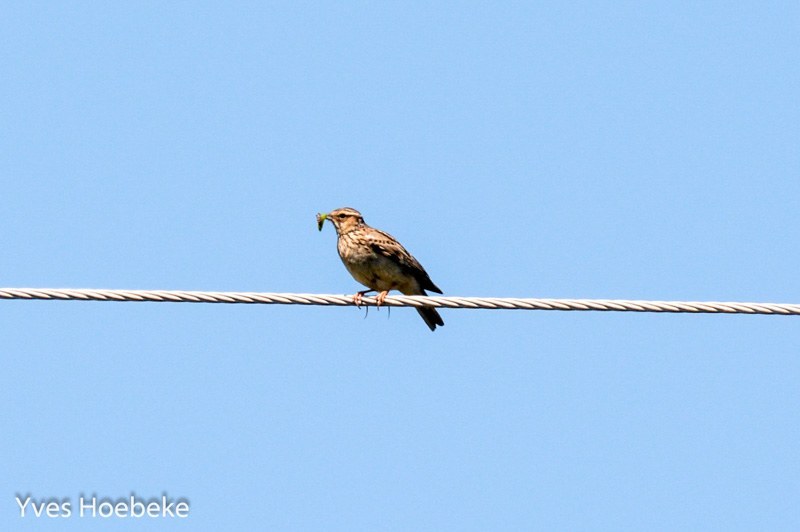
Key Field Marks
- Size & shape: A small lark (about 15 cm), noticeably shorter-tailed and more compact than a Skylark, with a rounded head profile.
- Face pattern: Distinctive pale supercilium (eyebrow stripe) that extends around the back of the head and meets in a pale V on the nape — a key diagnostic feature.
- Wing pattern: A bold black-and-white mark on the leading edge of the folded wing (the carpal patch/alula area), visible at rest and useful at a distance.
- Upperparts: Streaked brown, well camouflaged against bare ground and short vegetation.
- Tail: Short, with limited white edging compared to the Skylark's longer, white-edged tail.
- Behavior: Often perches in low trees or bushes, unlike the more strictly ground/flight-bound Skylark; walks and runs on the ground while foraging for seeds and insects.
Separating It From Similar Species
- Skylark is larger, has a small but noticeable crest, a longer tail with white outer tail feathers, and lacks the Woodlark's pale nape V and bold wing carpal patch.
- Crested Lark shows a more prominent spiky crest, a longer, more curved bill, and lacks the Woodlark's contrasting facial pattern.
- The nape-meeting supercilium and short tail are the most reliable features when views are brief.
Where and When to Look
- Habitat: Open heathland, forest clearings and edges, recently felled or young plantation woodland, and dry grassland with scattered trees and bare ground.
- Range: Breeds across much of Europe, from Britain and Iberia east into western Asia; more concentrated in southern and western Europe, becoming scarcer and more localized in the north of its range.
- Season: Resident in milder parts of its range (e.g., southern Britain, southern Europe); more northerly and continental populations are partial migrants, moving south for winter.
- Best viewing: Visit heathland or open woodland-edge reserves at dawn in spring; the species often begins singing before sunrise and can even sing on moonlit nights.
Voice
- A rich, melodious, fluting song, often transcribed as repeated "lu-lu-lu" phrases, considered one of the most beautiful songs of any European bird.
- Frequently sung in a slow, circling, undulating song-flight at height, though also delivered from a perch or the ground; unusual among larks for sometimes singing after dark.
Frequently asked questions
How do you tell a Woodlark from a Skylark?
Woodlark is smaller and shorter-tailed with a pale supercilium that meets in a V on the nape and a bold black-and-white carpal patch on the folded wing; Skylark is larger, has a small crest, and shows white-edged outer tail feathers instead.
What does the Woodlark's song sound like?
A rich, melodious series of fluting "lu-lu-lu" phrases, often delivered in a slow circling song-flight and regarded as one of the most beautiful songs among European birds.
What habitat does the Woodlark prefer?
Open heathland, forest clearings and edges, and dry grassland with scattered trees and patches of bare ground for foraging.
Does the Woodlark sing at night?
It can, unusually for a lark — Woodlarks sometimes sing after dark or on moonlit nights, in addition to singing at dawn.