
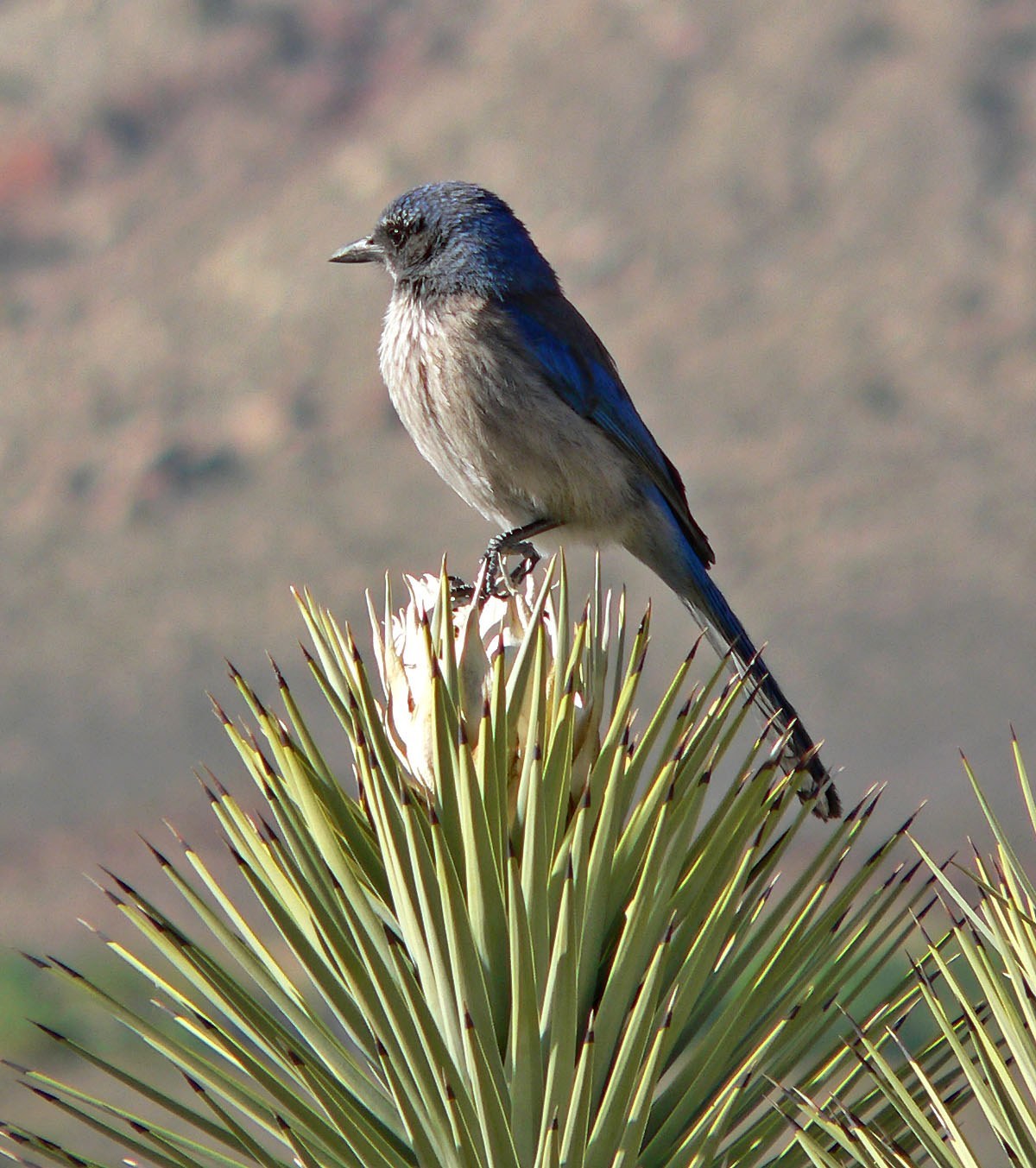
Woodhouse's Scrub-Jay
Aphelocoma woodhouseii
A pale, crestless blue jay of the interior West's pinyon-juniper woodlands, closely tied to pine nut crops.
- Size
- 27-30 cm (10.5-12 in) long, 38-40 cm wingspan
- Habitat
- pinyon-juniper woodland, sagebrush, and dry montane scrub of the interior West
- Type
- songbird
Spotted a bird like this?
Identify any bird from a photo, free.
Overview
Woodhouse's Scrub-Jay is a crestless jay of the interior western United States, similar in shape to its coastal relative the California Scrub-Jay but paler and grayer overall, with a less contrasting blue necklace and duller blue coloring on the head and wings.
Formerly lumped with the California Scrub-Jay as the 'Western Scrub-Jay,' this species was recognized as distinct in 2016. It is closely associated with pinyon pine and juniper woodlands across the Great Basin, Colorado Plateau, and southern Rocky Mountains, playing a key ecological role in dispersing pinyon pine seeds.
How to identify it
Key Field Marks
- No crest
- Duller, paler blue on the head, wings, and tail compared to California Scrub-Jay
- Grayish-brown back
- Pale gray underparts with a faint, less distinct blue necklace
- Pale eyebrow stripe
Similar Species
- California Scrub-Jay is brighter blue with a more distinct necklace and inhabits coastal oak woodland rather than interior pinyon-juniper habitat; ranges meet but overlap little.
- Pinyon Jay shares similar habitat but is entirely blue-gray with no white on the underparts and a shorter tail, and travels in large, noisy flocks rather than pairs.
Habitat & range
Habitat
Woodhouse's Scrub-Jay favors pinyon-juniper woodland, sagebrush steppe with scattered junipers, and dry montane scrub and oak habitat in the interior West.
Range
Found across the Great Basin, Colorado Plateau, and southern Rocky Mountains, including parts of Nevada, Utah, Colorado, Arizona, New Mexico, and western Texas, extending into the Mexican highlands.
Migration
This species is largely non-migratory, though some populations shift to lower elevations in harsh winters.
Behavior & voice
Behavior
Woodhouse's Scrub-Jays are territorial and pair-bonded, foraging on the ground and in low vegetation, and are well known for caching pinyon pine seeds in fall, an important factor in pinyon pine forest regeneration.
Voice
Calls include a harsh, scratchy shreep or check note, similar to but slightly different in tone from the California Scrub-Jay's calls.
Feeding
Diet centers on pinyon pine seeds and juniper berries where available, supplemented by acorns, insects, and occasionally small lizards or eggs.
Nesting
Pairs build a twig nest in a low tree or shrub, often a juniper or pinyon pine; the female incubates 2-6 pale green, spotted eggs.
Frequently asked questions
How is Woodhouse's Scrub-Jay different from the California Scrub-Jay?
It is paler and grayer with a less distinct blue necklace, and it lives in interior pinyon-juniper woodland rather than coastal oak woodland; the two species were split in 2016.
Where does Woodhouse's Scrub-Jay live?
It lives in pinyon-juniper woodland and dry scrub across the Great Basin, Colorado Plateau, and southern Rocky Mountains.
What does Woodhouse's Scrub-Jay eat?
It primarily eats pinyon pine seeds and juniper berries, along with acorns, insects, and occasionally small vertebrates.
Does Woodhouse's Scrub-Jay have a crest?
No, like other scrub-jays it lacks a crest, distinguishing it from Steller's Jay and Blue Jay.
Woodhouse's Scrub-Jay guides
In-depth guides for identifying, finding, and understanding Woodhouse's Scrub-Jay.
Other birds you may enjoy

Black Redstart
13-14.5 cm (5.1-5.7 in) long, 23-26 cm wingspan

Black-throated Sparrow
12-14 cm (4.7-5.5 in) long, about 19-20 cm (7.5-8 in) wingspan

Greater Bird-of-paradise
Body about 43 cm; males with additional flank plumes up to 50 cm and long tail wires

Blue Tit
11-12 cm (4.3-4.7 in) long, 17-20 cm wingspan

Red-billed Quelea
11.5–13 cm long, wingspan about 20–22 cm
White-plumed Antbird
13-14 cm (5-5.5 in) long

Pyrrhuloxia
19-22 cm (7.5-8.7 in) long, 30 cm wingspan

Blue-gray Tanager
16-18 cm (6-7 in) long

Blackburnian Warbler
11-13 cm (4.3-5.1 in) long, 20-22 cm wingspan

Bluethroat
13-14 cm (5.1-5.5 in) long, 20-22 cm wingspan

Eurasian Nuthatch
12-14.5 cm (4.7-5.7 in) long, 22.5-27 cm wingspan

Wood Thrush
19-21 cm (7.5-8.3 in) long, about 33 cm (13 in) wingspan