
Woodhouse's Scrub-Jay Identification Guide
A crestless blue-and-grey jay of the interior American West's pinyon-juniper and scrub-oak country, split from the California Scrub-Jay in 2016.
Read the full Woodhouse's Scrub-Jay encyclopedia entry →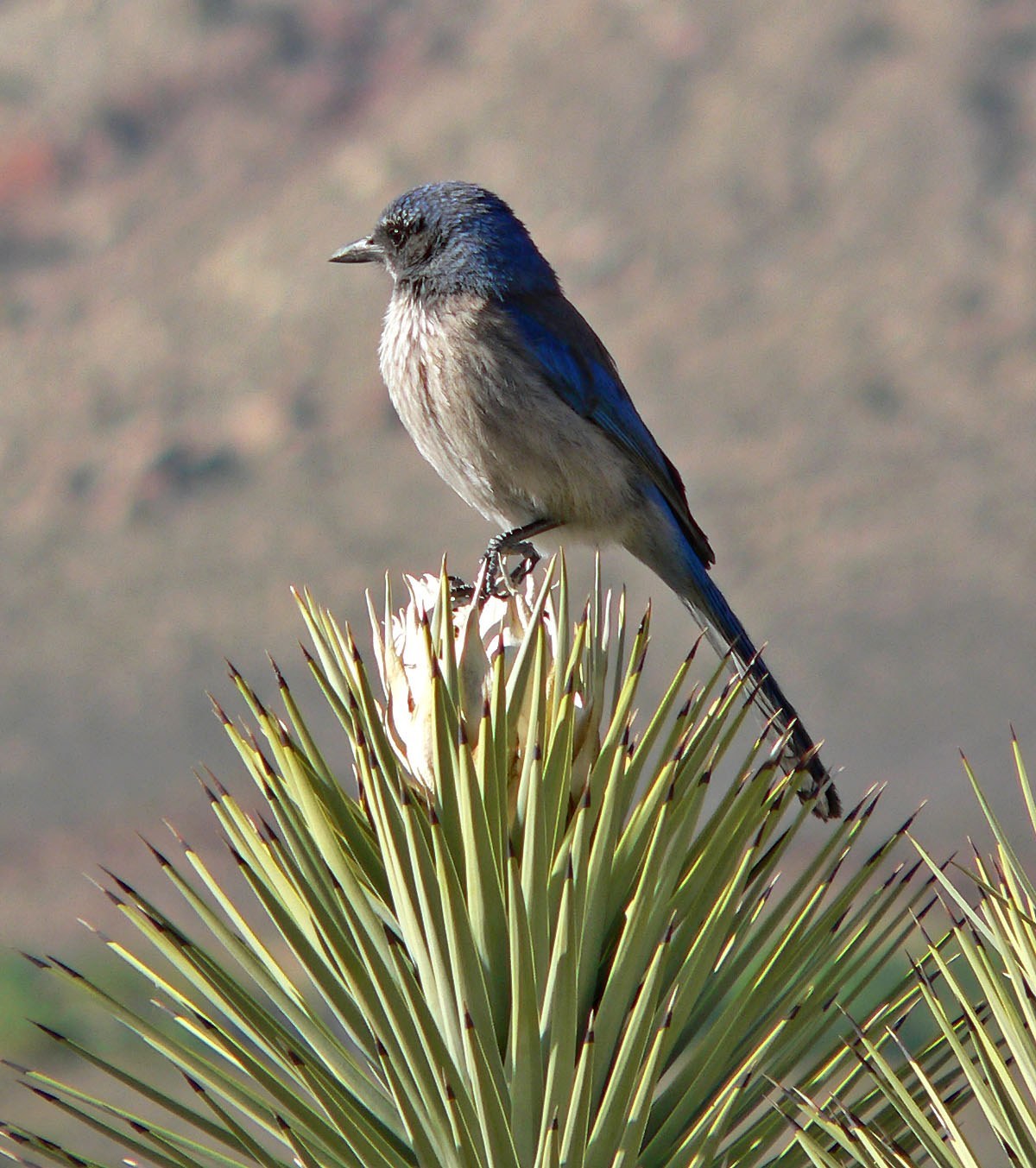
Key Field Marks
- Size & shape: A medium-sized, slender jay (about 28–30 cm) with a long tail and no crest, giving it a smooth-headed profile.
- Plumage: Blue head, wings, and tail; grayish-brown back; underparts pale grayish with a faint, relatively indistinct blue necklace across the upper breast.
- Face: A modest whitish supercilium (eyebrow) and pale throat, less bold than in coastal relatives.
- Behavior: Bold, inquisitive, and often conspicuous, perching on fence posts, shrubs, or utility wires; caches pinyon pine seeds and acorns for later use, an important ecological role in seed dispersal.
Separating It From Similar Species
- California Scrub-Jay shows a brighter, more saturated blue, a whiter belly, and a bolder, more sharply defined blue breast necklace; ranges are largely separated by the Sierra Nevada/Central Valley and desert regions, with limited contact zones.
- Mexican Jay lacks a breast necklace entirely, has duller, more uniform blue-grey plumage, and typically travels in larger family groups.
- Pinyon Jay is uniformly blue overall with a short tail and no pale underparts contrast, and moves in large flocks rather than singly or in pairs.
- Range and habitat are often the most practical clues, since the split from California Scrub-Jay is subtle; Woodhouse's occupies the interior Great Basin, Rocky Mountain foothills, and southwestern woodlands rather than the Pacific coast.
Where and When to Look
- Habitat: Pinyon-juniper woodland, scrub oak, and dry montane foothill scrub across the interior West.
- Range: Great Basin, Rocky Mountain foothills, and much of the interior Southwest United States into northern Mexico.
- Season: Resident year-round throughout its range, with little seasonal movement.
- Best viewing: Visit pinyon-juniper or scrub-oak habitat at moderate elevation; birds are often easy to see near trailheads, campgrounds, and residential areas within their range.
Voice
- A harsh, scratchy, downslurred "shreenk" or "jreep," given singly or in a rough series — similar to other scrub-jays but slightly softer/less strident than the California Scrub-Jay's call to experienced ears.
- Also gives various harsh chatters and rattles, especially when mobbing predators.
Frequently asked questions
What is the difference between Woodhouse's Scrub-Jay and the California Scrub-Jay?
Woodhouse's is duller blue with a less contrasting breast necklace and pale grayish (not white) underparts, and it occupies interior habitats like pinyon-juniper woodland, while California Scrub-Jay is brighter and coastal/Central Valley in range.
Why was Woodhouse's Scrub-Jay recently renamed?
In 2016 the former Western Scrub-Jay was split into three species — California Scrub-Jay, Woodhouse's Scrub-Jay, and Island Scrub-Jay — based on genetic, vocal, and plumage differences.
What habitat does Woodhouse's Scrub-Jay prefer?
Pinyon-juniper woodland and scrub oak in the interior West, including the Great Basin, Rocky Mountain foothills, and southwestern uplands.
Does Woodhouse's Scrub-Jay migrate?
No, it is a year-round resident throughout its range with little seasonal movement.