
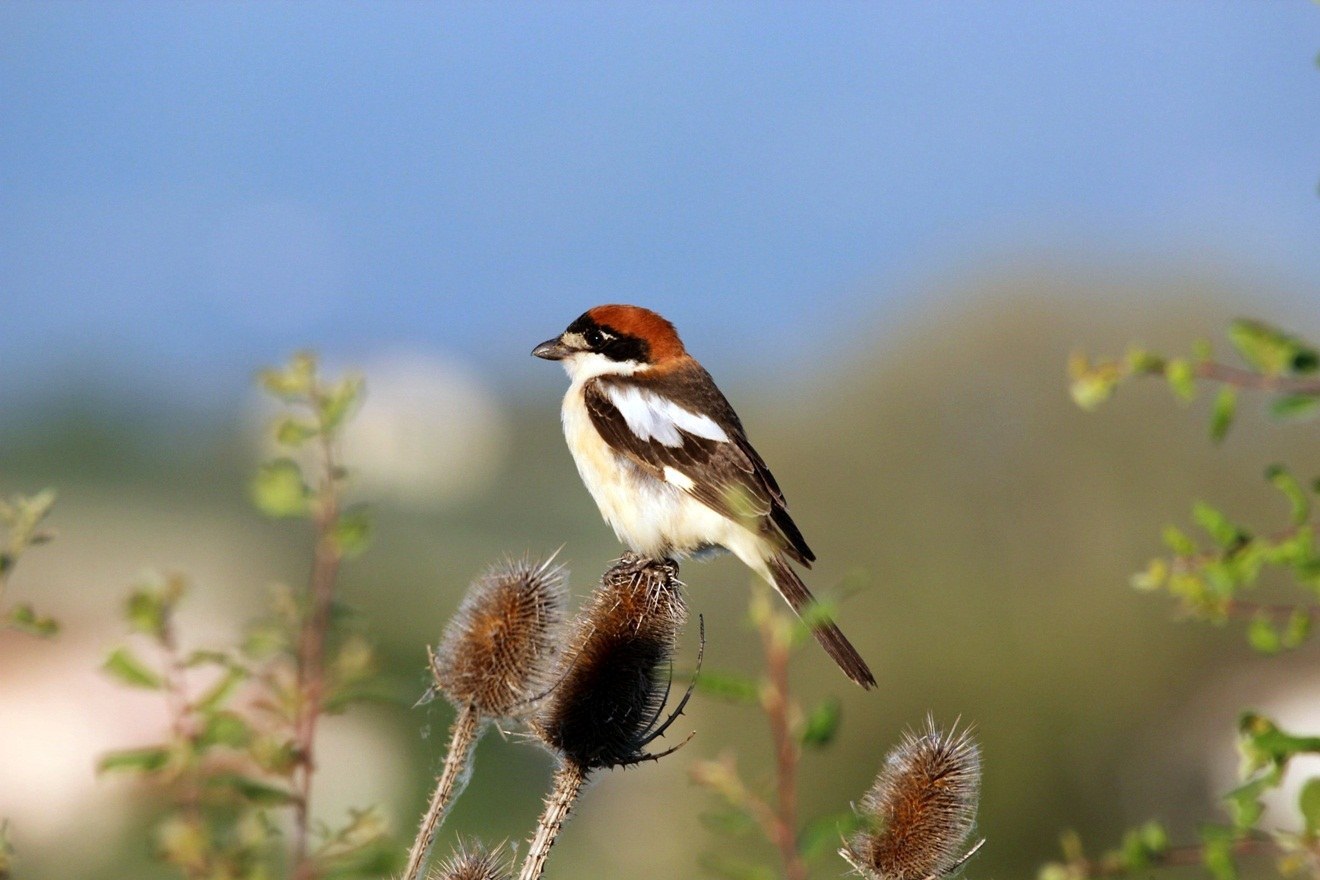
Woodchat Shrike
Lanius senator
A striking Mediterranean shrike with a chestnut crown, black mask, and bold white wing patches.
- Size
- 17-19 cm (6.5-7.5 in) long, 27-33 cm wingspan
- Habitat
- open, sunny country with scattered trees, orchards, olive groves, and scrubland
- Type
- songbird
Spotted a bird like this?
Identify any bird from a photo, free.
Overview
The Woodchat Shrike is a handsome, sharply patterned predatory songbird of sunny Mediterranean landscapes. Adults are striking: a rich chestnut-orange crown and nape contrast with a black mask, black wings marked with a bold white patch, a black tail, and clean white underparts and rump.
Juveniles look completely different, mottled greyish-brown with fine vermiculated barring, resembling a young shrike of almost any species until the chestnut cap develops.
Like other shrikes, it is a fierce hunter for its size, often perching prominently on wires, dead branches, or the tops of bushes before dropping onto prey.
How to identify it
Key field marks
- Bright chestnut crown and nape, sharply demarcated from the black mask and black back
- Bold white patch at the base of the black wing, visible both perched and in flight
- White underparts, white rump, and a black tail with white edges
- Juveniles are dull brown and finely barred, lacking the chestnut cap
Similar species
The chestnut crown (rather than chestnut back) distinguishes adult Woodchat Shrikes from Red-backed Shrikes. It is also more boldly patterned in black and white than the greyer Lesser Grey Shrike, which lacks the chestnut cap entirely.
Habitat & range
Range
Breeds around the Mediterranean basin, from Iberia and North Africa east through southern Europe to the Middle East and Central Asia. It is a trans-Saharan migrant, wintering in the Sahel zone of sub-Saharan Africa.
Habitat
Prefers warm, dry, open country with scattered trees or bushes for perching, including olive groves, orchards, vineyards, and dehesa-type parkland. It requires open ground below its perches to spot and pursue prey.
Migration
Departs breeding areas in late summer, crossing the Sahara to reach wintering grounds in West and Central Africa, returning to Europe in spring.
Behavior & voice
Behavior
Hunts from an exposed perch, dropping down onto insects and small animals on the ground, or occasionally catching prey in flight. Like other shrikes it will cache surplus food by impaling it on thorns.
Voice
The song is a varied, chattering warble often mixed with mimicry of other birds. Calls include harsh, scolding notes given in alarm.
Feeding
Feeds mainly on large insects such as beetles and crickets, along with small lizards; it will also take small birds and rodents opportunistically.
Nesting and breeding
Builds a neat cup nest in a tree or tall bush, laying 4-6 eggs incubated mainly by the female. Both parents help feed the young after hatching.
Frequently asked questions
What makes the Woodchat Shrike easy to identify?
Its bright chestnut crown and nape combined with a bold white wing patch and black-and-white body make adults highly distinctive.
Where does the Woodchat Shrike live?
It breeds around the Mediterranean and winters in the Sahel region of sub-Saharan Africa.
Does the Woodchat Shrike impale its prey like other shrikes?
Yes, it often caches large insects and small vertebrates by impaling them on thorns or spines.
How do juvenile Woodchat Shrikes differ from adults?
Juveniles are mottled greyish-brown with fine barring and lack the adult's chestnut crown and bold black-and-white pattern.
Woodchat Shrike guides
In-depth guides for identifying, finding, and understanding Woodchat Shrike.
Other birds you may enjoy

Black Redstart
13-14.5 cm (5.1-5.7 in) long, 23-26 cm wingspan

Black-throated Sparrow
12-14 cm (4.7-5.5 in) long, about 19-20 cm (7.5-8 in) wingspan

Greater Bird-of-paradise
Body about 43 cm; males with additional flank plumes up to 50 cm and long tail wires

Blue Tit
11-12 cm (4.3-4.7 in) long, 17-20 cm wingspan

Red-billed Quelea
11.5–13 cm long, wingspan about 20–22 cm
White-plumed Antbird
13-14 cm (5-5.5 in) long

Pyrrhuloxia
19-22 cm (7.5-8.7 in) long, 30 cm wingspan

Blue-gray Tanager
16-18 cm (6-7 in) long

Blackburnian Warbler
11-13 cm (4.3-5.1 in) long, 20-22 cm wingspan

Bluethroat
13-14 cm (5.1-5.5 in) long, 20-22 cm wingspan

Eurasian Nuthatch
12-14.5 cm (4.7-5.7 in) long, 22.5-27 cm wingspan

Wood Thrush
19-21 cm (7.5-8.3 in) long, about 33 cm (13 in) wingspan