
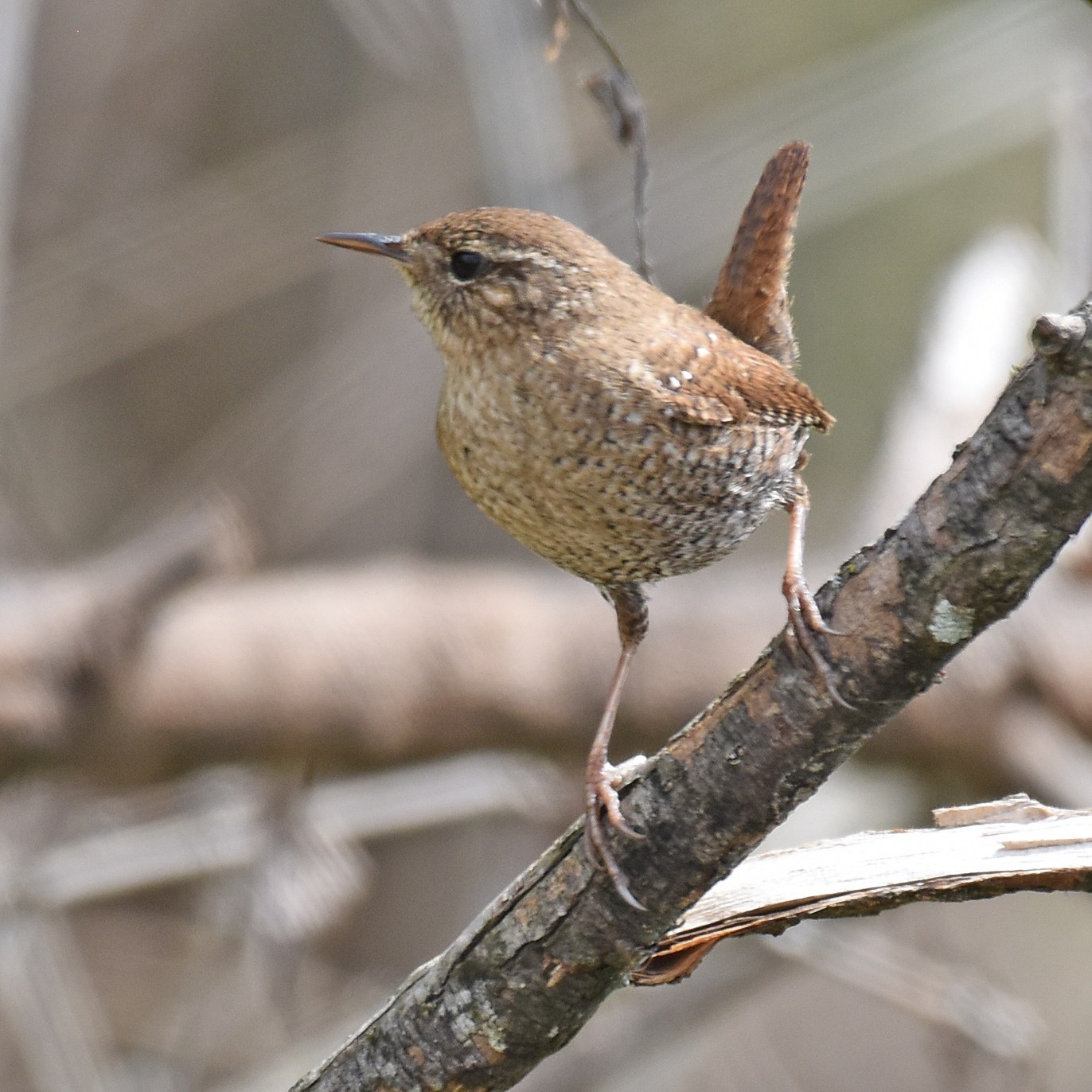
Winter Wren
Troglodytes hiemalis
A tiny, dark, almost tailless woodland wren of eastern North America known for its remarkably long, bubbling song.
- Size
- 9-10 cm (3.5-4 in) long, 13-16 cm wingspan
- Habitat
- dense understory of coniferous and mixed forests, tangled thickets, and ravines with fallen logs
- Type
- songbird
Spotted a bird like this?
Identify any bird from a photo, free.
Overview
The Winter Wren is one of the smallest songbirds in North America, a mouse-like ball of feathers that spends most of its life scurrying through tangled brush piles, root wads, and mossy logs on the forest floor. Its overall plumage is rich reddish-brown to dark cinnamon, finely barred with darker brown on the wings, flanks, and belly, giving it a subtly scaled appearance up close.
Its most distinctive physical trait is its stubby tail, which is often held cocked sharply upward, sometimes nearly touching its back. Despite its diminutive size, the Winter Wren is famous for producing one of the longest and most complex songs of any North American bird, a cascading, tinkling warble that can last ten seconds or more.
How to identify it
Key Field Marks
- Very small, round-bodied, and almost tailless, with the short tail typically cocked upward
- Rich reddish-brown to dark brown overall, darker than most other wrens
- Fine dark barring on the wings, flanks, and undertail coverts
- Pale, indistinct eyebrow stripe (supercilium)
- Thin, slightly downcurved dark bill
Similar Species
The Winter Wren is virtually identical in appearance to the closely related Pacific Wren, and the two were only split into separate species in 2010; range and voice are the most reliable distinctions, since Winter Wren occupies eastern North America while Pacific Wren replaces it in the west. House Wren is larger, grayer-brown, longer-tailed, and less richly colored, and it favors more open, brushy habitats rather than deep forest interior.
Habitat & range
Habitat
Winter Wrens favor the dark, damp understory of mature coniferous and mixed forests, especially areas with abundant downed logs, upturned root masses, mossy banks, and dense tangles where they can forage and nest close to the ground.
Range
This species breeds across eastern Canada and the northeastern and Appalachian United States, favoring cooler, moister forest types. In winter, many birds withdraw to the southeastern United States, foraging in brush piles, streamside thickets, and wooded ravines.
Migration
Winter Wrens are short- to medium-distance migrants, moving from northern breeding grounds to milder wintering areas in the southeastern states, though some populations in milder parts of the range are largely resident.
Behavior & voice
Behavior
Winter Wrens are energetic and secretive, creeping mouse-like through tangled vegetation and rarely venturing far from cover. They often bob and dip while foraging and flick their short tails frequently.
Voice
The song is an extraordinarily long, rapid series of clear, tinkling notes and trills, delivered with remarkable power for such a small bird. The call is a sharp, hard 'chip-chip' or a scolding chatter given when alarmed.
Feeding
They forage low to the ground, probing into crevices in bark, moss, and leaf litter for insects, spiders, and other invertebrates, often disappearing into log piles and root tangles while hunting.
Nesting & Breeding
Males build multiple bulky, domed nests of moss, twigs, and leaves tucked into root wads, stumps, or cavities; the female selects one, lines it with feathers, and lays 4-7 eggs. Males are often polygynous, mating with more than one female in a season.
Frequently asked questions
What is the difference between a Winter Wren and a Pacific Wren?
They look nearly identical, but Winter Wren occurs in eastern North America and Pacific Wren in the west; their songs also differ subtly, and they were only recognized as separate species in 2010.
Why does the Winter Wren hold its tail up?
Cocking the short tail nearly vertical is a characteristic wren posture, likely used in communication and visible even at a distance in dim forest understory.
Where do Winter Wrens nest?
They build bulky, domed nests tucked into root wads, mossy stumps, or brush piles close to the ground in dense forest.
What does a Winter Wren eat?
It eats insects, spiders, and other small invertebrates gleaned from bark, moss, and forest-floor litter.
Is the Winter Wren's song really that long?
Yes, its song can last ten seconds or more and contains dozens of notes, making it proportionally one of the longest and most complex songs of any songbird its size.
Winter Wren guides
In-depth guides for identifying, finding, and understanding Winter Wren.
Other birds you may enjoy

Black Redstart
13-14.5 cm (5.1-5.7 in) long, 23-26 cm wingspan

Black-throated Sparrow
12-14 cm (4.7-5.5 in) long, about 19-20 cm (7.5-8 in) wingspan

Greater Bird-of-paradise
Body about 43 cm; males with additional flank plumes up to 50 cm and long tail wires

Blue Tit
11-12 cm (4.3-4.7 in) long, 17-20 cm wingspan

Red-billed Quelea
11.5–13 cm long, wingspan about 20–22 cm
White-plumed Antbird
13-14 cm (5-5.5 in) long

Pyrrhuloxia
19-22 cm (7.5-8.7 in) long, 30 cm wingspan

Blue-gray Tanager
16-18 cm (6-7 in) long

Blackburnian Warbler
11-13 cm (4.3-5.1 in) long, 20-22 cm wingspan

Bluethroat
13-14 cm (5.1-5.5 in) long, 20-22 cm wingspan

Eurasian Nuthatch
12-14.5 cm (4.7-5.7 in) long, 22.5-27 cm wingspan

Wood Thrush
19-21 cm (7.5-8.3 in) long, about 33 cm (13 in) wingspan