
Wilson's Warbler
Cardellina pusilla
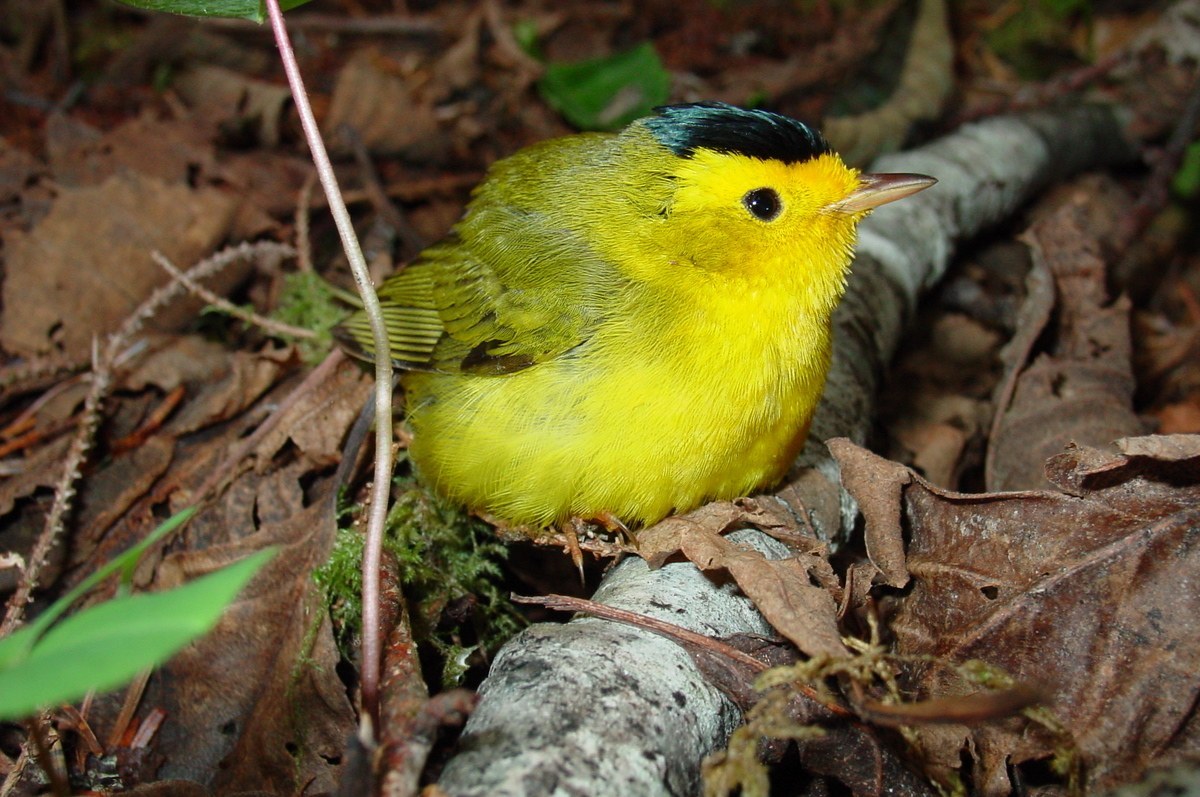
A small, bright yellow warbler with an olive back and, in males, a neat round black cap, often seen flicking its tail as it forages actively in low shrubs.
- Size
- 10-12 cm (4-4.7 in) long, 14-17 cm wingspan
- Habitat
- shrubby thickets near streams, wet meadows, and willow tangles
- Type
- songbird
Spotted a bird like this?
Identify any bird from a photo, free.
Overview
The Wilson's Warbler is a tiny, vividly colored warbler, bright lemon-yellow below and olive-green above, with a beady black eye that stands out against the plain yellow face. Adult males wear a small, neat black skullcap that gives the species its alternate name, while females and immatures show a duller, sometimes barely-there cap.
Restless and constantly in motion, Wilson's Warblers are famous for flicking their tails as they hop through low, dense vegetation, a habit that often helps observers pick them out even in thick cover.
How to identify it
Key field marks
- Bright yellow underparts and olive-green upperparts
- Round black cap on adult males (reduced or absent in females/immatures)
- Plain face with a dark beady eye and no eyering or eyeline
- No wingbars
- Frequent tail-flicking while foraging
Similar species
Female and immature Wilson's Warblers lacking a strong cap can resemble Yellow Warbler or Hooded Warbler females, but Wilson's is smaller, plainer-faced (no eye markings), and lacks the yellow tail spots and larger size of Hooded Warbler, while Yellow Warbler shows yellow tail spots and a heavier build.
Habitat & range
Wilson's Warblers breed across a huge range from Alaska and much of Canada south through the western mountains to California and the Rockies, typically in dense shrubby thickets near streams, bogs, and wet meadows, including willow and alder tangles. A small, disjunct population also breeds in the northeastern United States.
They winter from Mexico south through Central America, with some reaching northern South America, generally favoring similar shrubby, humid habitats at low to middle elevations.
Behavior & voice
Behavior and voice
Active and low-foraging, Wilson's Warblers glean insects from leaves and frequently sally out to catch flying insects in mid-air, flicking their tails almost continuously. They forage lower in vegetation than many warblers, often within a few feet of the ground.
The song is a rapid, chattering series of "chi" notes that drops in pitch toward the end, often rendered as "chi-chi-chi-chi-chi-chet-chet."
Nesting
The nest is built by the female directly on or very near the ground, tucked into a mossy hummock, grass tussock, or shrub base, and consists of a bulky cup of moss, leaves, and grass. Clutches typically hold 4-6 eggs.
Frequently asked questions
How do I tell a male from a female Wilson's Warbler?
Males have a neat, well-defined black cap on the crown, while females and immatures show a much duller cap that may be faint or nearly absent.
What makes Wilson's Warbler easy to spot in dense cover?
Its habit of constantly flicking its tail while foraging low in shrubs often draws the eye, even before the bird itself is clearly seen.
Where does Wilson's Warbler breed?
It breeds across a broad range from Alaska and Canada south through the western mountains to California, typically in shrubby thickets near water, plus a small disjunct population in the northeastern U.S.
What does a Wilson's Warbler eat?
Primarily insects and spiders, which it gleans from foliage or catches in short flycatching sallies.
How can you distinguish a female Wilson's Warbler from a Yellow Warbler?
Wilson's Warbler is smaller and plainer-faced with a beady dark eye and no tail spots, while Yellow Warbler shows yellow spots in the tail and a slightly bulkier build.
Wilson's Warbler guides
In-depth guides for identifying, finding, and understanding Wilson's Warbler.
Other birds you may enjoy

Black Redstart
13-14.5 cm (5.1-5.7 in) long, 23-26 cm wingspan

Black-throated Sparrow
12-14 cm (4.7-5.5 in) long, about 19-20 cm (7.5-8 in) wingspan

Greater Bird-of-paradise
Body about 43 cm; males with additional flank plumes up to 50 cm and long tail wires

Blue Tit
11-12 cm (4.3-4.7 in) long, 17-20 cm wingspan

Red-billed Quelea
11.5–13 cm long, wingspan about 20–22 cm
White-plumed Antbird
13-14 cm (5-5.5 in) long

Pyrrhuloxia
19-22 cm (7.5-8.7 in) long, 30 cm wingspan

Blue-gray Tanager
16-18 cm (6-7 in) long

Blackburnian Warbler
11-13 cm (4.3-5.1 in) long, 20-22 cm wingspan

Bluethroat
13-14 cm (5.1-5.5 in) long, 20-22 cm wingspan

Eurasian Nuthatch
12-14.5 cm (4.7-5.7 in) long, 22.5-27 cm wingspan

Wood Thrush
19-21 cm (7.5-8.3 in) long, about 33 cm (13 in) wingspan