
Wilson's Warbler Identification Guide
A small, bright yellow New World warbler with an unmarked yellow face and a neat black cap, often seen flicking its tail while foraging low in wet thickets.
Read the full Wilson's Warbler encyclopedia entry →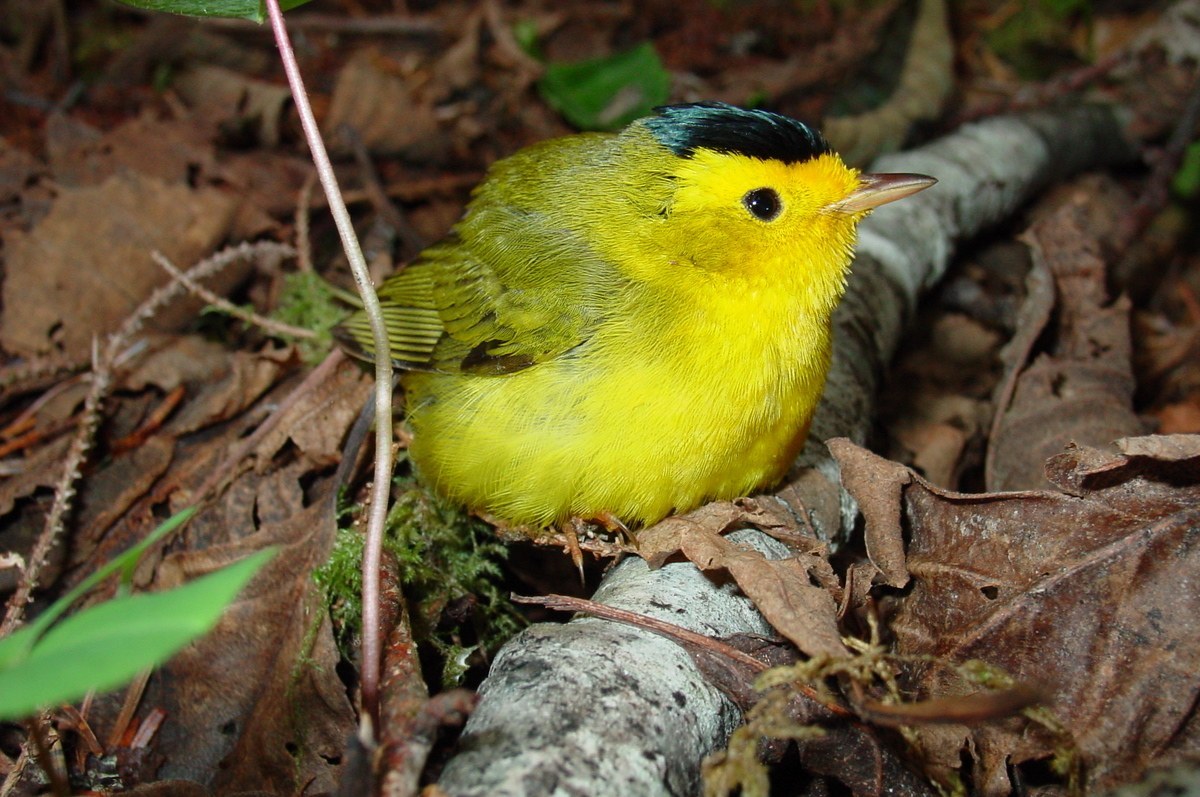
Key Field Marks
- Tiny (10-12 cm), plain-faced warbler, bright yellow-olive above and clear yellow below with no wing bars, no streaking, and no eye-ring - one of the plainest-faced North American warblers aside from the cap.
- Adult male has a neat, glossy black cap covering the crown, contrasting with the plain yellow face and olive-yellow body.
- Females and immatures show a reduced, duller, sometimes nearly absent black cap, appearing more uniformly olive-yellow overall.
- Fairly long tail, often held cocked or flicked and pumped while the bird forages actively and restlessly through low vegetation.
- Thin, pointed black bill and dark legs typical of an active insectivorous warbler.
Similar Species
- Yellow Warbler is larger, more uniformly yellow (including yellow in the wings and tail spots), and males show rusty breast streaking rather than a black cap.
- Hooded Warbler male has a full black hood surrounding a yellow face (not just a cap), and shows white in the outer tail feathers; female Hooded also tends to show at least a hint of a dark hood/mask that Wilson's lacks.
- Wilson's Warbler's combination of a small black cap restricted to the crown, entirely plain yellow face, and lack of wing bars or tail spots is diagnostic among expected species.
Habitat & Range
- Breeds across a broad swath of North America: the Pacific coast and mountains from Alaska through California, and across boreal Canada into the northeastern edge of the range, favoring wet thickets, willow and alder streamside tangles, and shrubby forest edges and openings.
- Migrates through virtually the entire United States and Mexico to winter from Mexico south to Panama, using low, dense vegetation on migration.
- Forages low, often near or below eye level in shrubby understorey, unlike many warblers that stay higher in the canopy.
Voice
- Song: a rapid, staccato chatter of dry notes that often accelerates and drops in pitch toward the end, sometimes rendered "chi-chi-chi-chi-chi-chet-chet."
- Call: a flat "chip" or "tik."
Behavior Notes
- Highly active, constantly flicking its tail up and sideways while gleaning insects from leaves, and frequently sallying short distances to catch flying prey.
- Nests on or very near the ground in dense, low, wet shrub thickets, unlike many warblers that nest higher in trees.
Frequently asked questions
How do I tell a male Wilson's Warbler from a Yellow Warbler?
Male Wilson's Warbler has a small, neat black cap on an otherwise plain yellow face and body with no wing markings, while male Yellow Warbler lacks a black cap and instead shows rusty streaking on a yellow breast plus yellow edges in the wings and tail.
Do female Wilson's Warblers have a black cap?
Many females show only a faint, reduced dark cap or none at all, making them harder to sex by cap alone; overall shape, plain face, and tail-flicking behavior still help confirm the species.
What habitat is best for finding Wilson's Warbler?
Look low in dense, wet shrub thickets - willow and alder tangles along streams, boggy edges, and brushy forest openings - where it forages close to the ground rather than high in the canopy.
What is a distinctive behavior of Wilson's Warbler?
It constantly flicks and pumps its tail while actively gleaning insects in low, dense vegetation, a helpful behavioral cue alongside its plain yellow face and black cap.