
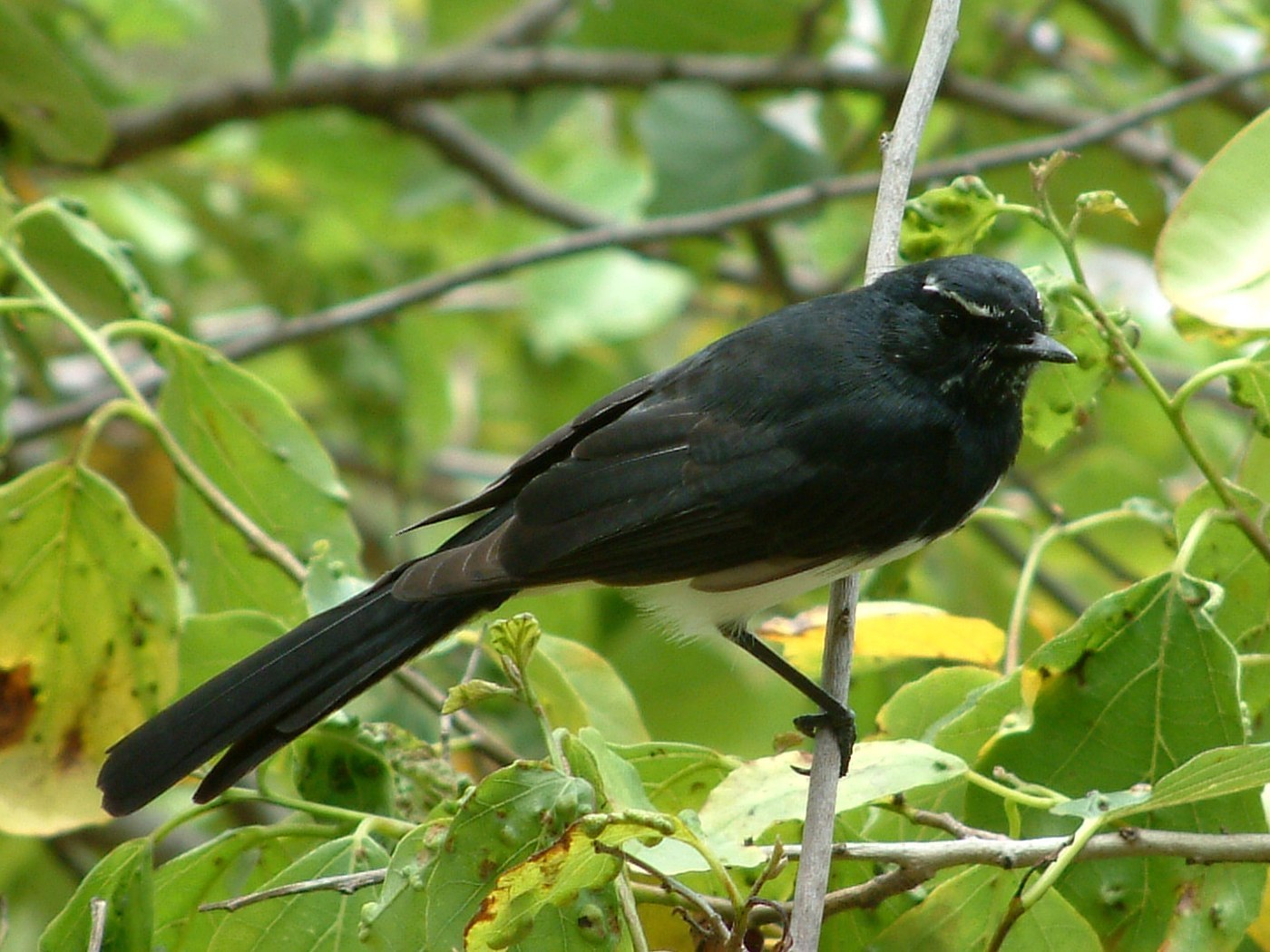
Willie Wagtail
Rhipidura leucophrys
A small, confident black-and-white bird constantly wagging its tail from side to side, well known for its cheerful song and bold habit of mobbing much larger birds.
- Size
- 19-21 cm (7.5-8.5 in) long
- Habitat
- open woodland, farmland, parks, gardens, and areas near water throughout mainland Australia
- Type
- songbird
Spotted a bird like this?
Identify any bird from a photo, free.
Overview
The Willie Wagtail is a small, striking bird, glossy black above with a black throat and breast, a clean white belly, and a thin white eyebrow stripe that gives it an almost quizzical expression. Its most recognizable feature, however, is behavioral rather than plumage-based: the long black tail is almost constantly fanned and swept from side to side as the bird forages, a habit that gives the species its common name.
Despite its small size, the Willie Wagtail is famously bold, frequently seen chasing and harassing much larger birds, including hawks, magpies, and even domestic animals, that venture too close to its territory or nest.
How to identify it
Key field marks
- Glossy black upperparts, throat, and breast
- Clean white belly and undertail
- Thin white eyebrow stripe
- Long black tail almost constantly wagged side to side
- Fine, whisker-like bristles at the base of the bill
Similar species
The Willie Wagtail's combination of size, bold black-and-white pattern, and constant tail-wagging makes it essentially unmistakable within its range; no other small Australian bird shares this exact combination of features. Fantails such as the Grey Fantail are smaller and brown-toned rather than black and white.
Habitat & range
Habitat
Willie Wagtails are highly adaptable, found in open woodland, farmland, parks, gardens, and especially near water bodies including dams, rivers, and wetland edges.
Range
The species is common and widespread across almost the entire Australian mainland, and also occurs in New Guinea, parts of Indonesia, and the Solomon Islands.
Migration
Mostly sedentary, with resident pairs holding territories year-round, though some local movement can occur in response to conditions.
Behavior & voice
Behavior
Willie Wagtails are active, confident foragers, often following livestock, mowers, or people to catch insects disturbed from the ground, and are well known for aggressively mobbing much larger birds, including raptors and corvids, that intrude on their territory.
Voice
The song is a cheerful, repeated "sweet pretty creature" or similar bright, whistled phrase, often sung both day and night, including on moonlit nights.
Feeding
Diet consists almost entirely of insects, caught by aerial sallies from a low perch as well as active foraging on open ground, with the wagging tail thought to help flush hidden prey.
Nesting and breeding
Nests are small, neat cups of grass bound with spider web, built on horizontal branches, fence wires, or other supports. Clutches typically contain three to four pale, speckled eggs, incubated by both parents, with the pair also cooperating to raise and defend the chicks.
Frequently asked questions
Why does the Willie Wagtail wag its tail?
It constantly sweeps its tail from side to side while foraging, a behavior thought to help flush insects from grass and ground litter; the exact function is still debated by researchers.
Why does a Willie Wagtail attack bigger birds?
Willie Wagtails are highly territorial and will boldly mob and chase much larger birds, including hawks and crows, that come too close to their nest or territory.
What does a Willie Wagtail eat?
It feeds almost entirely on insects, caught both in short aerial flights and while foraging actively on the ground.
Where is the Willie Wagtail found?
It is common across almost all of mainland Australia, as well as New Guinea, parts of Indonesia, and the Solomon Islands.
Does the Willie Wagtail sing at night?
Yes, it is known to sing on moonlit nights in addition to its usual daytime singing.
Willie Wagtail guides
In-depth guides for identifying, finding, and understanding Willie Wagtail.
Other birds you may enjoy

Black Redstart
13-14.5 cm (5.1-5.7 in) long, 23-26 cm wingspan

Black-throated Sparrow
12-14 cm (4.7-5.5 in) long, about 19-20 cm (7.5-8 in) wingspan

Greater Bird-of-paradise
Body about 43 cm; males with additional flank plumes up to 50 cm and long tail wires

Blue Tit
11-12 cm (4.3-4.7 in) long, 17-20 cm wingspan

Red-billed Quelea
11.5–13 cm long, wingspan about 20–22 cm
White-plumed Antbird
13-14 cm (5-5.5 in) long

Pyrrhuloxia
19-22 cm (7.5-8.7 in) long, 30 cm wingspan

Blue-gray Tanager
16-18 cm (6-7 in) long

Blackburnian Warbler
11-13 cm (4.3-5.1 in) long, 20-22 cm wingspan

Bluethroat
13-14 cm (5.1-5.5 in) long, 20-22 cm wingspan

Eurasian Nuthatch
12-14.5 cm (4.7-5.7 in) long, 22.5-27 cm wingspan

Wood Thrush
19-21 cm (7.5-8.3 in) long, about 33 cm (13 in) wingspan