
Willie Wagtail Identification Guide
A bold black-and-white Australasian flycatcher known for its constant side-to-side tail-wagging and fearless, chattering nature.
Read the full Willie Wagtail encyclopedia entry →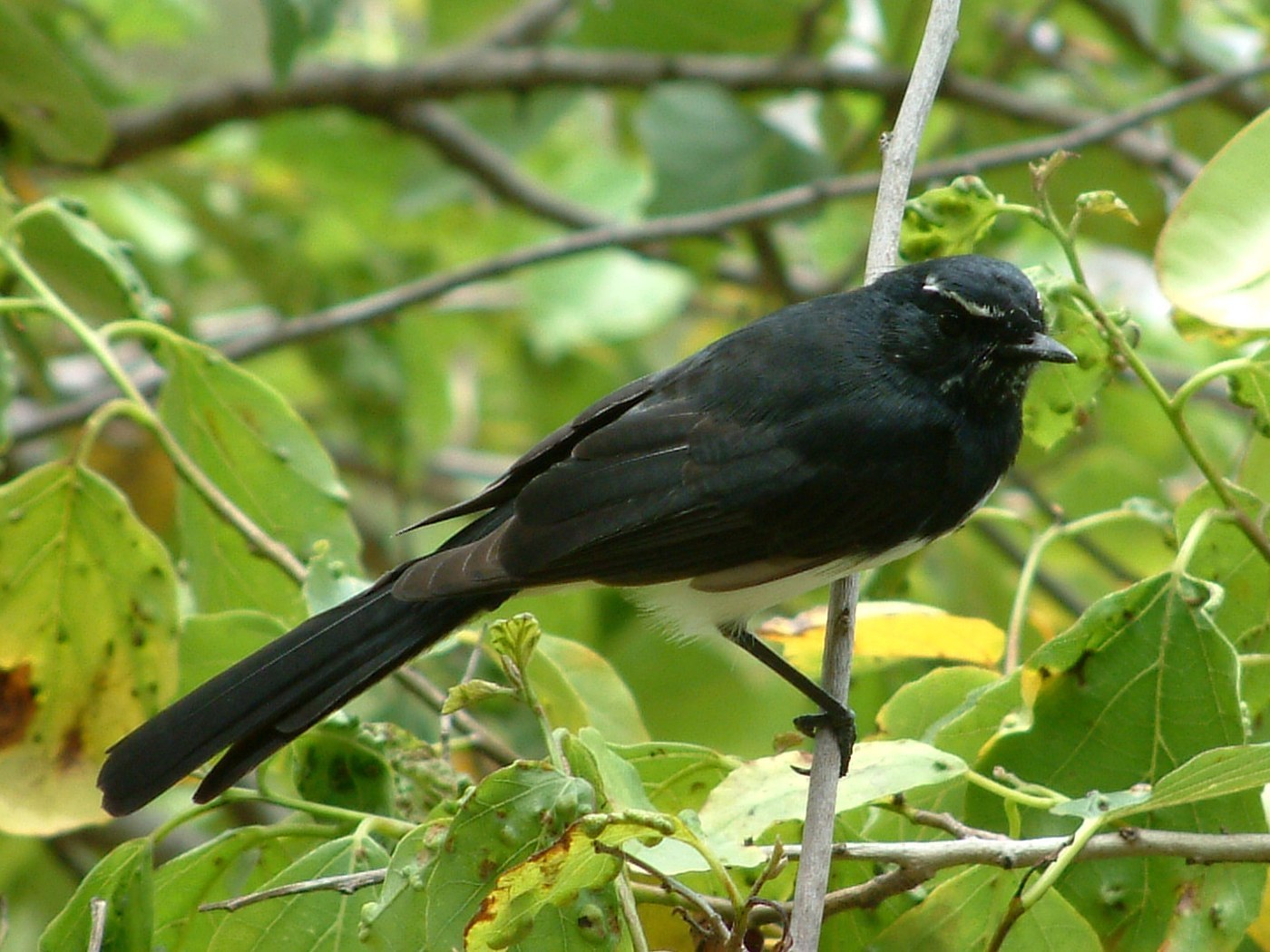
Key Field Marks
- Small (19-21 cm), slender bird with a long, fan-shaped tail almost always held cocked and swishing side to side (not up and down).
- Glossy black upperparts, head, and throat contrast sharply with a clean white belly.
- Distinct white eyebrow (supercilium) and white whisker mark that stand out against the black face.
- Fine black bill, typical of an aerial insect-hawking flycatcher (family Rhipiduridae, the fantails).
- Long black legs; often seen running and darting on the ground as much as flying.
Similar Species
- No other common Australian bird combines the black-and-white pattern with a constantly wagging fan-tail; Magpie-lark (Mudlark) is larger, has a different tail shape, and does not wag its tail side to side.
- Pied butcherbirds and Australian Magpies are much larger with heavier bills and lack the fan-tail-wagging habit.
- In New Guinea and other range areas, other fantails are smaller and browner, lacking the crisp black-and-white pattern.
Habitat & Range
- Found throughout mainland Australia (absent only from the driest deserts and Tasmania), plus New Guinea, the Bismarck Archipelago, and parts of eastern Indonesia and the Solomon Islands.
- Highly adaptable: open woodland, farmland, parks, gardens, wetland edges, and urban areas; often nests close to human dwellings.
- Non-migratory resident across most of its range, though some local movements occur after breeding.
Voice
- A cheerful, chattering "chit-chit-chit-chitty-chit" delivered almost continuously while foraging, plus a scolding rattle when mobbing intruders (including much larger birds or people) near the nest.
- Frequently sings even at night, especially on moonlit nights or near artificial lighting.
Behavior Notes
- Aggressively defends territory and nest, often diving at crows, hawks, or even dogs and humans that stray too close.
- Forages by sallying from low perches or the ground to snatch flying insects, and by running quickly across lawns and bare ground.
Frequently asked questions
Why does the Willie Wagtail wag its tail?
It flicks its fanned tail side to side while foraging, which is thought to help flush insects from grass and foliage so the bird can chase and catch them.
Is the Willie Wagtail related to true wagtails?
No. Despite the name and habit, it is a fantail (family Rhipiduridae), not a true wagtail (family Motacillidae) like the Yellow Wagtail; the resemblance in behavior is convergent.
How can I tell a Willie Wagtail from a Magpie-lark?
The Willie Wagtail is smaller with a long, constantly wagging fan-tail and a fine insect-eating bill, while the Magpie-lark is larger, has a stouter bill, more extensive white in the wings, and does not wag its tail.
Where is the best place to see a Willie Wagtail?
Almost anywhere in Australia outside deserts and Tasmania - they are common in backyards, parks, farmland, and along waterways, often perching low and calling from fences or lawns.