
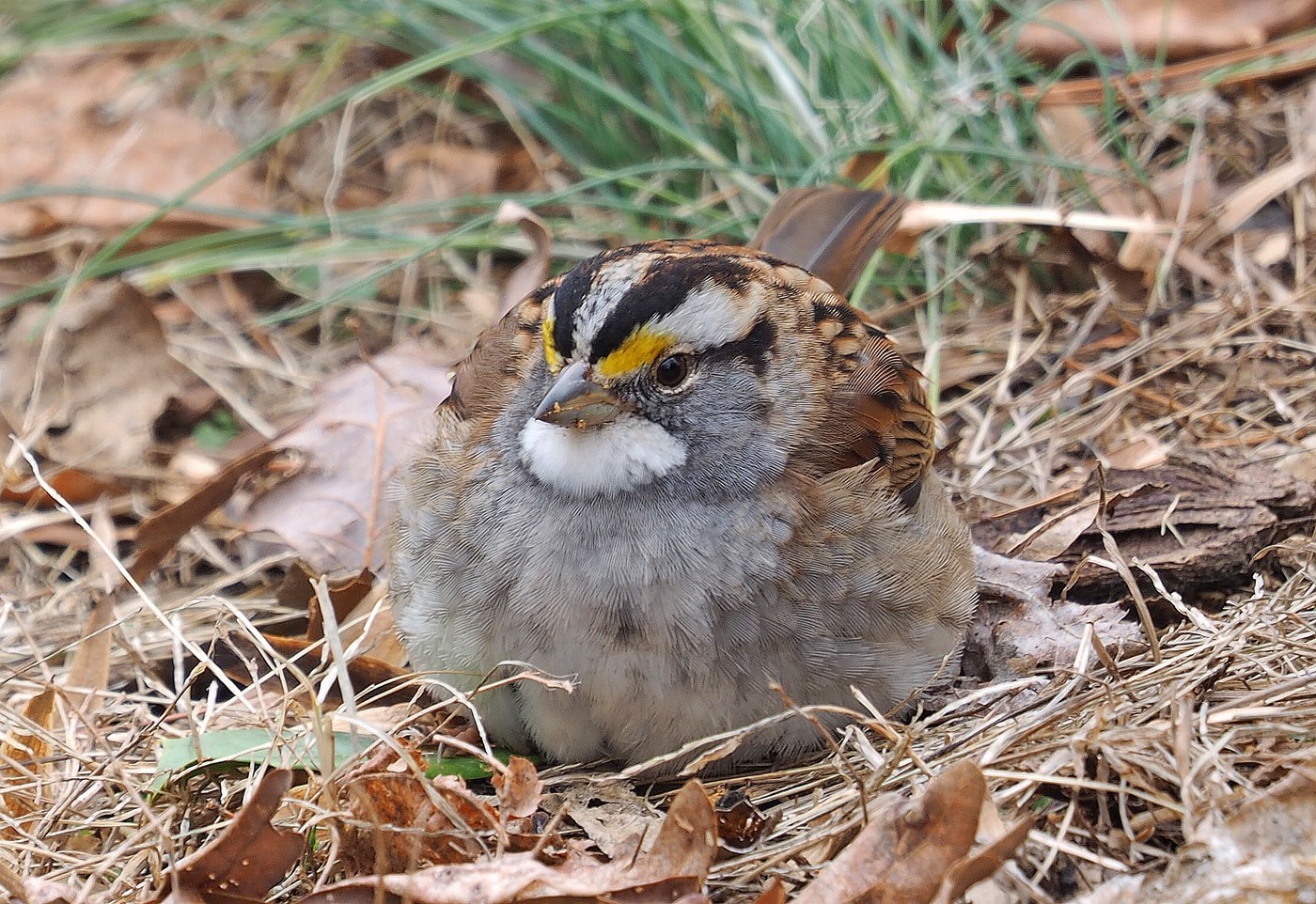
White-throated Sparrow
Zonotrichia albicollis
A large, boldly patterned sparrow with a crisp white throat patch and yellow lores, famous for its whistled "Oh-sweet-Canada" song.
- Size
- 15-19 cm (6-7.5 in) long, 20-23 cm (8-9 in) wingspan
- Habitat
- brushy woodland edges, thickets, and undergrowth in forests
- Type
- songbird
Spotted a bird like this?
Identify any bird from a photo, free.
Overview
The White-throated Sparrow is a large, handsome sparrow of eastern and northern North America, easily recognized by its sharply defined white throat patch and small bright yellow spot between the eye and bill (the lores). It occurs in two color morphs regardless of sex: a white-striped morph with bold black-and-white head stripes, and a tan-striped morph with duller brown-and-tan head stripes; both morphs share the white throat and yellow lores.
This species is a common winter and migratory visitor to yards and woodland edges across much of the eastern and central United States, and it breeds in boreal and mixed forests of Canada and the northern U.S.
How to identify it
Key Field Marks
- Crisp white throat patch bordered by a dark malar stripe
- Small bright yellow spot (lores) between the eye and bill
- Bold head stripes, either black-and-white or tan-and-brown depending on morph
- Grayish breast and unstreaked belly (in adults)
Similar Species
- White-crowned Sparrow: lacks the white throat patch and yellow lores, has a plain gray breast and a pink or yellowish bill, and bold black-and-white crown stripes reaching the bill.
- Song Sparrow: heavily streaked breast with a central spot, unlike the White-throated Sparrow's plain gray breast.
- Fox Sparrow: larger, often more reddish, with heavy chevron streaking on the underparts and no yellow lores.
Habitat & range
Habitat
They favor brushy edges, thickets, and dense understory in and near forests, including woodland edges, overgrown fields, and shrubby gardens, especially during migration and winter.
Range
White-throated Sparrows breed across the boreal forest of Canada and the northeastern and north-central United States, and winter across the eastern and southern United States, generally avoiding the far north in winter.
Migration
They are medium- to long-distance migrants, moving between northern breeding grounds and wintering areas farther south, often arriving at feeders in flocks during fall and remaining through winter.
Behavior & voice
Behavior
White-throated Sparrows often forage on the ground in flocks, scratching through leaf litter with a distinctive double-footed backward hop, and frequently associate with Dark-eyed Juncos in winter.
Voice
The song is a series of clear, thin whistles often rendered as "Oh-sweet-Canada-Canada-Canada" or "Old-Sam-Peabody-Peabody-Peabody," one of the most recognizable songs among North American sparrows.
Feeding
They eat seeds, berries, and insects, foraging mostly on or near the ground in leaf litter and low vegetation, and readily visit feeders offering millet or sunflower seed.
Nesting & Breeding
Nests are built on or near the ground in dense vegetation within boreal and mixed forest habitat, typically containing 3-5 eggs. Interestingly, the white-striped and tan-striped morphs almost always pair with the opposite morph, an unusual mating system tied to differences in behavior and hormones between morphs.
Frequently asked questions
What does the White-throated Sparrow's song sound like?
It is a series of clear whistled notes commonly remembered by the mnemonics "Oh-sweet-Canada-Canada-Canada" or "Old-Sam-Peabody-Peabody-Peabody."
What are the two color morphs of White-throated Sparrow?
There is a white-striped morph with bold black-and-white head stripes and a tan-striped morph with duller brown head stripes; both occur in males and females, and the morphs almost always mate with the opposite morph.
How do you tell White-throated and White-crowned Sparrows apart?
White-throated Sparrows have a defined white throat patch and yellow spot near the bill, while White-crowned Sparrows lack these features and instead show a plain gray breast with a pink or orange bill.
Do White-throated Sparrows visit backyard feeders?
Yes, especially in fall and winter across the eastern and southern U.S., where they forage on the ground beneath feeders for seed.
Where do White-throated Sparrows breed?
They breed in boreal and mixed coniferous-deciduous forests across Canada and the far northeastern and north-central United States.
White-throated Sparrow guides
In-depth guides for identifying, finding, and understanding White-throated Sparrow.
Other birds you may enjoy

Black Redstart
13-14.5 cm (5.1-5.7 in) long, 23-26 cm wingspan

Black-throated Sparrow
12-14 cm (4.7-5.5 in) long, about 19-20 cm (7.5-8 in) wingspan

Greater Bird-of-paradise
Body about 43 cm; males with additional flank plumes up to 50 cm and long tail wires

Blue Tit
11-12 cm (4.3-4.7 in) long, 17-20 cm wingspan

Red-billed Quelea
11.5–13 cm long, wingspan about 20–22 cm
White-plumed Antbird
13-14 cm (5-5.5 in) long

Pyrrhuloxia
19-22 cm (7.5-8.7 in) long, 30 cm wingspan

Blue-gray Tanager
16-18 cm (6-7 in) long

Blackburnian Warbler
11-13 cm (4.3-5.1 in) long, 20-22 cm wingspan

Bluethroat
13-14 cm (5.1-5.5 in) long, 20-22 cm wingspan

Eurasian Nuthatch
12-14.5 cm (4.7-5.7 in) long, 22.5-27 cm wingspan

Wood Thrush
19-21 cm (7.5-8.3 in) long, about 33 cm (13 in) wingspan