
White-crowned Sparrow
Zonotrichia leucophrys
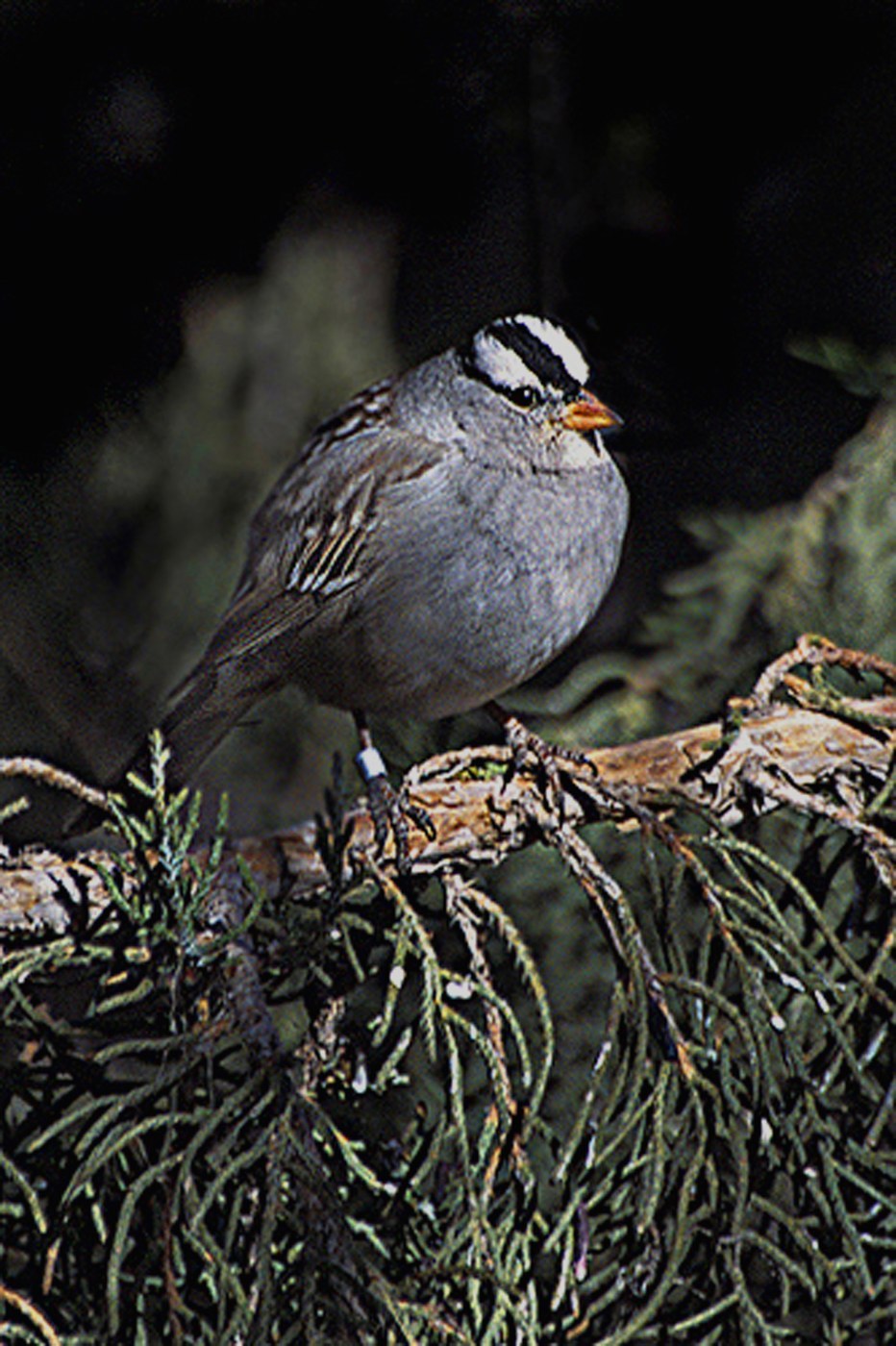
A crisply marked sparrow with bold black-and-white crown stripes, a plain gray breast, and a pink or yellowish bill.
- Size
- 15-18 cm (6-7 in) long, 22-24 cm (8.5-9.5 in) wingspan
- Habitat
- brushy fields, chaparral, tundra edges, and gardens
- Type
- songbird
Spotted a bird like this?
Identify any bird from a photo, free.
Overview
The White-crowned Sparrow is a large, elegant sparrow known for its neat, bold head pattern: alternating black and white stripes running from the bill over the crown to the nape. The face and breast are clean gray, without the streaking found on many other sparrows, and the back and wings are brown with two white wing bars. The bill is typically pink, orange, or yellowish depending on subspecies.
Juveniles and first-winter birds have a similar pattern but with rufous-brown and buffy stripes instead of black and white, gradually acquiring the adult head pattern. The species is common across much of North America during migration and winter, and breeds in the far north and in mountainous or coastal areas of the West.
How to identify it
Key Field Marks
- Bold black-and-white crown stripes reaching down to the bill
- Plain gray face and unstreaked gray breast
- Pink, orange, or yellowish bill (varies by subspecies)
- Brownish back and wings with two white wing bars
Similar Species
- White-throated Sparrow: has a white throat patch and yellow lores, plus a darker, streakier overall look, unlike the White-crowned Sparrow's plain gray breast.
- Golden-crowned Sparrow (western North America): has a yellow crown patch bordered by black, without the crisp white-and-black striping of the White-crowned Sparrow.
- Immature White-crowned Sparrow: shows rufous-brown and buffy head stripes rather than black and white, which can cause confusion with other streak-headed sparrows until learned.
Habitat & range
Habitat
White-crowned Sparrows use brushy and shrubby habitats, including chaparral, forest edges, tundra shrub zones, hedgerows, and weedy fields, as well as gardens during migration and winter.
Range
They breed across the Arctic and subarctic tundra of Canada and Alaska, as well as mountainous and coastal areas of the western United States, and winter across much of the southern and western U.S. and Mexico.
Migration
Most populations are medium- to long-distance migrants, and this species has been an important model for studying orientation and the physiology of migration in songbirds; some western populations are largely resident.
Behavior & voice
Behavior
White-crowned Sparrows often forage in flocks on the ground or in low shrubs, kicking through leaf litter, and they are frequently seen along woodland edges and brushy fields in loose association with other sparrow species.
Voice
The song is a mix of clear whistles followed by buzzy trilled notes, and it varies distinctly by region, forming local "dialects" that have been extensively studied by ornithologists.
Feeding
They primarily eat seeds, along with insects during the breeding season, foraging mostly on the ground in open, brushy areas.
Nesting & Breeding
Nests are built low in shrubs or on the ground, well hidden in vegetation, typically holding 3-5 eggs. This species has been a key subject in research on hormonal and neural control of migratory timing and song learning.
Frequently asked questions
How do White-crowned Sparrows differ from White-throated Sparrows?
White-crowned Sparrows have a plain gray breast and lack the white throat patch and yellow lores of the White-throated Sparrow, and their crown stripes reach all the way to the bill.
Why do White-crowned Sparrow songs vary by region?
The species exhibits regional song dialects, where young birds learn local song variations from neighboring males, resulting in geographically distinct song patterns that have been widely studied.
What color is a White-crowned Sparrow's bill?
It is typically pink, orange, or yellowish, with the exact shade varying somewhat among subspecies and individuals.
Where do White-crowned Sparrows breed?
They breed in Arctic and subarctic tundra across Canada and Alaska, and also in mountainous and coastal scrub habitats of the western United States.
How can you tell an immature White-crowned Sparrow?
Young birds show rufous-brown and buffy head stripes instead of the crisp black-and-white pattern of adults, gradually molting into adult plumage.
White-crowned Sparrow guides
In-depth guides for identifying, finding, and understanding White-crowned Sparrow.
Other birds you may enjoy

Black Redstart
13-14.5 cm (5.1-5.7 in) long, 23-26 cm wingspan

Black-throated Sparrow
12-14 cm (4.7-5.5 in) long, about 19-20 cm (7.5-8 in) wingspan

Greater Bird-of-paradise
Body about 43 cm; males with additional flank plumes up to 50 cm and long tail wires

Blue Tit
11-12 cm (4.3-4.7 in) long, 17-20 cm wingspan

Red-billed Quelea
11.5–13 cm long, wingspan about 20–22 cm
White-plumed Antbird
13-14 cm (5-5.5 in) long

Pyrrhuloxia
19-22 cm (7.5-8.7 in) long, 30 cm wingspan

Blue-gray Tanager
16-18 cm (6-7 in) long

Blackburnian Warbler
11-13 cm (4.3-5.1 in) long, 20-22 cm wingspan

Bluethroat
13-14 cm (5.1-5.5 in) long, 20-22 cm wingspan

Eurasian Nuthatch
12-14.5 cm (4.7-5.7 in) long, 22.5-27 cm wingspan

Wood Thrush
19-21 cm (7.5-8.3 in) long, about 33 cm (13 in) wingspan