
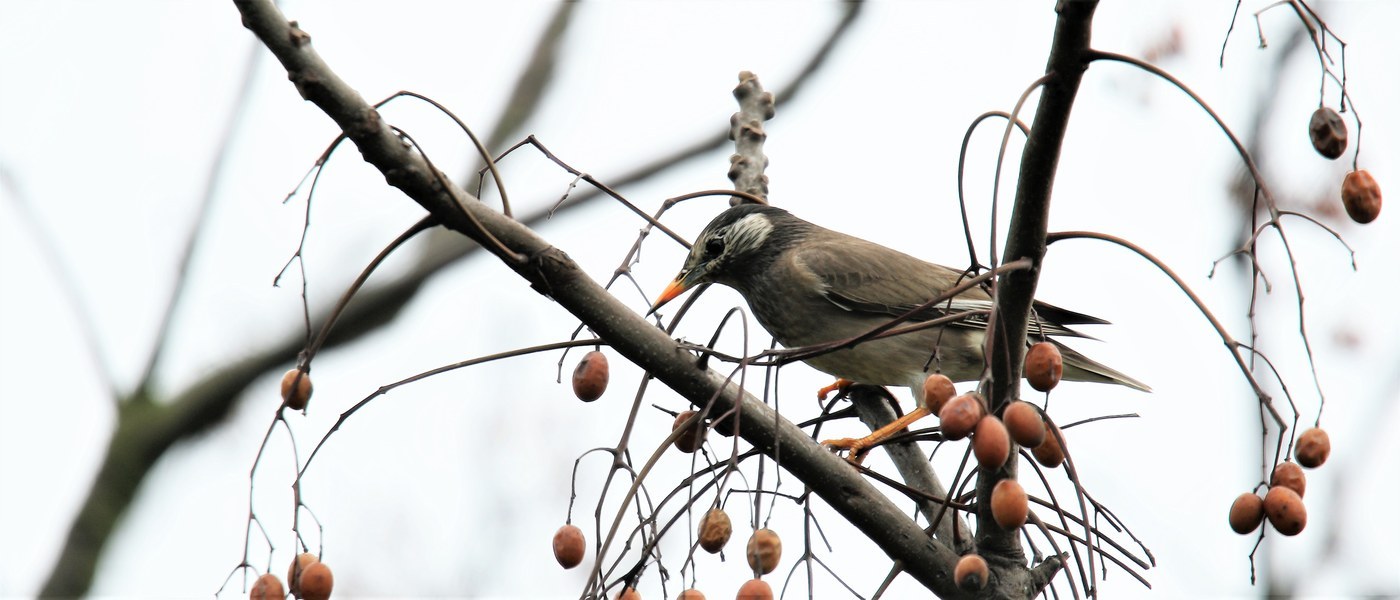
White-cheeked Starling
Spodiopsar cineraceus
A sooty grey-brown starling with a bold white face patch and orange-yellow bill, common in farmland and cities across East Asia.
- Size
- 21-24 cm (8.5-9.5 in) long
- Habitat
- farmland, grassy fields, urban areas, and parks
- Type
- songbird
Spotted a bird like this?
Identify any bird from a photo, free.
Overview
The White-cheeked Starling, also widely known as the Grey Starling, is a medium-sized starling with overall sooty grey-brown plumage. Its face is marked with bold white patches on the forehead, cheeks, and around the base of the bill, giving it a distinctive masked appearance, while the bill and legs are bright orange-yellow. In flight, a whitish rump patch is often visible.
Highly social and adaptable, it is one of the most familiar birds in cities, towns, and farmland across Japan, Korea, and eastern China, often seen in large, noisy flocks foraging on lawns and fields or gathering at communal roosts in the evening.
How to identify it
Key field marks
- Sooty grey-brown body plumage
- Bold white patches on the forehead, lores, and cheeks
- Bright orange-yellow bill and legs
- Pale, whitish rump visible in flight
Similar species
- Common Starling is glossier and more iridescent with a longer, more pointed bill and lacks the bold white face patches.
- Red-billed Starling has a mostly white head with a black mask, differing in pattern.
Habitat & range
Habitat
Uses open farmland, rice paddies, grassy fields, parks, and urban areas, often foraging on lawns and plowed ground.
Range
Widespread across Japan, the Korean Peninsula, and eastern China, with some populations wintering further south into southern China and Taiwan.
Migration
Partially migratory; northern populations move south for winter while many southern populations are resident, and large post-breeding flocks form communal roosts.
Behavior & voice
Behavior
Highly gregarious, foraging in flocks on the ground and gathering in large, noisy communal roosts, sometimes numbering in the thousands, especially in urban trees at dusk.
Voice
A varied mix of harsh chattering, squeaky, and whistled notes, often given by many birds at once at roost sites.
Feeding
Walks on open ground probing for insects and grubs, and also eats fruit, berries, and grain, readily foraging in farmland and urban lawns.
Nesting
Nests in cavities such as tree holes, building eaves, or nest boxes; lays 4-6 pale blue eggs.
Frequently asked questions
How do you identify a White-cheeked Starling?
Look for sooty grey-brown plumage, bold white patches on the face around the bill, and a bright orange-yellow bill and legs.
Why do White-cheeked Starlings gather in such large flocks?
They are highly social and form large communal roosts, especially after the breeding season, often in urban trees, which can number in the thousands.
What does a White-cheeked Starling eat?
Insects and grubs found by probing the ground, along with fruit, berries, and grain.
Where does the White-cheeked Starling live?
In farmland, grassy fields, parks, and urban areas across Japan, Korea, and eastern China.
White-cheeked Starling guides
In-depth guides for identifying, finding, and understanding White-cheeked Starling.
Other birds you may enjoy

Black Redstart
13-14.5 cm (5.1-5.7 in) long, 23-26 cm wingspan

Black-throated Sparrow
12-14 cm (4.7-5.5 in) long, about 19-20 cm (7.5-8 in) wingspan

Greater Bird-of-paradise
Body about 43 cm; males with additional flank plumes up to 50 cm and long tail wires

Blue Tit
11-12 cm (4.3-4.7 in) long, 17-20 cm wingspan

Red-billed Quelea
11.5–13 cm long, wingspan about 20–22 cm
White-plumed Antbird
13-14 cm (5-5.5 in) long

Pyrrhuloxia
19-22 cm (7.5-8.7 in) long, 30 cm wingspan

Blue-gray Tanager
16-18 cm (6-7 in) long

Blackburnian Warbler
11-13 cm (4.3-5.1 in) long, 20-22 cm wingspan

Bluethroat
13-14 cm (5.1-5.5 in) long, 20-22 cm wingspan

Eurasian Nuthatch
12-14.5 cm (4.7-5.7 in) long, 22.5-27 cm wingspan

Wood Thrush
19-21 cm (7.5-8.3 in) long, about 33 cm (13 in) wingspan