
White-cheeked Starling Identification Guide
A chunky East Asian starling with sooty-gray plumage, a pale cheek patch, and a bright orange-yellow bill, usually seen in noisy flocks in farmland and city parks.
Read the full White-cheeked Starling encyclopedia entry →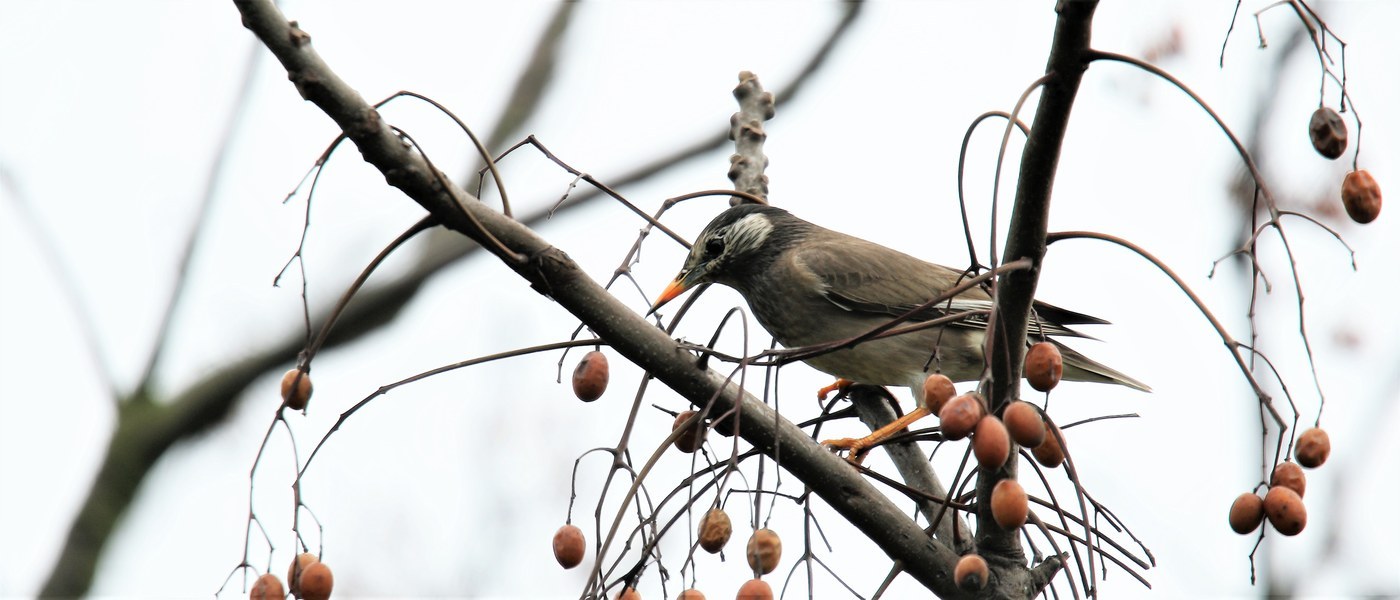
Key Field Marks
- Size & shape: A medium-sized starling, about 24 cm (9.5 in) long, with the typical short-tailed, pointed-billed, chunky starling silhouette.
- Plumage: Overall sooty gray-brown body, darkest on the crown and back, paler gray-brown on the breast and flanks.
- Face pattern: The defining mark is a whitish to pale gray patch on the cheeks and forehead that contrasts with the blackish crown and lores, giving the bird a distinctly "masked" look.
- Bill and legs: Bill is bright orange-yellow with a dark tip; legs are orange to yellowish-orange.
- Wings and tail: Dark wings show a pale gray-white patch near the base of the primaries visible in flight; the tail has a narrow whitish terminal band.
- Sexes: Similar, though females tend to be slightly duller with a less extensive pale cheek patch.
Behavior
- Highly gregarious, forming large, noisy flocks outside the breeding season, often mixing with other starlings and mynas.
- Forages on the ground in open fields, lawns, and plowed land, walking and probing with a slightly waddling gait typical of starlings.
- Roosts communally in large numbers in trees or reedbeds, sometimes numbering in the thousands.
Similar Species
- Red-billed Starling (Spodiopsar sericeus): Has an all-white head and a red (not orange-yellow) bill; ranges overlap in parts of China.
- Common Myna: Larger, with a yellow eye-patch and bare yellow skin around the eye rather than a pale cheek patch, and a mostly dark bill.
- Daurian Starling: Smaller and more glossy with a purple-green sheen and lacks the pale cheek patch.
Habitat & Range
- Breeds across northeastern China, the Korean Peninsula, and Japan.
- Winters in southern China, Taiwan, and parts of Southeast Asia, with vagrants occasionally reaching far-flung locations.
- Favors open country: farmland, rice paddies, orchards, parks, and urban and suburban areas, generally avoiding dense forest.
Voice
- Vocal and chattery, giving a variety of harsh chattering notes, squeaky whistles, and grating calls typical of starlings.
- Flocks produce a constant babble of chirps and rattles, especially at communal roosts in the evening.
Seasonal Notes
- Present year-round in parts of its range but shows clear migratory movement, with birds departing northern breeding grounds in autumn and returning in spring.
- Numbers swell dramatically at wintering sites, where huge pre-roost flocks can be spectacular to watch at dusk.
Frequently asked questions
What is the easiest way to identify a White-cheeked Starling?
Look for a chunky, sooty-gray starling with a pale whitish cheek patch contrasting against a dark crown, paired with a bright orange-yellow bill and legs.
How does the White-cheeked Starling differ from the Red-billed Starling?
Red-billed Starling has an entirely whitish head and a red bill, while White-cheeked Starling shows a dark crown with only the cheeks pale, and an orange-yellow bill.
Where is the best place to see White-cheeked Starlings?
They are common in farmland, rice paddies, and urban parks across Japan, Korea, and eastern China, especially in large foraging or roosting flocks.
Is the White-cheeked Starling migratory?
Yes, populations in the northern part of the range migrate south to winter in southern China, Taiwan, and Southeast Asia, while some populations are more sedentary.
What habitat should I search for this species?
Open, human-modified landscapes such as plowed fields, lawns, orchards, and city parks are most productive, as the species avoids dense forest.