
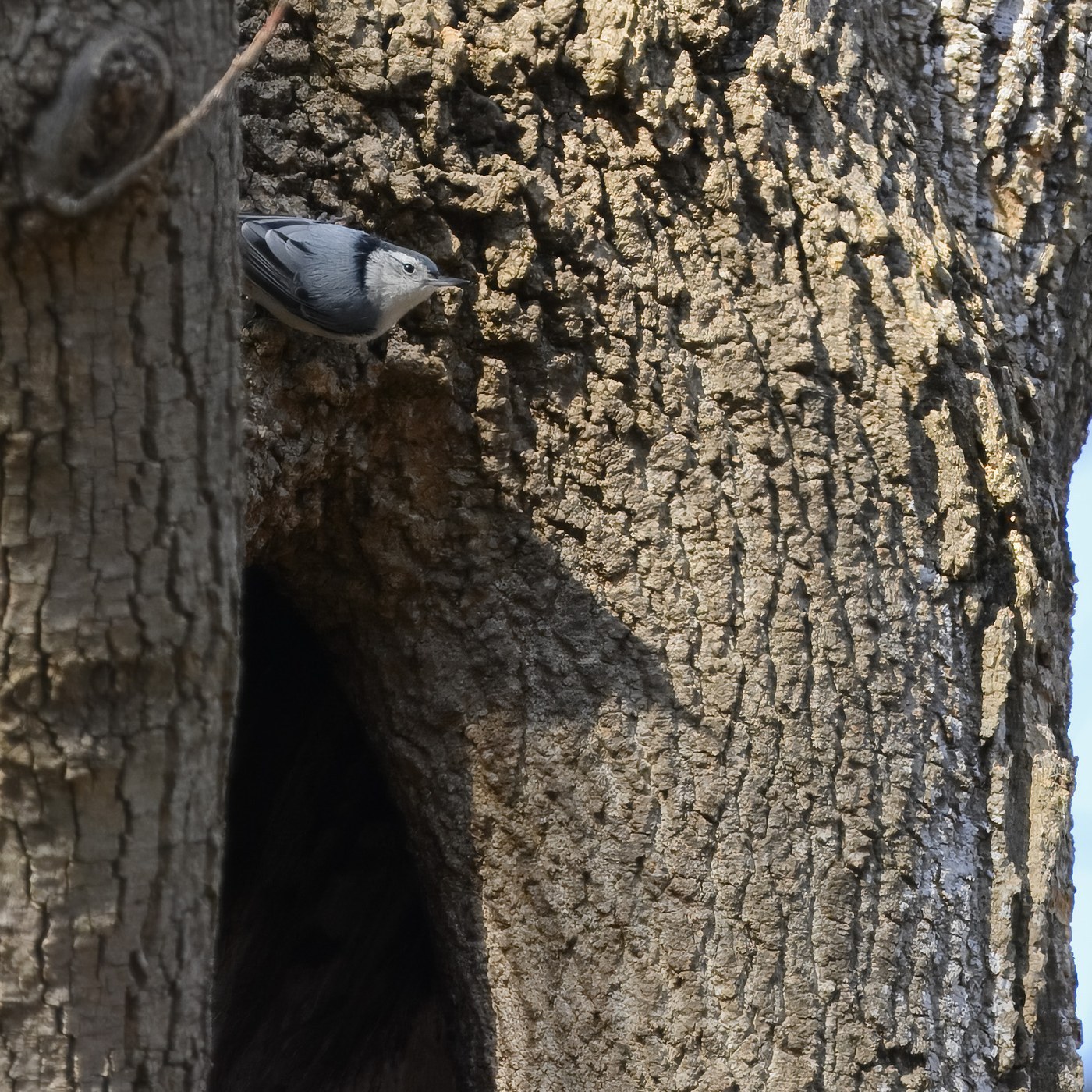
White-breasted Nuthatch
Sitta carolinensis
A compact, short-tailed bird with blue-gray upperparts and white underparts, famous for creeping headfirst down tree trunks.
- Size
- 13-14 cm (5-5.5 in) long, 20-27 cm (8-11 in) wingspan
- Habitat
- deciduous and mixed forests, woodland edges, parks, and gardens with mature trees
- Type
- songbird
Spotted a bird like this?
Identify any bird from a photo, free.
Overview
The White-breasted Nuthatch is a small, stocky woodland bird notable for its habit of moving down tree trunks headfirst, a behavior unusual among birds that lets it inspect bark crevices from a different angle than upward-climbing species like woodpeckers and creepers. It has blue-gray upperparts, a black cap (in males) or gray-black cap (in females), and clean white underparts and face, with rusty coloring on the lower flanks and undertail.
Its body is compact with almost no visible neck, a long straight bill, and a short tail, giving it a distinctive, top-heavy silhouette as it clings to bark.
How to identify it
Key Field Marks
- Blue-gray back, black or gray-black cap, and white face and underparts
- Rusty wash on the lower flanks and undertail coverts
- Long, straight, slightly upturned bill
- Habit of creeping down tree trunks headfirst
Similar Species
- Red-breasted Nuthatch: smaller, with a black eye-line bordered by white eyebrow stripes and rusty-orange (not just flank) underparts, and prefers coniferous forest.
- Brown-headed Nuthatch (southeastern pine forests): smaller, with a brown cap instead of black, and found specifically in pine woodlands.
- Black-and-white Warbler: also creeps on bark, but is smaller and boldly striped black-and-white overall, without the nuthatch's plain gray back.
Habitat & range
Habitat
White-breasted Nuthatches favor mature deciduous and mixed forests, especially those with large trees, as well as woodland edges, parks, and wooded residential areas.
Range
They are widespread and resident across most of the United States and southern Canada, extending south in mountainous areas into Mexico.
Migration
White-breasted Nuthatches are non-migratory and defend year-round territories, though they may join mixed-species winter flocks and occasionally wander short distances when food is scarce.
Behavior & voice
Behavior
Nuthatches are agile, acrobatic climbers, moving both up and down tree trunks and along the undersides of branches, most notably descending headfirst while probing bark crevices for food.
Voice
The common call is a nasal, repeated "yank-yank-yank," often described as tin-horn-like; the song is a series of rapid, low whistled notes.
Feeding
They eat insects and spiders gleaned from bark, as well as seeds and nuts, and are famous for wedging large nuts and seeds into bark crevices and hammering them open (giving rise to the name "nuthatch," from "nut hack"). They also cache food for later retrieval.
Nesting & Breeding
White-breasted Nuthatches nest in tree cavities, either natural or old woodpecker holes, lined with fur, feathers, and bark shreds. They typically lay 5-9 eggs, and pairs often remain together and defend a territory year-round.
Frequently asked questions
Why do White-breasted Nuthatches climb down trees headfirst?
Descending headfirst allows them to spot insects and food hidden in bark crevices from an angle different from birds that climb upward, such as woodpeckers, reducing competition for the same food resources.
Where does the name 'nuthatch' come from?
It derives from the bird's habit of wedging nuts and large seeds into bark crevices and hacking them open with its bill, originally called a "nuthack."
Do White-breasted Nuthatches migrate?
No, they are non-migratory and typically remain on the same territory throughout the year.
What does a White-breasted Nuthatch sound like?
Its most common call is a nasal, repetitive "yank-yank-yank," often likened to a small tin horn.
Where do White-breasted Nuthatches nest?
They nest in tree cavities, using natural holes or abandoned woodpecker cavities, lined with fur, feathers, and bark fragments.
White-breasted Nuthatch guides
In-depth guides for identifying, finding, and understanding White-breasted Nuthatch.
Other birds you may enjoy

Black Redstart
13-14.5 cm (5.1-5.7 in) long, 23-26 cm wingspan

Black-throated Sparrow
12-14 cm (4.7-5.5 in) long, about 19-20 cm (7.5-8 in) wingspan

Greater Bird-of-paradise
Body about 43 cm; males with additional flank plumes up to 50 cm and long tail wires

Blue Tit
11-12 cm (4.3-4.7 in) long, 17-20 cm wingspan

Red-billed Quelea
11.5–13 cm long, wingspan about 20–22 cm
White-plumed Antbird
13-14 cm (5-5.5 in) long

Pyrrhuloxia
19-22 cm (7.5-8.7 in) long, 30 cm wingspan

Blue-gray Tanager
16-18 cm (6-7 in) long

Blackburnian Warbler
11-13 cm (4.3-5.1 in) long, 20-22 cm wingspan

Bluethroat
13-14 cm (5.1-5.5 in) long, 20-22 cm wingspan

Eurasian Nuthatch
12-14.5 cm (4.7-5.7 in) long, 22.5-27 cm wingspan

Wood Thrush
19-21 cm (7.5-8.3 in) long, about 33 cm (13 in) wingspan