
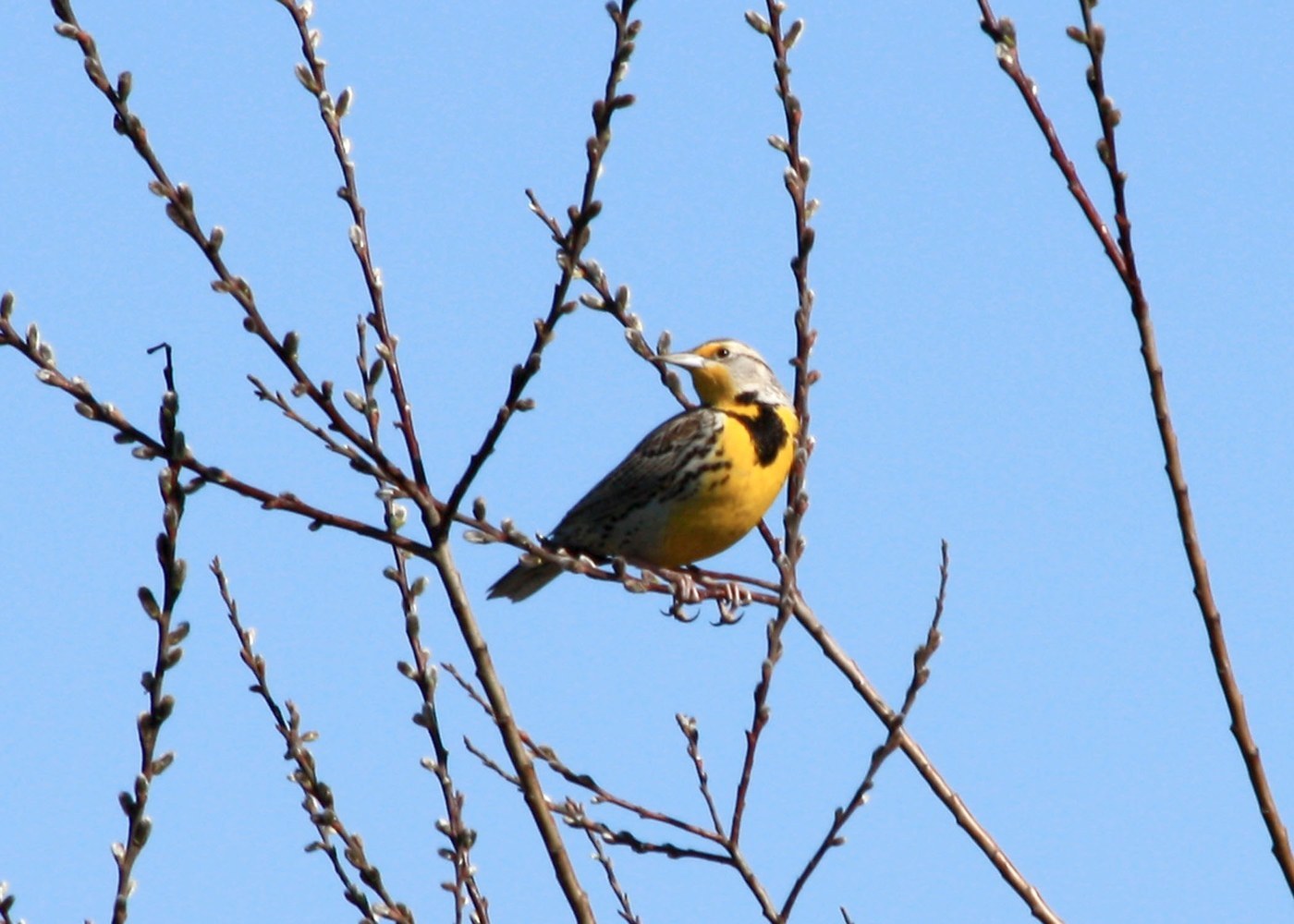
Western Meadowlark
Sturnella neglecta
The state bird of six U.S. states, prized for its rich, bubbling, flute-like song delivered across open western grasslands.
- Size
- 19-26 cm (7.5-10.2 in) long, 35-40 cm wingspan
- Habitat
- grasslands, prairies, farmland, and open sagebrush country
- Type
- songbird
Spotted a bird like this?
Identify any bird from a photo, free.
Overview
The Western Meadowlark is a stocky, ground-loving grassland songbird nearly identical in appearance to its eastern counterpart, with a bright yellow breast crossed by a bold black V and camouflaged brown, black, and buff upperparts. It is best distinguished from the Eastern Meadowlark by its song and, more subtly, by slightly paler overall coloration and more yellow extending onto the malar (cheek) region.
Renowned for its rich, complex, flute-like song, the Western Meadowlark is the official state bird of six U.S. states, more than any other species, reflecting its familiarity and popularity across the American West and Great Plains.
How to identify it
Key Field Marks
- Bright yellow throat and breast with a bold black V-shaped bib
- Mottled brown, black, and buff upperparts providing camouflage
- White outer tail feathers flashed in flight
- Yellow extending slightly onto the cheek (malar) area, more so than Eastern Meadowlark
- Stiff-winged, fluttering flight low over open ground
Similar Species
- Eastern Meadowlark is nearly identical in plumage; the most reliable distinction is voice, with Western giving a more complex, gurgling, flute-like song versus the Eastern's clear, slurred whistle.
- Where ranges overlap on the Great Plains, hybridization is rare because the species recognize each other primarily by song.
Habitat & range
Habitat
Western Meadowlarks inhabit open grasslands, prairies, agricultural fields, and sagebrush steppe, generally favoring drier habitats than the Eastern Meadowlark.
Range
Found throughout western and central North America, from southern Canada through the western and central United States into central Mexico.
Migration
Northern and high-elevation populations migrate south for winter, while many populations in milder regions are year-round residents.
Behavior & voice
Behavior
Western Meadowlarks forage on the ground, walking steadily through grass while probing for food, and often perch conspicuously on fence posts, shrubs, or utility wires to sing. Flight is a series of stiff, shallow wingbeats interspersed with short glides.
Voice
The song is a rich, complex, bubbling series of flute-like notes, often described as more melodious and varied than the Eastern Meadowlark's simpler whistle. A sharp chuck call is given year-round.
Feeding
Diet consists mainly of insects such as grasshoppers, crickets, and beetles during the breeding season, shifting to seeds and grain in fall and winter.
Nesting & Breeding
The female builds a domed, grass-woven ground nest, often with a roofed entrance tunnel, hidden within dense grass cover. She incubates 3-7 eggs alone; males are often polygynous, defending territories that may include more than one nesting female.
Frequently asked questions
What is the difference between a Western and Eastern Meadowlark?
They look almost identical, but the Western Meadowlark's song is a rich, gurgling, flute-like series of notes, distinctly different from the Eastern's simpler, clear whistle; song is the most reliable field mark.
Why is the Western Meadowlark a state bird for so many states?
Its cheerful, distinctive song and widespread presence across open grasslands and farmland made it a popular, easily recognized choice, leading six U.S. states to adopt it as their official state bird.
What does a Western Meadowlark eat?
It mainly eats insects like grasshoppers and beetles in summer, switching to seeds and waste grain in winter.
Where do Western Meadowlarks build their nests?
They build a domed, grass-woven nest directly on the ground, often with a woven tunnel entrance, hidden in dense grassland vegetation.
Are Western Meadowlark populations declining?
While still widespread, populations have declined in parts of their range due to loss of native grassland habitat to agriculture and development.
Western Meadowlark guides
In-depth guides for identifying, finding, and understanding Western Meadowlark.
Other birds you may enjoy

Black Redstart
13-14.5 cm (5.1-5.7 in) long, 23-26 cm wingspan

Black-throated Sparrow
12-14 cm (4.7-5.5 in) long, about 19-20 cm (7.5-8 in) wingspan

Greater Bird-of-paradise
Body about 43 cm; males with additional flank plumes up to 50 cm and long tail wires

Blue Tit
11-12 cm (4.3-4.7 in) long, 17-20 cm wingspan

Red-billed Quelea
11.5–13 cm long, wingspan about 20–22 cm
White-plumed Antbird
13-14 cm (5-5.5 in) long

Pyrrhuloxia
19-22 cm (7.5-8.7 in) long, 30 cm wingspan

Blue-gray Tanager
16-18 cm (6-7 in) long

Blackburnian Warbler
11-13 cm (4.3-5.1 in) long, 20-22 cm wingspan

Bluethroat
13-14 cm (5.1-5.5 in) long, 20-22 cm wingspan

Eurasian Nuthatch
12-14.5 cm (4.7-5.7 in) long, 22.5-27 cm wingspan

Wood Thrush
19-21 cm (7.5-8.3 in) long, about 33 cm (13 in) wingspan