
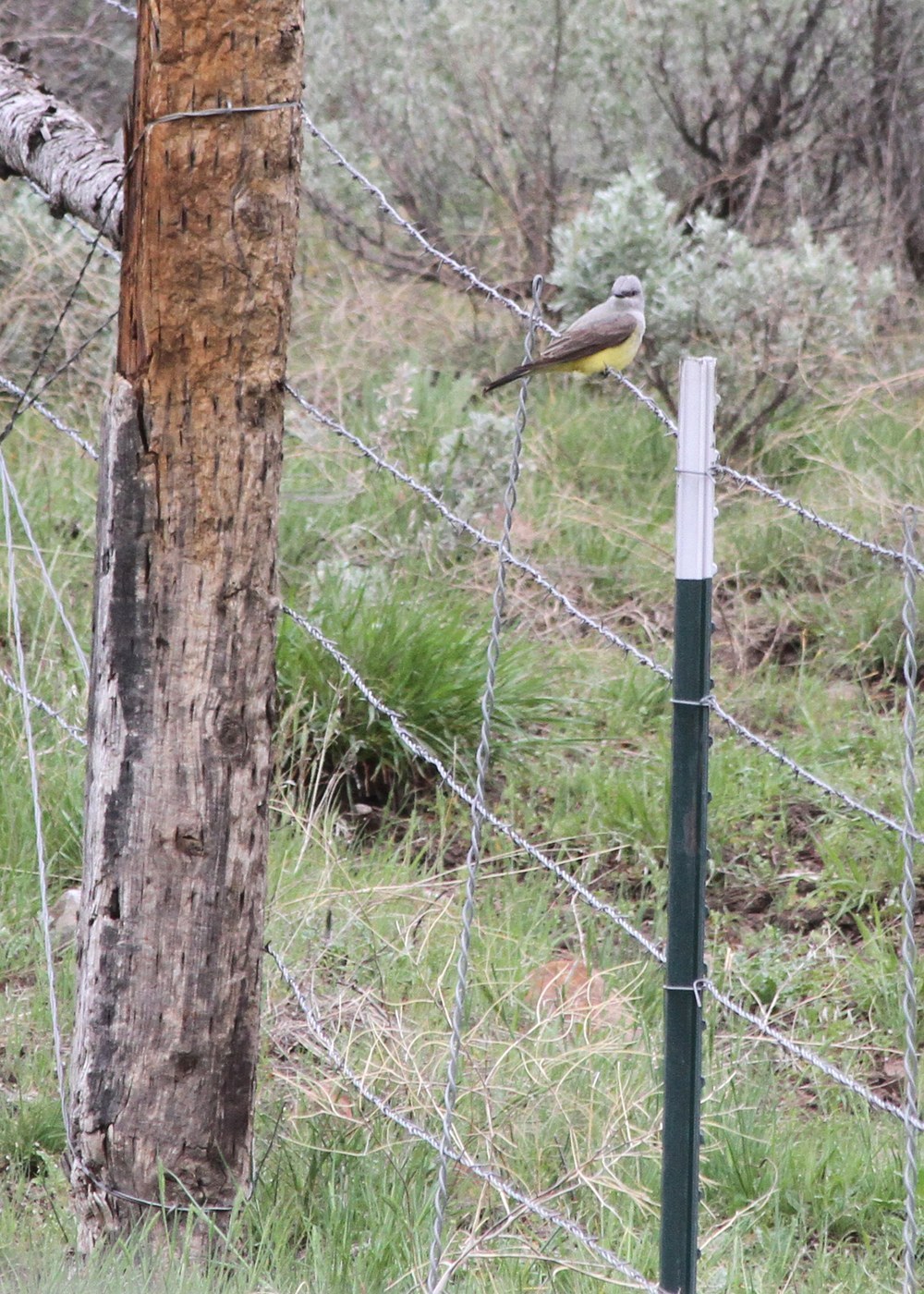
Western Kingbird
Tyrannus verticalis
A pale gray-headed, lemon-bellied flycatcher commonly seen perched on wires and fence posts across open western landscapes.
- Size
- 20-23 cm (8-9 in) long, 38-41 cm wingspan
- Habitat
- open country, farmland, roadsides, and towns across the western and central United States
- Type
- songbird
Spotted a bird like this?
Identify any bird from a photo, free.
Overview
The Western Kingbird is a familiar, conspicuous flycatcher of open country across the western and central United States, easily recognized by its pale gray head and breast contrasting with a bright lemon-yellow belly, set off by a blackish tail with white outer edges. Like other kingbirds, it is a bold and territorial defender of its nest site, often seen chasing crows, hawks, and other birds away from its territory.
Highly adaptable, this species has thrived alongside human development, readily nesting on utility poles, buildings, and roadside trees, and is one of the most commonly seen flycatchers along rural highways in the West.
How to identify it
Key Field Marks
- Pale ashy-gray head and breast contrasting with a bright yellow belly
- Blackish tail with white outer edges (unlike the white terminal band of the Eastern Kingbird)
- Greenish-gray back
- Concealed reddish-orange crown patch, rarely visible
Similar Species
- Cassin's Kingbird is darker overall with a more contrasting white chin and lacks the white outer tail edges, having a pale terminal tail band instead.
- Eastern Kingbird has blackish upperparts, white (not yellow) underparts, and a white-tipped tail rather than white outer edges.
- Ash-throated Flycatcher is smaller with a browner back, rufous in the tail, and a pale throat, lacking the gray hood of the kingbird.
Habitat & range
Western Kingbirds breed across open habitats of the western and central United States and southwestern Canada, including grasslands, farmland, ranches, and towns, typically where scattered trees, utility poles, or structures provide nesting and perching sites. They are absent from dense forest and high mountains.
The species winters primarily in Central America, migrating south in late summer and early fall, with a notable pattern of some individuals wandering to the eastern United States during migration.
Behavior & voice
Voice
Gives sharp, twittering calls and a buzzy, chattering dawn song of rapid pip-pip-pip-kip-kip-kadeer phrases, especially vocal during territorial disputes.
Feeding
Sallies from an exposed perch such as a wire or fence post to catch flying insects, sometimes hovering briefly; also eats some berries, particularly outside the breeding season.
Nesting
Builds a bulky cup nest of twigs, grass, and debris, often lined with soft materials, placed in a tree, on a utility pole, or on a building ledge; aggressively defends the nest area against intruders, including much larger birds.
Frequently asked questions
How do I identify a Western Kingbird?
Look for a flycatcher with a pale gray head and breast, bright yellow belly, and a blackish tail with white outer edges, often perched on wires in open country.
How is the Western Kingbird different from the Eastern Kingbird?
The Western Kingbird has a yellow belly and gray head, while the Eastern Kingbird has white underparts, blackish upperparts, and a white-tipped (not white-edged) tail.
Where do Western Kingbirds nest?
They commonly nest in trees, on utility poles, or on building ledges in open country, farmland, and towns across the western and central U.S.
Do Western Kingbirds migrate?
Yes, they winter mainly in Central America and migrate north to breed across the western and central United States each spring.
Western Kingbird guides
In-depth guides for identifying, finding, and understanding Western Kingbird.
Other birds you may enjoy

Black Redstart
13-14.5 cm (5.1-5.7 in) long, 23-26 cm wingspan

Black-throated Sparrow
12-14 cm (4.7-5.5 in) long, about 19-20 cm (7.5-8 in) wingspan

Greater Bird-of-paradise
Body about 43 cm; males with additional flank plumes up to 50 cm and long tail wires

Blue Tit
11-12 cm (4.3-4.7 in) long, 17-20 cm wingspan

Red-billed Quelea
11.5–13 cm long, wingspan about 20–22 cm
White-plumed Antbird
13-14 cm (5-5.5 in) long

Pyrrhuloxia
19-22 cm (7.5-8.7 in) long, 30 cm wingspan

Blue-gray Tanager
16-18 cm (6-7 in) long

Blackburnian Warbler
11-13 cm (4.3-5.1 in) long, 20-22 cm wingspan

Bluethroat
13-14 cm (5.1-5.5 in) long, 20-22 cm wingspan

Eurasian Nuthatch
12-14.5 cm (4.7-5.7 in) long, 22.5-27 cm wingspan

Wood Thrush
19-21 cm (7.5-8.3 in) long, about 33 cm (13 in) wingspan