
Western Kingbird Identification Guide
The Western Kingbird is a pale grey-headed flycatcher of open western landscapes, told by its ashy-grey upperparts, lemon-yellow belly, black tail with white outer edges, and habit of perching conspicuously on wires.
Read the full Western Kingbird encyclopedia entry →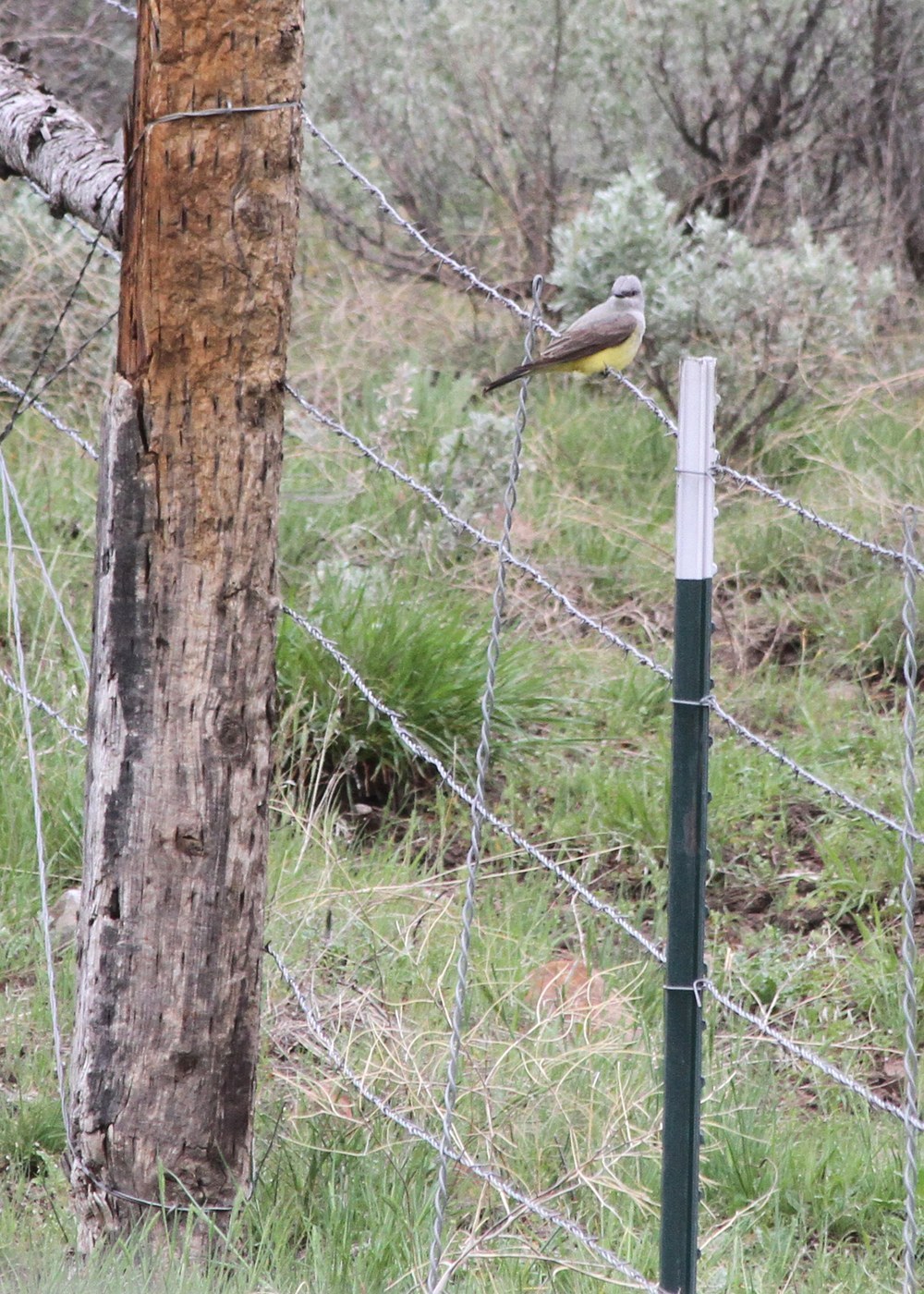
Key Field Marks
- Size and shape: A medium-sized, upright flycatcher (about robin-sized) with a fairly large head, straight thin bill, and a squared-off tail — the classic kingbird silhouette, often seen perched boldly on wires, fences, and treetops.
- Head and upperparts: Pale ashy-grey head and back, with a darker grey-brown wash on the wings.
- Underparts: Pale grey throat and breast grading into a bright lemon-yellow belly and undertail — a key mark visible even in flight or backlit views.
- Tail: Black, squared, with crisp white outer edges (white confined to the edges, not forming a full terminal band) — a critical mark separating it from Cassin's Kingbird.
- Behavior: Highly conspicuous, perching in the open on wires, fence posts, and dead branches to sally out after flying insects. Aggressively mobs hawks, crows, and other large birds near the nest, and often sings from an exposed perch at dawn.
Similar Species
- Cassin's Kingbird: Darker olive-grey overall, with a whitish (not blackish) tail lacking sharp white edges, and a whitish chin contrasting more with a darker breast; voice is a more strident "ka-KEER" versus the Western's chattering call.
- Eastern Kingbird: Blackish above with entirely white underparts (no yellow belly) and a bold white terminal tail band rather than white edges.
- Tropical/Couch's Kingbird: Brighter yellow below with a notched (not squared) tail and a larger bill; ranges barely overlap with Western Kingbird except in the southern borderlands.
Where and When to Look
Breeds widely across open country of the western and central United States and southwestern Canada — grasslands, farmland, savanna, and increasingly towns and roadsides, wherever scattered trees, poles, or wires provide nest sites and hunting perches. A long-distance migrant, wintering mainly in Mexico and Central America (with a growing number wintering in Florida), it arrives on the breeding grounds in April–May and departs by September, giving a clear spring-through-summer window across most of its range.
Voice
A sharp, chattering "pik-pik-pik-pikeer" or a rapid, twittering series of buzzy notes, often delivered from a wire perch; the dawn song is a more sustained, tumbling twitter given in flight.
Frequently asked questions
What's the easiest field mark for Western Kingbird?
A pale grey head and breast contrasting with a bright yellow belly, paired with a black tail that has clean white outer edges.
How do I tell Western Kingbird from Cassin's Kingbird?
Western Kingbird has a blacker tail with crisp white edges and a paler grey head, while Cassin's Kingbird has a duller whitish tail without sharp white edges and a darker olive-grey head with a whiter chin.
Does Western Kingbird have yellow underparts like Eastern Kingbird?
Western Kingbird has a yellow belly, while Eastern Kingbird is white below with no yellow at all — that alone separates the two.
Where is the best habitat to find Western Kingbirds?
Open country with scattered perches — farmland, grasslands, roadsides, and small towns — across the western and central United States in summer.
When do Western Kingbirds arrive on their breeding grounds?
Typically April to May, departing again for wintering grounds in Mexico and Central America by September.