
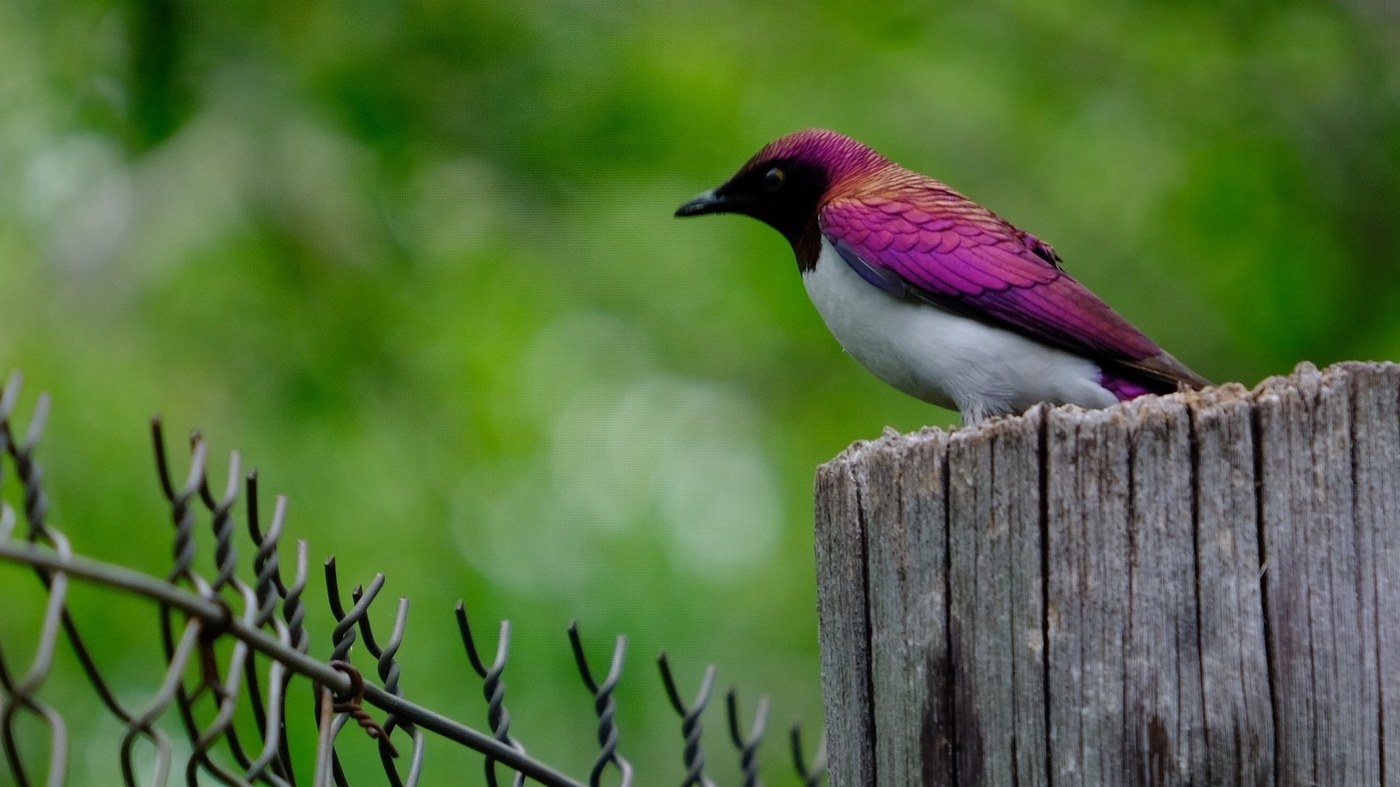
Violet-backed Starling
Cinnyricinclus leucogaster
A small African starling with a striking sexual difference: males glow amethyst-violet while females are streaky brown and white.
- Size
- 17–18 cm long
- Habitat
- Woodland, savanna edges, riverine forest, and forest clearings
- Type
- songbird
Spotted a bird like this?
Identify any bird from a photo, free.
Overview
The Violet-backed Starling is a small, strongly dimorphic starling found across sub-Saharan Africa. Males are among the most striking starlings on the continent, with head, back, and breast washed in an iridescent amethyst-violet that can appear almost metallic pink or purple depending on the light, sharply set off by a clean white belly.
Females look entirely different: brown above with heavy dark streaking, and white below with brown streaks, resembling a large, streaky thrush more than a starling.
How to identify it
Key field marks
- Small, compact starling with a short tail
- Adult male: iridescent violet-purple head, back and throat contrasting with a bright white belly
- Adult female: brown and heavily streaked above and below, unlike any other starling in range
- Juveniles resemble females
Similar species
No other African starling shows the male's violet-and-white pattern, making adult males unmistakable. Females can be confused with thrushes or other streaked brown birds, but the compact starling shape and typically arboreal, fruit-eating habits help distinguish them.
Habitat & range
Habitat and range
This species is widespread across sub-Saharan Africa, from Senegal east to Ethiopia and south to South Africa, generally avoiding dense rainforest and arid deserts. It favors broadleaf woodland, savanna edges, riverine growth, and clearings with scattered fruiting trees.
Migration
Some populations are resident while others are partial migrants or nomadic, moving seasonally in response to fruiting trees and rainfall patterns.
Behavior & voice
Behavior
Violet-backed Starlings are usually seen alone, in pairs, or small family groups, often perched high in trees. They can gather in larger numbers at abundant fruiting trees.
Voice
The song is a soft, warbling series of whistles and chattering notes, quieter and less harsh than many other starlings.
Feeding
They feed mainly on fruit and berries taken in the canopy, supplemented with insects caught by sallying from a perch.
Nesting and breeding
Pairs nest in natural tree cavities or old woodpecker holes, lining the cavity with leaves and other soft material. Clutches typically contain 2–4 eggs.
Frequently asked questions
Why do male and female Violet-backed Starlings look so different?
The species shows strong sexual dimorphism: males are iridescent violet and white to attract mates, while females have cryptic brown streaked plumage that provides camouflage while nesting.
What is another name for the Violet-backed Starling?
It is also commonly called the Plum-coloured Starling or Amethyst Starling.
Where does the Violet-backed Starling live?
It occurs across sub-Saharan Africa in woodland, savanna edges, and riverine habitats.
What does the Violet-backed Starling eat?
Mainly fruit and berries, supplemented by insects caught in flight.
Violet-backed Starling guides
In-depth guides for identifying, finding, and understanding Violet-backed Starling.
Other birds you may enjoy

Black Redstart
13-14.5 cm (5.1-5.7 in) long, 23-26 cm wingspan

Black-throated Sparrow
12-14 cm (4.7-5.5 in) long, about 19-20 cm (7.5-8 in) wingspan

Greater Bird-of-paradise
Body about 43 cm; males with additional flank plumes up to 50 cm and long tail wires

Blue Tit
11-12 cm (4.3-4.7 in) long, 17-20 cm wingspan

Red-billed Quelea
11.5–13 cm long, wingspan about 20–22 cm
White-plumed Antbird
13-14 cm (5-5.5 in) long

Pyrrhuloxia
19-22 cm (7.5-8.7 in) long, 30 cm wingspan

Blue-gray Tanager
16-18 cm (6-7 in) long

Blackburnian Warbler
11-13 cm (4.3-5.1 in) long, 20-22 cm wingspan

Bluethroat
13-14 cm (5.1-5.5 in) long, 20-22 cm wingspan

Eurasian Nuthatch
12-14.5 cm (4.7-5.7 in) long, 22.5-27 cm wingspan

Wood Thrush
19-21 cm (7.5-8.3 in) long, about 33 cm (13 in) wingspan