
Violet-backed Starling Identification Guide
A small African starling whose male gleams amethyst-violet above with a clean white belly, while the female is an entirely different brown, heavily streaked bird.
Read the full Violet-backed Starling encyclopedia entry →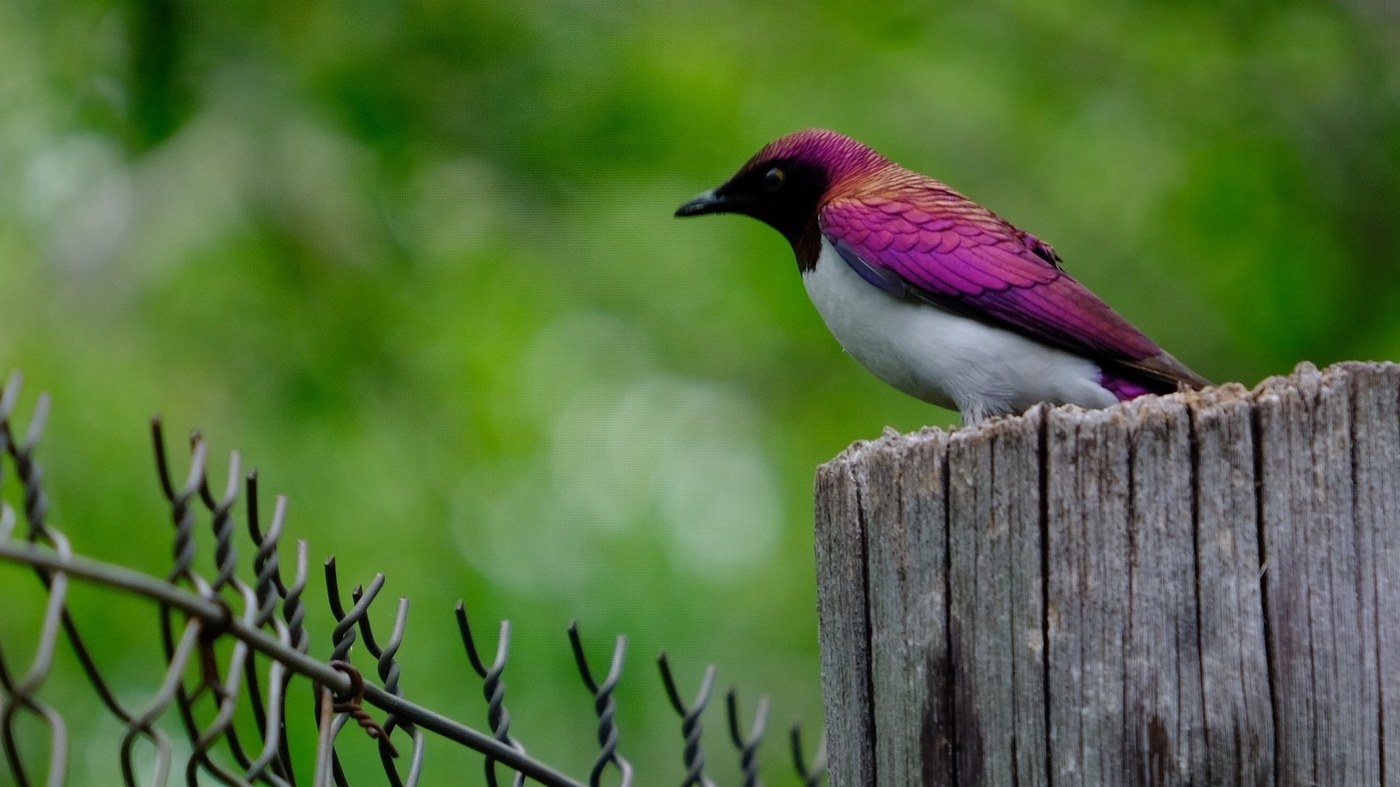
Key Field Marks
- Size & shape: A small starling, more compact and slender than many of its relatives, with a fairly short tail and a straight, pointed bill.
- Adult male: Brilliant, iridescent violet-amethyst covering the head, back, throat, and upper breast, sharply demarcated from a clean white lower breast and belly — a striking, two-tone pattern.
- Adult female / immature: Completely different from the male — brown above with dense white or buffy streaking below, giving a thrush-like appearance rather than a typical starling look.
- Behavior: Often seen in pairs or small groups in woodland canopy, sallying for fruit and insects; less terrestrial than many starlings.
Separating Violet-backed Starling from Similar Species
- Male: Essentially unmistakable — no other African starling combines a fully violet-amethyst upperbody with a crisp white belly.
- Female: Easily overlooked or misidentified as a thrush or other streaky brown bird due to its heavily streaked underparts; the starling's bill shape, posture, and presence of an accompanying male are the best clues.
Where & When to See One
Widespread across woodland, savanna, and forest-edge habitats throughout sub-Saharan Africa. A largely resident species in much of its range, though some populations show local or seasonal movements tied to fruiting trees and rainfall patterns. Look for it in the canopy of open woodland and along forest edges, often in small family groups.
Voice
Relatively soft and unobtrusive for a starling — a series of warbling, squeaky, and twittering notes, quite different from the harsher calls of many other African starlings.
Frequently asked questions
Why do male and female Violet-backed Starlings look so different?
The species shows strong sexual dimorphism: males are iridescent violet with a white belly, while females are streaky brown, resembling a thrush rather than a typical starling.
How can I identify a female Violet-backed Starling?
Look for dense white or buffy streaking on brown underparts, a starling-like bill and posture, and often the presence of a much more conspicuous violet male nearby.
What habitat does the Violet-backed Starling prefer?
Open woodland, savanna, and forest edges across sub-Saharan Africa, typically foraging for fruit and insects in the canopy.
Is the Violet-backed Starling migratory?
Mostly resident, though some populations make local movements linked to fruit availability and rainfall rather than long-distance migration.