
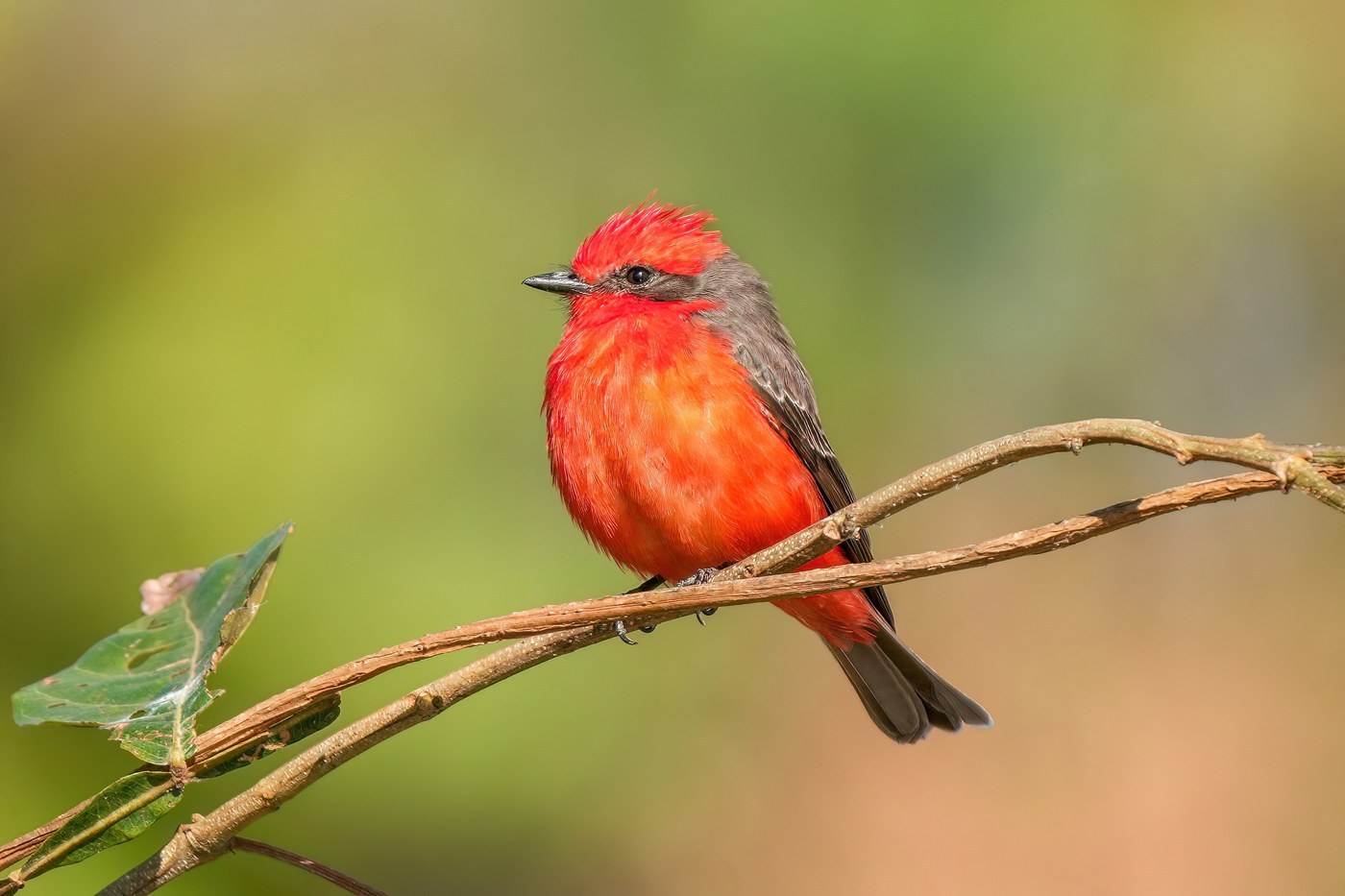
Vermilion Flycatcher
Pyrocephalus rubinus
A tiny, brilliant scarlet-red flycatcher of southwestern deserts and riverbanks, among the most vividly colored songbirds in North America.
- Size
- 13-14 cm (5-5.5 in) long, 24 cm wingspan
- Habitat
- open riparian areas, deserts, ranchland, and agricultural land in the southwestern U.S. through South America
- Type
- songbird
Spotted a bird like this?
Identify any bird from a photo, free.
Overview
The male Vermilion Flycatcher is one of the most eye-catching songbirds in North America, glowing with fiery scarlet-red plumage over the crown, throat, and underparts, set against a contrasting blackish-brown mask, back, and tail. Females and juveniles are far more subdued, showing grayish-brown upperparts, a streaked whitish breast, and a peachy-pink wash on the lower belly.
Found in open, sunny habitats near water in the desert Southwest and south through Mexico and much of South America, this small flycatcher often performs a fluttering display flight and song high over its territory, making the male's brilliant color even more conspicuous.
How to identify it
Key Field Marks
- Male: brilliant scarlet-red crown, throat, and underparts contrasting with a blackish-brown mask, back, and tail
- Female/immature: grayish-brown above with a whitish, streaked breast and a peachy-salmon wash on the belly, lacking the male's red
- Small size and relatively short tail
- Often perches low and conspicuously, flicking its tail
Similar Species
- No other North American flycatcher shows the male's all-red plumage, making adult males unmistakable.
- Females can be confused with other small flycatchers but show a distinctive peachy belly wash and streaked breast not matched by similar species.
Habitat & range
Vermilion Flycatchers inhabit open, sunny habitats with scattered trees or shrubs near water, including desert riparian corridors, ranchland, agricultural fields, and mesquite bosques, from the southwestern United States (Arizona, New Mexico, Texas, and southern California) south through Mexico, Central America, and much of South America.
Most U.S. populations are largely resident or short-distance migrants, with some northern birds moving south or to lower elevations in winter.
Behavior & voice
Voice
Gives a soft, tinkling song often described as pit-pit-pitseet, frequently delivered during a fluttering display flight in which the male rises and flutters down while singing.
Feeding
Sallies from a low, exposed perch to catch flying insects, often returning to the same perch after each sortie; forages actively over open ground, water, and low vegetation.
Nesting
Builds a small, shallow cup nest of twigs and grass, saddled on a horizontal branch, typically in a tree near water; the female alone incubates while the male defends the territory and feeds her during incubation.
Frequently asked questions
Why is the male Vermilion Flycatcher so brightly colored?
The male's vivid scarlet-red plumage is used in courtship displays, including a fluttering song-flight, to attract mates and advertise territory.
Do female Vermilion Flycatchers look like the males?
No, females are grayish-brown above with a streaked whitish breast and a peachy-pink wash on the belly, lacking the male's brilliant red coloring.
Where can I find a Vermilion Flycatcher?
Look in open, sunny habitats near water such as desert riparian areas, ranchland, and agricultural fields in the southwestern U.S., Mexico, and further south through Central and South America.
What does a Vermilion Flycatcher eat?
It feeds almost entirely on flying insects, caught by sallying out from a low perch.
Vermilion Flycatcher guides
In-depth guides for identifying, finding, and understanding Vermilion Flycatcher.
Other birds you may enjoy

Black Redstart
13-14.5 cm (5.1-5.7 in) long, 23-26 cm wingspan

Black-throated Sparrow
12-14 cm (4.7-5.5 in) long, about 19-20 cm (7.5-8 in) wingspan

Greater Bird-of-paradise
Body about 43 cm; males with additional flank plumes up to 50 cm and long tail wires

Blue Tit
11-12 cm (4.3-4.7 in) long, 17-20 cm wingspan

Red-billed Quelea
11.5–13 cm long, wingspan about 20–22 cm
White-plumed Antbird
13-14 cm (5-5.5 in) long

Pyrrhuloxia
19-22 cm (7.5-8.7 in) long, 30 cm wingspan

Blue-gray Tanager
16-18 cm (6-7 in) long

Blackburnian Warbler
11-13 cm (4.3-5.1 in) long, 20-22 cm wingspan

Bluethroat
13-14 cm (5.1-5.5 in) long, 20-22 cm wingspan

Eurasian Nuthatch
12-14.5 cm (4.7-5.7 in) long, 22.5-27 cm wingspan

Wood Thrush
19-21 cm (7.5-8.3 in) long, about 33 cm (13 in) wingspan