
Vermilion Flycatcher Identification Guide
A small flycatcher whose adult male glows brilliant red against a black mask and back, while females show a soft salmon wash on the belly.
Read the full Vermilion Flycatcher encyclopedia entry →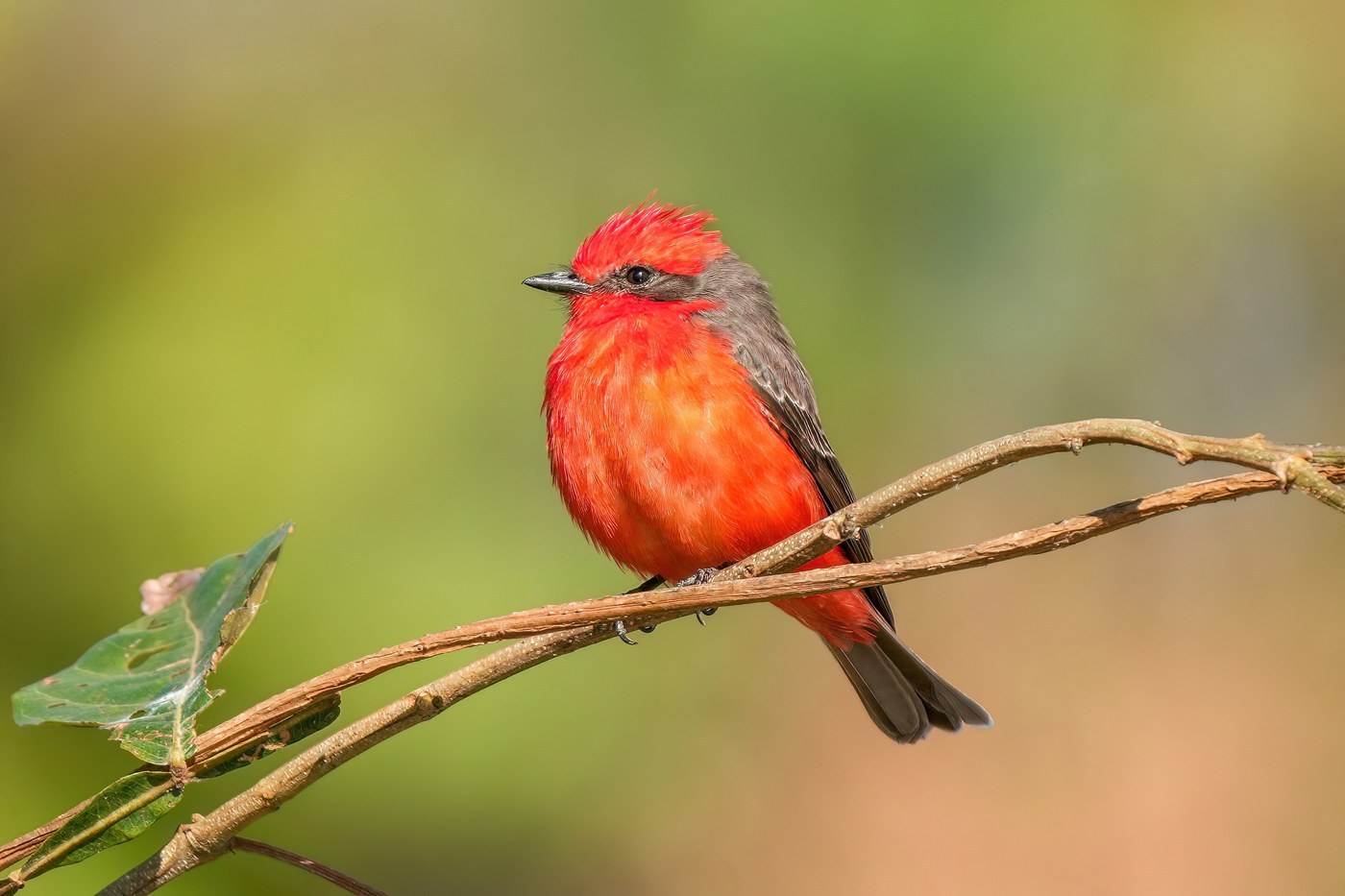
Key Field Marks
- Size & shape: A small, compact flycatcher (about 6 inches) with an upright posture, typical of the genus, often perching low and conspicuously.
- Adult male: Unmistakable — brilliant vermilion-red crown, throat, and underparts contrasting with a blackish-brown back, wings, tail, and a dark mask through the eye.
- Adult female / immature: Gray-brown above with a whitish breast finely streaked with gray, and a peachy-to-salmon wash on the lower belly and undertail coverts — this warm belly color is the best clue to identifying females.
- Bill: Small, thin, and dark, typical of a "flycatcher" bill used for sallying after insects.
- Behavior: Perches on low, exposed vantage points — fence wires, shrub tops, low branches — and makes short sallying flights to catch flying insects, often returning to the same perch.
Separating Vermilion Flycatcher from Similar Species
- Male: No other North American bird combines vermilion-red underparts with a black mask and back — essentially unmistakable.
- Female vs. other Empidonax/pewees: The peachy-salmon wash restricted to the lower belly, combined with open arid habitat and low perching behavior, separates female Vermilion Flycatchers from the grayer, unmarked bellies of pewees and Empidonax flycatchers.
- Immature males: Show a patchy mix of orange-red feathers coming in among gray-brown, which can look odd but is diagnostic of the species transitioning to adult plumage.
Where & When to See One
Found in open arid and semi-arid country — desert washes, riparian corridors, ranchland, and scrubby edges — of the southwestern United States (Arizona, New Mexico, Texas, southern California, southern Nevada) south through Mexico, Central America, and much of South America. Resident year-round through most of its core range; northernmost breeders may withdraw southward in winter. Often found near water or irrigation in otherwise dry country, where flying insects are abundant.
Voice
A soft, tinkling "pit-a-see" song, frequently delivered during a fluttering display flight over territory. The call note is a sharp, high "tsip."
Frequently asked questions
What does a female Vermilion Flycatcher look like?
Gray-brown above with a streaked whitish breast and a distinctive peachy-salmon wash on the belly, quite different from the male's all-red plumage.
Where can I find Vermilion Flycatchers in the US?
In open arid habitats, desert washes, and riparian areas of the Southwest, including Arizona, New Mexico, Texas, and southern California, especially near water.
Are Vermilion Flycatchers migratory?
Most populations are year-round residents in their core range, though birds at the northern edge of the range may move south in winter.
How can I tell an immature male from an adult female?
Immature males often show scattered orange-red feathers mixed with gray-brown as they molt toward adult plumage, unlike the uniformly salmon-washed belly of females.