
Verdin
Auriparus flaviceps
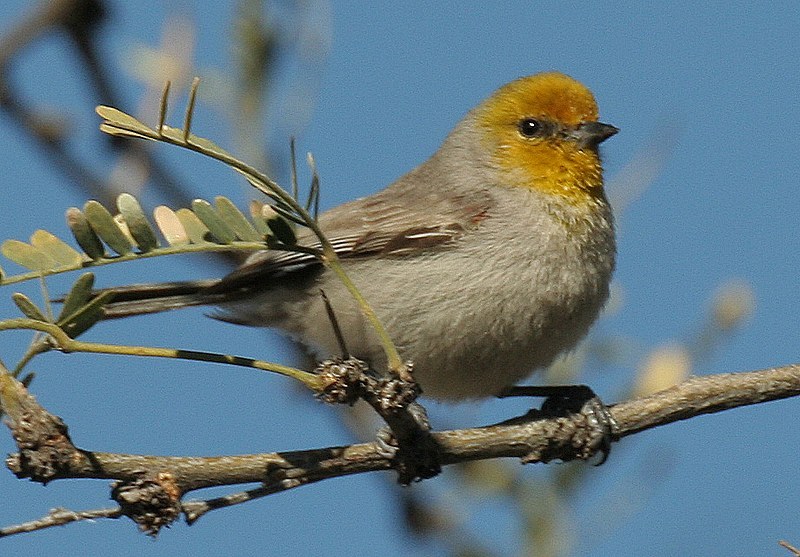
A tiny, active desert songbird with a bright yellow head and a chestnut shoulder patch, famous for its bulky twig nests.
- Size
- 10-11 cm (4-4.3 in) long, 17 cm (6.7 in) wingspan
- Habitat
- arid desert scrub, thorn scrub, and mesquite washes
- Type
- songbird
Spotted a bird like this?
Identify any bird from a photo, free.
Overview
The Verdin is one of the smallest songbirds in North America, a hyperactive little desert dweller found throughout the arid Southwest. Adults are mostly plain gray, offset by a bright yellow head and throat and a small chestnut patch at the bend of the wing.
Juveniles lack the yellow head and chestnut shoulder, appearing plain gray overall and can be mistaken for a bushtit at first glance. Verdins are constantly on the move, gleaning insects from twigs and foliage with quick, restless movements.
How to identify it
Key field marks
- Tiny, round-bodied songbird with a short tail
- Bright yellow head and throat in adults
- Small chestnut (reddish-brown) patch at the shoulder
- Otherwise plain gray body
- Sharp, thin, slightly downcurved bill
Similar species
Juvenile Verdins lacking yellow can resemble Bushtit, but Verdin has a thicker-based bill, a shorter tail, and lacks the bushtit's habit of moving in tight, twittering flocks. Lesser Goldfinch has a stouter, conical seed-eating bill and black cap or back rather than a plain gray body.
Habitat & range
Habitat
Verdins live in hot, arid desert scrub and thorny wash vegetation, including mesquite, acacia, palo verde, and creosote bush habitats.
Range
Resident year-round across the desert Southwest of the United States (California, Arizona, New Mexico, Texas) and much of northern and central Mexico. Verdins do not migrate, remaining on territory throughout the year.
Behavior & voice
Behavior
Verdins are almost constantly in motion, hopping and flitting through thorny shrubs while gleaning insects and spiders from twigs, bark, and leaves; they will also visit flowers for nectar.
Voice
The most common call is a sharp, repeated "tsee-tsee-tsee" or a scolding chip; the song is a simple, clear series of three or four whistled notes.
Feeding and nesting
Diet is mostly small insects and spiders, supplemented with berries and nectar. Verdins are notable nest builders, constructing large, conspicuous, football-sized globes of interwoven thorny twigs with a small side entrance. Pairs build multiple nests: one for breeding and additional roosting nests used year-round for shelter from heat and cold, an unusual habit among small songbirds.
Frequently asked questions
What does a Verdin look like?
A tiny gray desert songbird with a bright yellow head and throat and a small chestnut patch on the shoulder; juveniles are plain gray without the yellow.
Why do Verdins build so many nests?
In addition to a breeding nest, Verdins build separate roosting nests used year-round for shelter from extreme desert heat and cold, a distinctive behavior for a small songbird.
Where do Verdins live?
In arid desert scrub and thorny wash habitat across the southwestern United States and much of Mexico, where they are year-round residents.
What do Verdins eat?
Mainly small insects and spiders, along with some berries and nectar.
Are Verdins related to chickadees?
Verdins belong to the penduline tit family (Remizidae), a group related to but distinct from the chickadees and titmice family.
Verdin guides
In-depth guides for identifying, finding, and understanding Verdin.
Other birds you may enjoy

Black Redstart
13-14.5 cm (5.1-5.7 in) long, 23-26 cm wingspan

Black-throated Sparrow
12-14 cm (4.7-5.5 in) long, about 19-20 cm (7.5-8 in) wingspan

Greater Bird-of-paradise
Body about 43 cm; males with additional flank plumes up to 50 cm and long tail wires

Blue Tit
11-12 cm (4.3-4.7 in) long, 17-20 cm wingspan

Red-billed Quelea
11.5–13 cm long, wingspan about 20–22 cm
White-plumed Antbird
13-14 cm (5-5.5 in) long

Pyrrhuloxia
19-22 cm (7.5-8.7 in) long, 30 cm wingspan

Blue-gray Tanager
16-18 cm (6-7 in) long

Blackburnian Warbler
11-13 cm (4.3-5.1 in) long, 20-22 cm wingspan

Bluethroat
13-14 cm (5.1-5.5 in) long, 20-22 cm wingspan

Eurasian Nuthatch
12-14.5 cm (4.7-5.7 in) long, 22.5-27 cm wingspan

Wood Thrush
19-21 cm (7.5-8.3 in) long, about 33 cm (13 in) wingspan