
Verdin Identification Guide
A tiny, energetic desert songbird told by its gray body, bright yellow face, and hidden chestnut shoulder patch.
Read the full Verdin encyclopedia entry →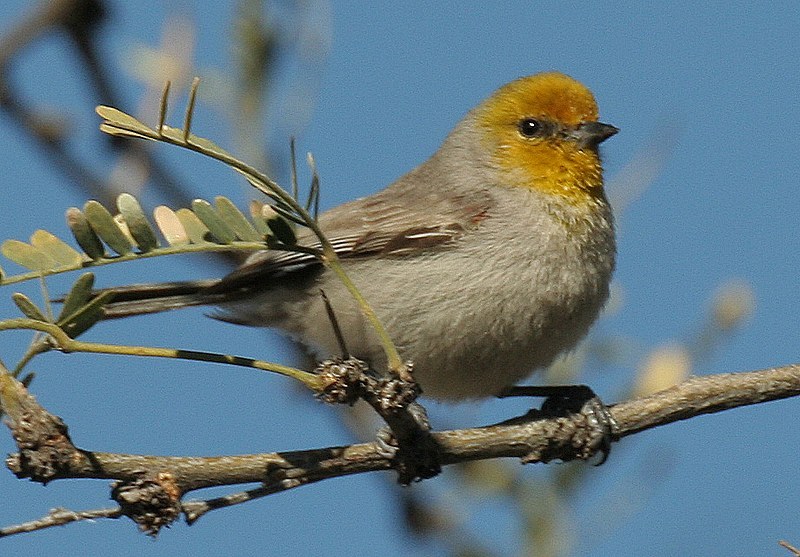
Key Field Marks
- Size & shape: Very small (about 4.5 inches), plump-bodied with a long, narrow tail and a proportionally large, sharply pointed bill — much thinner than a chickadee's or bushtit's bill.
- Plumage: Overall pale gray body; adults show a bright yellow face, forehead, and throat.
- Shoulder patch: A rufous-chestnut patch on the lesser wing coverts ("shoulder"), often hard to see when the wing is folded but flashes in flight or when the bird lifts its wings.
- Juveniles: Lack the yellow face and rufous shoulder entirely — plain gray overall, which can cause confusion with other small desert songbirds.
- Behavior: Constantly active and acrobatic, hanging upside down and probing flowers, twigs, and foliage for insects, much like a kinglet or chickadee.
Separating Verdin from Similar Species
- Bushtit: Grayer overall with no yellow on the face, a much blunter/stubbier bill, and a habit of traveling in large, chattering flocks — Verdins are usually solitary or in pairs.
- Lucy's Warbler: Has a rufous rump and crown patch rather than a yellow face, a thinner warbler bill, and more restless flitting behavior in mesquite bosques.
- Juvenile Verdin vs. kinglets/bushtits: Look for the sharp, needle-like bill and the eventual presence of an adult with yellow face nearby, since juveniles often travel with parents.
Where & When to See One
Verdins are non-migratory residents of arid scrub across the Sonoran, Chihuahuan, and Mojave deserts of the southwestern United States (Arizona, New Mexico, Texas, southern California, southern Nevada, Utah) and much of northern and central Mexico. Look for them year-round in mesquite, palo verde, creosote bush, and other thorny desert scrub. Their large, globular stick nests — built for both breeding and roosting — are a good clue to their presence even when the bird itself is hidden.
Voice
A sharp, insistent series of "tsee-tsee-tsee" or "chip" notes, along with a distinctive descending whistled call. The voice is often the first clue to a Verdin's presence in dense desert scrub.
Frequently asked questions
How do I tell a Verdin from a Bushtit?
Verdins have a bright yellow face and throat plus a sharp, pointed bill, while Bushtits are uniformly gray with a stubby bill and travel in larger, noisy flocks.
Do juvenile Verdins have yellow faces?
No, juveniles are plain gray with no yellow and no rufous shoulder patch, making them easy to mistake for other small gray desert birds until they molt into adult plumage.
Where is the best habitat to find a Verdin?
Dense, thorny desert scrub such as mesquite, palo verde, and creosote bush across the southwestern deserts of the US and northern Mexico.
What does a Verdin's nest look like?
A large, ball-shaped mass of interwoven twigs with a side entrance, built in thorny shrubs; the species builds separate nests for breeding and for roosting.