
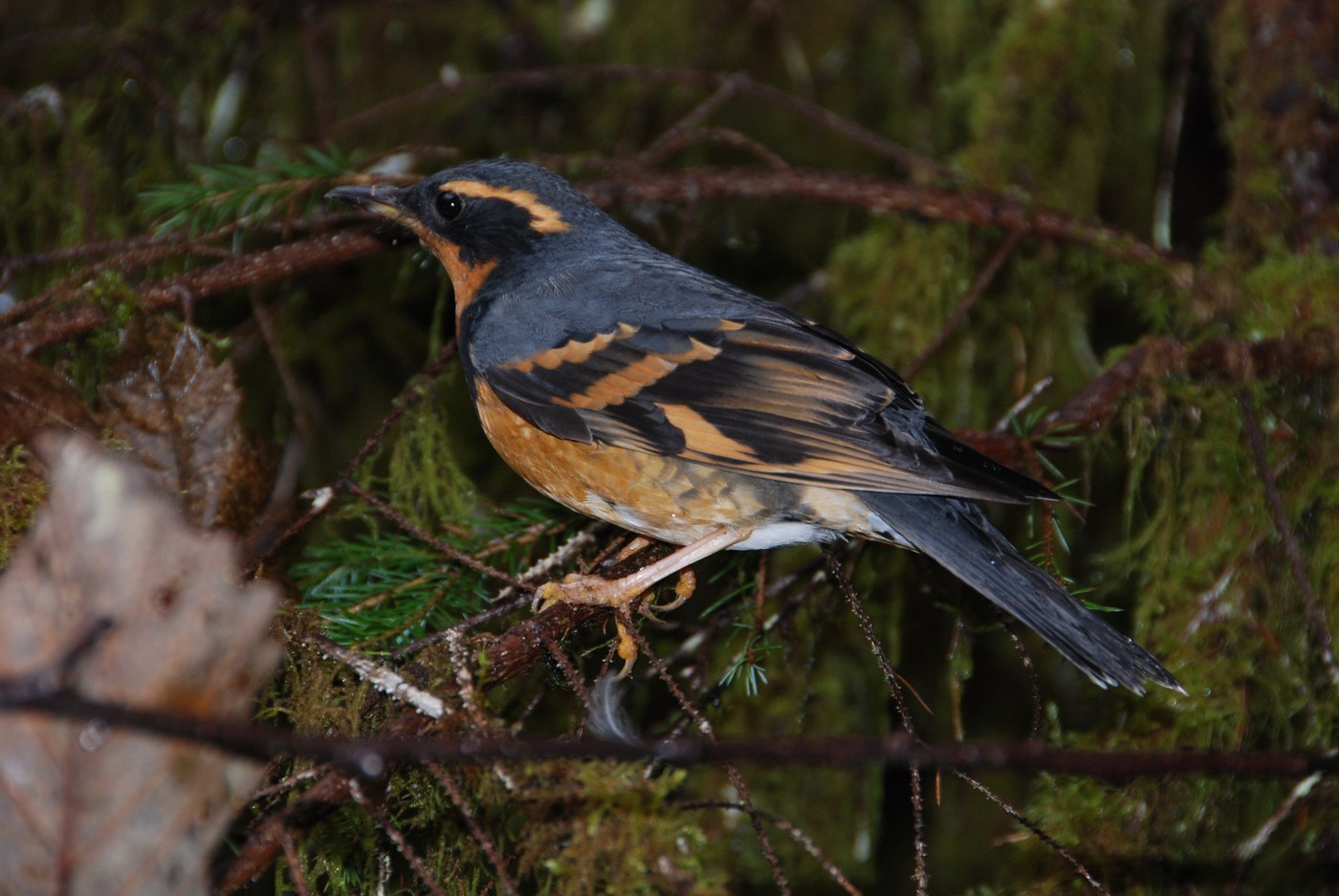
Varied Thrush
Ixoreus naevius
A striking Pacific Northwest thrush resembling a robin dressed in slate-gray and burnt orange, known for its eerie, single-note whistled song.
- Size
- 23-25 cm (9-10 in) long
- Habitat
- dense, dark, wet coniferous forests
- Type
- songbird
Spotted a bird like this?
Identify any bird from a photo, free.
Overview
The Varied Thrush is a strikingly colored bird of the shadowy, wet coniferous forests of the Pacific Northwest, often glimpsed as a flash of orange in the dim understory. It resembles an American Robin in shape but is far more boldly patterned, with slate-gray to blackish upperparts, a burnt-orange eyebrow stripe, and an orange breast crossed by a dark breast band.
Males are more richly colored and boldly patterned than females, which show duller, more brownish-gray tones overall. The species occasionally wanders far outside its normal range in winter, sometimes turning up as a surprise visitor at feeders across much of North America.
How to identify it
Key field marks
- Slate-gray to blackish upperparts (browner in females)
- Burnt-orange eyebrow stripe
- Orange throat and breast crossed by a dark breast band
- Orange wing bars visible on the folded wing
Similar species
American Robin is similarly sized and shaped but lacks the orange eyebrow, dark breast band, and orange wing bars, showing a plainer gray-brown back and uniform reddish-orange breast instead. No other North American thrush shares the Varied Thrush's bold facial and breast pattern.
Habitat & range
Habitat
Varied Thrushes favor dense, dark, moist coniferous forest, especially old-growth or mature stands with a closed canopy, often near streams, along the Pacific coast and interior mountains.
Range
The species breeds from Alaska south through coastal British Columbia, Washington, Oregon, and into northern California, extending into interior mountain ranges in some areas. It winters at lower elevations along the Pacific coast and occasionally wanders widely across North America.
Migration
Varied Thrushes are partial migrants, with many populations shifting to lower elevations or milder coastal areas in winter; some individuals irrupt well outside the normal range, sometimes appearing at bird feeders far to the east.
Behavior & voice
Behavior
Varied Thrushes forage on the forest floor, flipping leaf litter for insects and other invertebrates, and switch to eating berries and seeds heavily in fall and winter, sometimes visiting feeders during irruption years.
Voice
The song is an eerie, ethereal, single-pitched buzzy whistle, often repeated at different pitches with pauses between notes, giving the dim forest interior an otherworldly soundscape quite unlike typical thrush songs.
Nesting
Nests are built in the dense foliage of conifers, usually close to the trunk, constructed of twigs, moss, and mud. Females lay 2-5 pale blue eggs marked with brown spots.
Frequently asked questions
How do you tell a Varied Thrush from an American Robin?
Varied Thrush has a burnt-orange eyebrow stripe, a dark breast band crossing an orange breast, and orange wing bars, while American Robin has a plain gray-brown back and a uniform reddish-orange breast without these markings.
What does a Varied Thrush sound like?
Its song is an eerie, single-pitched buzzy whistle repeated at different pitches, quite different from the rich warbling of an American Robin.
Where do Varied Thrushes live?
They breed in dense, wet coniferous forests of the Pacific Northwest, from Alaska south to northern California, and winter at lower elevations along the coast.
Do Varied Thrushes show up outside their normal range?
Yes, in some winters individuals wander far east of their usual range, occasionally appearing at bird feeders across the continent.
Varied Thrush guides
In-depth guides for identifying, finding, and understanding Varied Thrush.
Other birds you may enjoy

Black Redstart
13-14.5 cm (5.1-5.7 in) long, 23-26 cm wingspan

Black-throated Sparrow
12-14 cm (4.7-5.5 in) long, about 19-20 cm (7.5-8 in) wingspan

Greater Bird-of-paradise
Body about 43 cm; males with additional flank plumes up to 50 cm and long tail wires

Blue Tit
11-12 cm (4.3-4.7 in) long, 17-20 cm wingspan

Red-billed Quelea
11.5–13 cm long, wingspan about 20–22 cm
White-plumed Antbird
13-14 cm (5-5.5 in) long

Pyrrhuloxia
19-22 cm (7.5-8.7 in) long, 30 cm wingspan

Blue-gray Tanager
16-18 cm (6-7 in) long

Blackburnian Warbler
11-13 cm (4.3-5.1 in) long, 20-22 cm wingspan

Bluethroat
13-14 cm (5.1-5.5 in) long, 20-22 cm wingspan

Eurasian Nuthatch
12-14.5 cm (4.7-5.7 in) long, 22.5-27 cm wingspan

Wood Thrush
19-21 cm (7.5-8.3 in) long, about 33 cm (13 in) wingspan