
Varied Thrush Identification Guide
A robin-shaped thrush of Pacific Northwest forests, boldly marked with a burnt-orange breast band, eyebrow, and wing bars set against slaty upperparts.
Read the full Varied Thrush encyclopedia entry →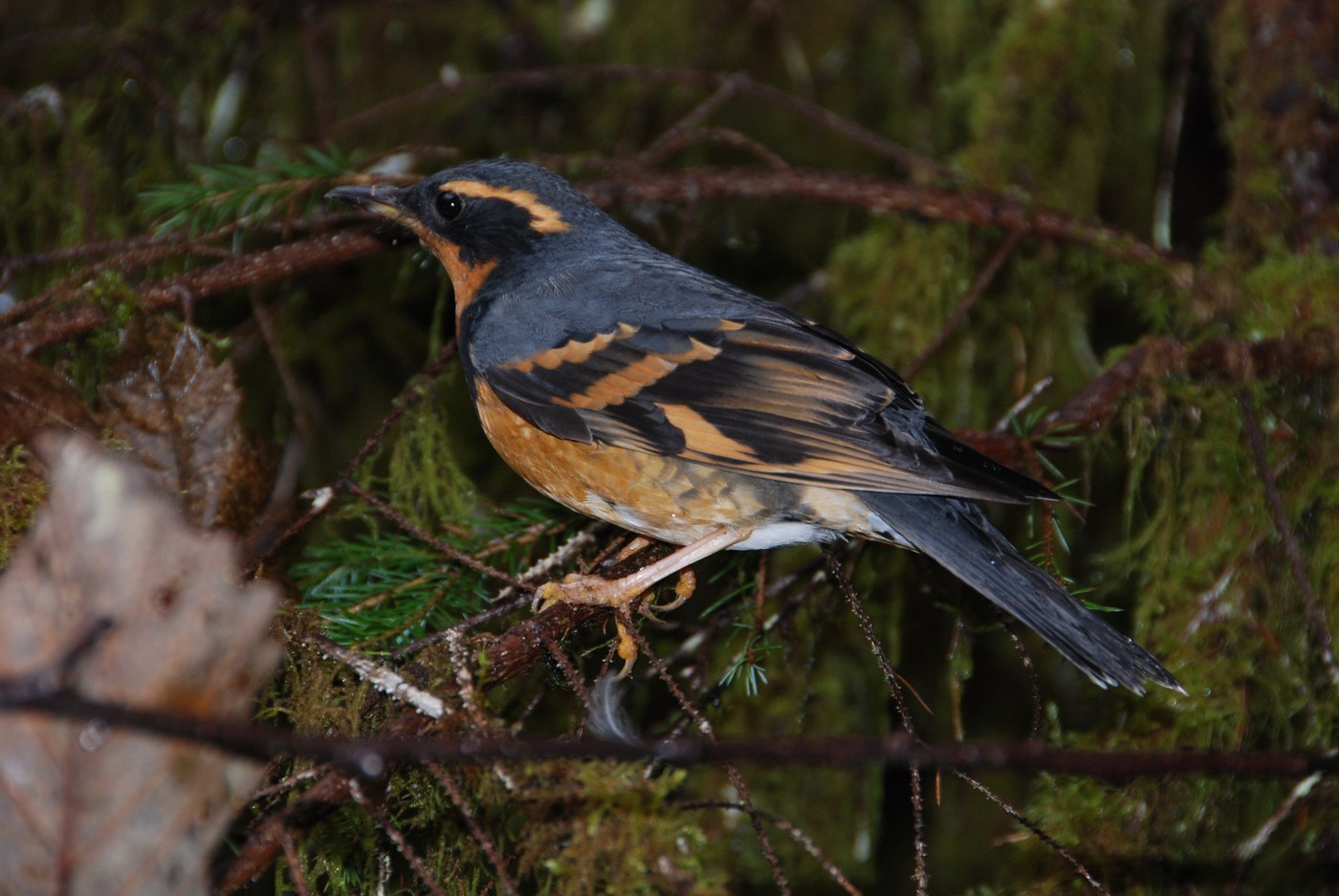
Key Field Marks
- Robin-sized and robin-shaped (about 23-25 cm), but more boldly patterned, with a plump body and fairly short tail.
- Males show slate-gray to blackish upperparts, a bold burnt-orange eyebrow stripe, orange wing bars, and orange underparts crossed by a solid blackish breast band.
- Females are similarly patterned but duller and browner overall, with a grayish-brown (rather than black) and less defined breast band.
- Orange wing bars and orange underwing linings are visible in flight, along with a dark tail.
- Stands more upright than a robin and often forages by flipping leaf litter on the forest floor.
Similar Species
- American Robin: lacks the black breast band, orange eyebrow, and orange wing bars; robin's underparts are a more uniform brick-orange without the sharp banded pattern.
- No other North American thrush shows the combination of slate upperparts, orange eyebrow, orange wing bars, and dark breast band, making adult Varied Thrush essentially unmistakable when seen well.
Habitat, Range & Season
- Breeds in humid coniferous and mixed forest, especially old-growth and dense second-growth, along the Pacific coast from Alaska south through British Columbia, Washington, Oregon, and into northern California, extending east into parts of the northern Rockies.
- In winter, many birds move to lower elevations and into a broader range along the Pacific coast, and individuals occasionally wander far east across North America, sometimes appearing at feeders offering suet or fruit during cold snaps.
- Prefers deep shade and dense understory, often staying low and can be surprisingly hard to see despite its bright colors, especially when foraging quietly on the ground.
- Present on breeding grounds spring through late summer; many descend to lower elevations or move south for winter (roughly October through March).
Voice
- Song is a distinctive, eerie, single sustained buzzy whistle on one pitch, followed after a pause by another single note on a different pitch, producing a slow, ringing, almost otherworldly series that carries far through quiet forest.
- Call is a soft, low "chuck" or "tuk," often given while foraging.
Frequently asked questions
How do you tell a Varied Thrush from an American Robin?
Varied Thrush has a bold orange eyebrow, orange wing bars, and a black breast band on slate-gray upperparts, all features that American Robin lacks.
What does a Varied Thrush sound like?
Its song is an eerie series of single, sustained buzzy whistles, each note on a different pitch, with pauses between notes, unlike the cheerful caroling song of an American Robin.
Where does the Varied Thrush live?
It breeds in humid coniferous forest along the Pacific coast from Alaska to northern California, and shifts to lower elevations or wanders more broadly, sometimes far to the east, in winter.
Why do Varied Thrushes sometimes show up far from the Pacific Northwest in winter?
Individuals occasionally irrupt or wander east across North America during winter, likely tied to food availability, and can turn up unexpectedly at feeders far outside the normal range.