
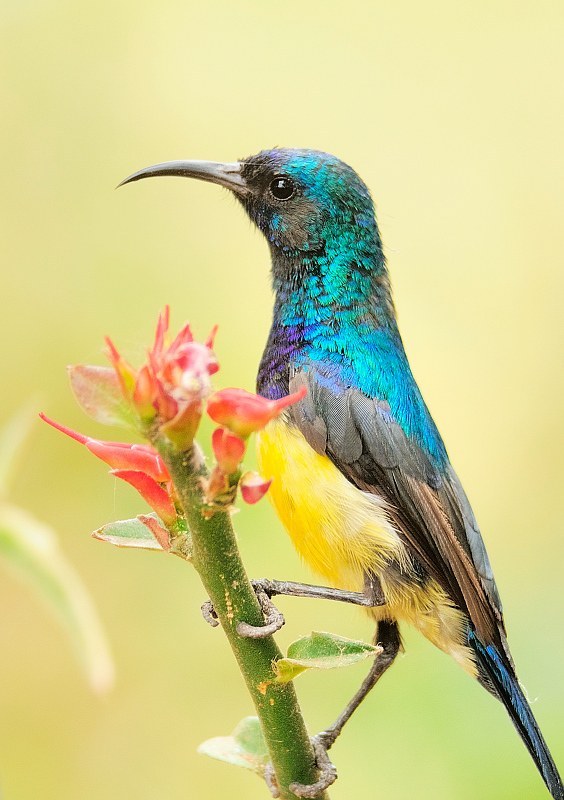
Variable Sunbird
Cinnyris venustus
A small, widespread East African sunbird whose male plumage pattern shifts noticeably from one region to the next, giving the species its name.
- Size
- 10-12 cm long, tiny-bodied with a short slightly decurved bill
- Habitat
- Savanna woodland, forest edge, gardens and cultivated land across East Africa
- Type
- songbird
Spotted a bird like this?
Identify any bird from a photo, free.
Overview
The Variable Sunbird is a tiny, energetic nectar-feeder found across East Africa, from South Sudan and Ethiopia south through Kenya and Tanzania. It gets its common name from the striking degree of plumage variation shown by males across different populations, which for decades led to confusion over how many species were actually involved.
Appearance
Males are iridescent, typically combining a metallic green or blue-green crown, throat and upper back with a violet or blue chest band, and a belly that ranges from bright yellow to sooty black depending on the subspecies. Females are far plainer: olive-grey above and pale yellowish below, lacking any iridescence.
Like other sunbirds, the bill is slender and downcurved, adapted for probing tubular flowers, and the wings are short and rounded.
How to identify it
Key field marks
- Small size (about the size of a warbler) with a thin, curved bill
- Male: iridescent green/blue head and throat, a narrow band of violet-blue across the breast, and a belly color that varies geographically from yellow to blackish
- Female: plain olive-grey above, dull yellow below, no bright colors
- Constant hovering and darting flight around flowering trees and shrubs
Similar species
Because male plumage varies so much between populations, local field guides are essential for pinning down exact appearance in a given region. Females and immatures are easily confused with other small sunbirds such as the Collared or Olive Sunbird; the combination of habitat, range, and lack of any breast band or throat patch usually narrows things down. Male Collared Sunbirds show a clean narrow purple collar on an otherwise unmarked green-and-yellow body, distinguishing them from the more blotchy-bellied Variable Sunbird.
Habitat & range
Habitat
Variable Sunbirds favor open and semi-open habitats: acacia savanna, woodland edges, coastal scrub, cultivated gardens, and flowering ornamental trees in towns and cities.
Range
The species occurs widely across East Africa, including South Sudan, Ethiopia, Somalia, Uganda, Kenya, and Tanzania, generally at low to mid elevations.
Migration
Most populations are resident, though some local movements track the flowering and fruiting seasons of favored nectar plants.
Behavior & voice
Behavior
Active and pugnacious for its size, the Variable Sunbird will chase other sunbirds and even much larger birds away from productive flowering trees. It moves quickly between blossoms, feeding while perched rather than hovering for extended periods like a hummingbird, though brief hovering bouts do occur.
Voice
The song is a fast, high-pitched jumble of chips and twitters, often delivered from an exposed perch. The call is a sharp, metallic "tsip" or "chip" note.
Feeding
Nectar makes up the bulk of the diet, supplemented by small insects and spiders gleaned from foliage or caught in short aerial sallies, which provide essential protein, especially when feeding young.
Nesting
The nest is an untidy, purse-shaped structure of grass, plant down, and spider web, suspended from a thin branch or twig with a side entrance hole, often partly shielded by an overhanging "porch." The female typically incubates one or two eggs alone.
Frequently asked questions
Why is it called the Variable Sunbird?
Male plumage, especially belly color, differs markedly between geographically separate populations, ranging from bright yellow to almost black, which inspired the name.
Where does the Variable Sunbird live?
It is found across East Africa, including Ethiopia, South Sudan, Somalia, Uganda, Kenya, and Tanzania, in savanna, woodland edge, and gardens.
What does a Variable Sunbird eat?
Mainly flower nectar, supplemented with small insects and spiders for protein.
How can I tell a male from a female Variable Sunbird?
Males show iridescent green or blue plumage with a violet chest band; females are plain olive-grey above and dull yellow below with no bright colors.
Is the Variable Sunbird endangered?
No, it is listed as Least Concern due to its wide range and generally stable population.
Variable Sunbird guides
In-depth guides for identifying, finding, and understanding Variable Sunbird.
Other birds you may enjoy

Black Redstart
13-14.5 cm (5.1-5.7 in) long, 23-26 cm wingspan

Black-throated Sparrow
12-14 cm (4.7-5.5 in) long, about 19-20 cm (7.5-8 in) wingspan

Greater Bird-of-paradise
Body about 43 cm; males with additional flank plumes up to 50 cm and long tail wires

Blue Tit
11-12 cm (4.3-4.7 in) long, 17-20 cm wingspan

Red-billed Quelea
11.5–13 cm long, wingspan about 20–22 cm
White-plumed Antbird
13-14 cm (5-5.5 in) long

Pyrrhuloxia
19-22 cm (7.5-8.7 in) long, 30 cm wingspan

Blue-gray Tanager
16-18 cm (6-7 in) long

Blackburnian Warbler
11-13 cm (4.3-5.1 in) long, 20-22 cm wingspan

Bluethroat
13-14 cm (5.1-5.5 in) long, 20-22 cm wingspan

Eurasian Nuthatch
12-14.5 cm (4.7-5.7 in) long, 22.5-27 cm wingspan

Wood Thrush
19-21 cm (7.5-8.3 in) long, about 33 cm (13 in) wingspan