
Variable Sunbird Identification Guide
A tiny, iridescent African sunbird whose underparts vary geographically from bright yellow to nearly white, giving rise to its name.
Read the full Variable Sunbird encyclopedia entry →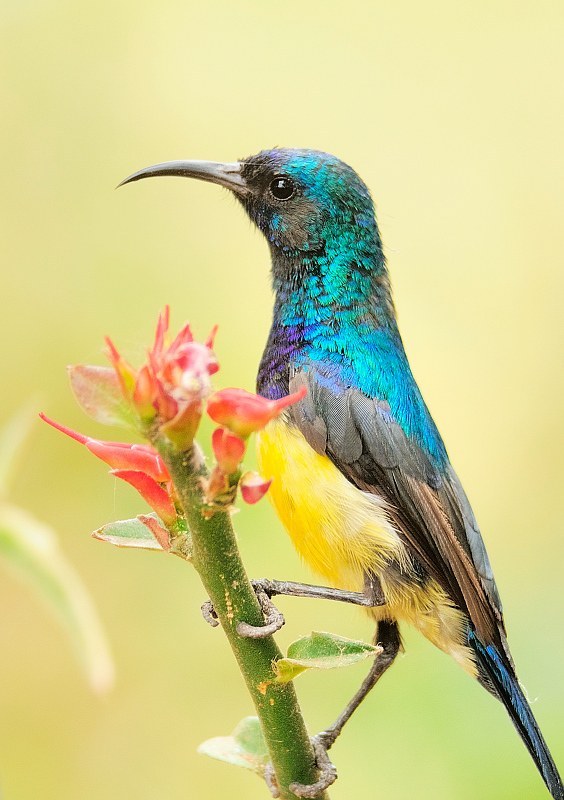
Key Field Marks
- Very small nectar-feeding bird (about 10-12 cm) with a thin, strongly downcurved bill adapted for probing flowers.
- Breeding males show an iridescent metallic green head, throat, and upper breast that can flash blue or bronze depending on light, bordered below by a narrow dark or maroon band and small yellow or orange pectoral tufts often hidden at the shoulder.
- Belly color is the most variable feature across the species' wide range, spanning bright yellow, pale yellow, grayish, or nearly whitish depending on subspecies and region, which is the origin of the common name.
- Females and non-breeding males are dull olive-gray above with pale yellowish or grayish underparts and a faint pale eyebrow, lacking iridescence; told from other female sunbirds mainly by range, size, and bill shape.
- Flight is fast and darting between flowering shrubs and trees.
Similar Species
- Beautiful Sunbird: males show a longer tail with elongated central tail feathers and a red breast band, differing clearly from the plainer-bellied Variable Sunbird male.
- Olive-bellied Sunbird and other small green-headed sunbirds: separated mainly by belly color and the presence/absence and color of the maroon breast band; careful attention to range and subspecies-specific plumage descriptions is often needed.
- Female Variable Sunbirds are best distinguished from similar female sunbirds by combination of small size, thin curved bill, and pale (not strongly streaked) underparts.
Habitat, Range & Season
- Widespread across sub-Saharan Africa, occurring from West Africa through East Africa and south into parts of southern Africa, with numerous named subspecies reflecting its variable plumage.
- Found in a broad range of open and semi-open habitats: woodland edge, savanna, gardens, parks, cultivated areas, and coastal scrub, generally avoiding dense unbroken forest interior.
- Resident across most of its range, though some populations show local or altitudinal movements tied to flowering seasons.
- Frequently visits garden flowers and flowering trees, making it one of the most commonly seen sunbirds around towns and villages within its range.
Voice
- Song is a thin, rapid, high-pitched jumble of warbling and buzzy notes, often given from an exposed perch.
- Call is a sharp, insect-like "tsip" or "chip" repeated while foraging or in flight between flowers.
Frequently asked questions
Why is it called the Variable Sunbird?
The name refers to how much the belly color varies geographically across its many subspecies, ranging from bright yellow to pale or almost whitish depending on the population.
How do you tell a male Variable Sunbird from a Beautiful Sunbird?
Male Beautiful Sunbirds have elongated central tail feathers and a red breast band below the green throat, features the shorter-tailed, plain-bellied Variable Sunbird lacks.
What habitats does the Variable Sunbird prefer?
It favors open woodland, savanna, gardens, and cultivated land with flowering plants, and is one of the most frequently seen sunbirds in African towns and gardens.
What does the Variable Sunbird eat?
It feeds mainly on nectar from flowering trees and shrubs, supplemented with small insects and spiders, especially when feeding nestlings.