
Tui
Prosthemadera novaeseelandiae
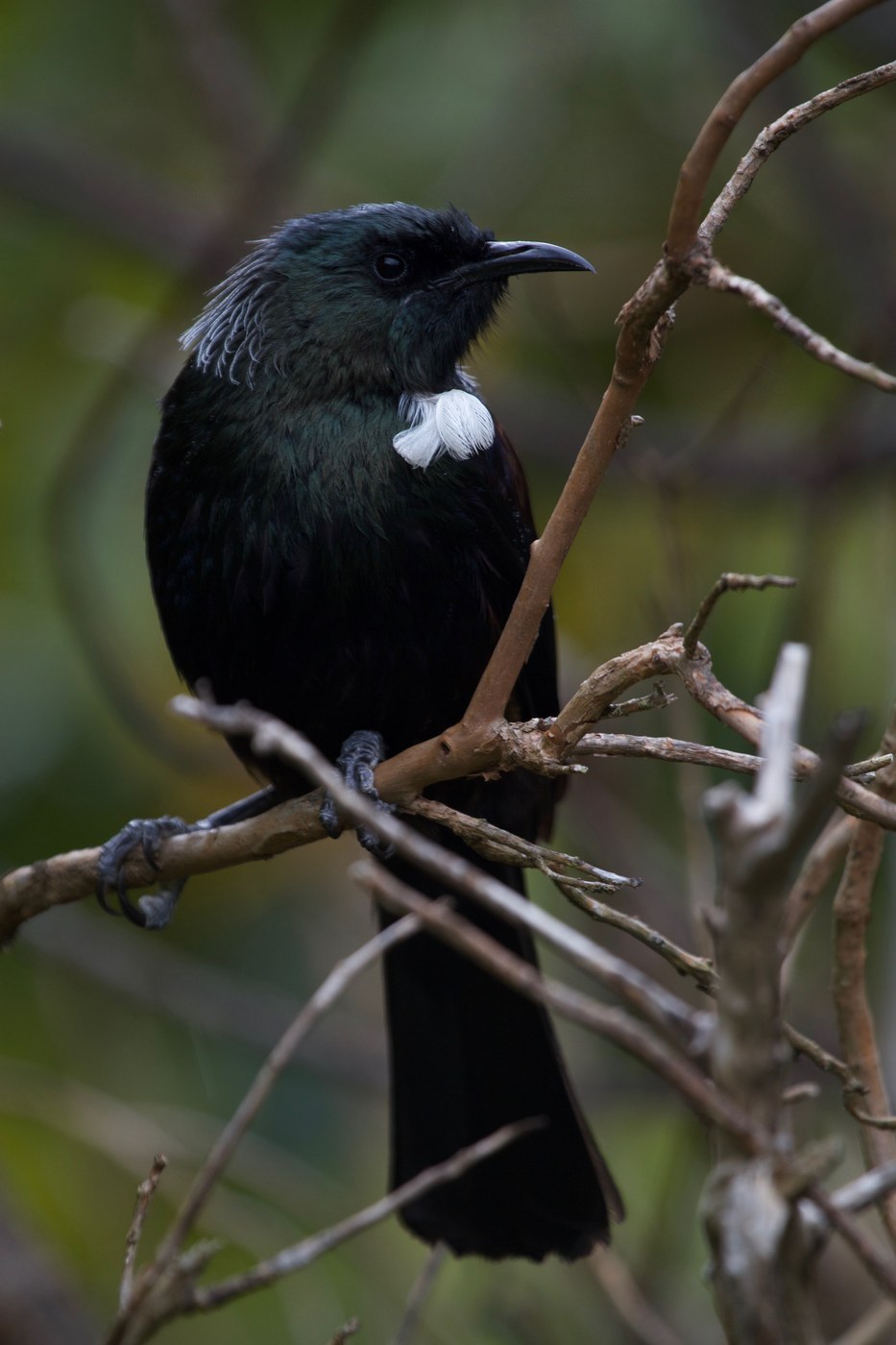
An iridescent, dark New Zealand honeyeater with a distinctive white throat tuft, famed for its extraordinarily varied, bell-like and mechanical song.
- Size
- 30 cm (12 in) long
- Habitat
- native forest, scrub, and flowering gardens across New Zealand
- Type
- songbird
Spotted a bird like this?
Identify any bird from a photo, free.
Overview
The Tui is one of New Zealand's most familiar and vocal native birds, a large honeyeater cloaked in glossy dark plumage that shimmers with iridescent blue, green, and bronze in good light. At the throat sits a tuft of curled white feathers, the "parson's collar" that gives it the old colonial nickname "parson bird," set off by a lacy band of fine white feathers across the nape and shoulders.
Tui are powerful, agile fliers with a whirring wingbeat audible as they dash between flowering trees. They are considered one of the most vocally accomplished New Zealand birds, capable of an enormous range of clear bell notes, coughs, clicks, and wheezes, sometimes stitched together with tones pitched beyond human hearing.
How to identify it
Key field marks
- Glossy black-green plumage with iridescent blue and bronze sheen
- Distinctive curled white throat tuft ("parson's collar")
- Lacy white feathering across the nape and upper back
- Fairly long, slightly downcurved bill
- Noisy, whirring wingbeats in flight
Similar species
- New Zealand Bellbird is smaller, plain olive-green overall, and lacks the white throat tuft; its song is more purely bell-like without the Tui's mechanical clicks and coughs.
- North Island Kokako is much larger, blue-grey rather than glossy black, and has blue wattles rather than a white throat tuft.
Habitat & range
Range
Widespread throughout New Zealand's North, South, and Stewart Islands, as well as the Chatham Islands (a distinct subspecies), from coastal lowlands to montane forest edges.
Habitat
Inhabits native forest, scrub, and increasingly urban gardens and parks, especially where flowering trees such as kowhai, flax, pohutukawa, and eucalypts provide nectar.
Migration
Mostly sedentary, though some populations make local seasonal movements tracking flowering trees, especially in winter when food can be scarce at higher elevations.
Behavior & voice
Behavior
Bold, active, and often aggressive, Tui vigorously defend flowering trees from other nectar-feeders, chasing off rivals with noisy dives and wing-whirring displays.
Voice
An extraordinarily varied repertoire of clear bell-like notes mixed with coughs, clicks, wheezes, and grunts, plus some ultrasonic components; each bird's song can be highly individual, and Tui are also capable mimics.
Feeding
Primarily a nectar feeder, using a brush-tipped tongue to sip from tubular flowers, but also eats fruit and insects, and plays an important role pollinating native plants as it moves between flowers.
Nesting
Builds a bulky, twiggy cup nest hidden in dense foliage; the female alone incubates the two to four eggs, while both parents help feed the chicks once hatched.
Frequently asked questions
Why is the Tui called the parson bird?
Its tuft of curled white throat feathers resembles a clergyman's white collar, inspiring the old colonial nickname "parson bird."
Can Tui mimic sounds?
Yes, Tui are accomplished mimics and can learn to imitate other bird calls and even human sounds, in addition to their own varied natural song.
What do Tui eat?
Mainly nectar from native flowering trees such as kowhai and pohutukawa, supplemented with fruit and insects.
How is the Tui different from the Bellbird?
The Tui is larger and glossy black with a white throat tuft and a harsher, more mechanical song, while the Bellbird is smaller, plain olive-green, and sings a purer, bell-like song.
Tui guides
In-depth guides for identifying, finding, and understanding Tui.
Other birds you may enjoy

Black Redstart
13-14.5 cm (5.1-5.7 in) long, 23-26 cm wingspan

Black-throated Sparrow
12-14 cm (4.7-5.5 in) long, about 19-20 cm (7.5-8 in) wingspan

Greater Bird-of-paradise
Body about 43 cm; males with additional flank plumes up to 50 cm and long tail wires

Blue Tit
11-12 cm (4.3-4.7 in) long, 17-20 cm wingspan

Red-billed Quelea
11.5–13 cm long, wingspan about 20–22 cm
White-plumed Antbird
13-14 cm (5-5.5 in) long

Pyrrhuloxia
19-22 cm (7.5-8.7 in) long, 30 cm wingspan

Blue-gray Tanager
16-18 cm (6-7 in) long

Blackburnian Warbler
11-13 cm (4.3-5.1 in) long, 20-22 cm wingspan

Bluethroat
13-14 cm (5.1-5.5 in) long, 20-22 cm wingspan

Eurasian Nuthatch
12-14.5 cm (4.7-5.7 in) long, 22.5-27 cm wingspan

Wood Thrush
19-21 cm (7.5-8.3 in) long, about 33 cm (13 in) wingspan