
Tui Identification Guide
A large, boisterous New Zealand honeyeater with glossy, iridescent dark plumage, a distinctive white throat tuft, and an extraordinary vocal repertoire that mixes melodic song with harsh clicks and wheezes.
Read the full Tui encyclopedia entry →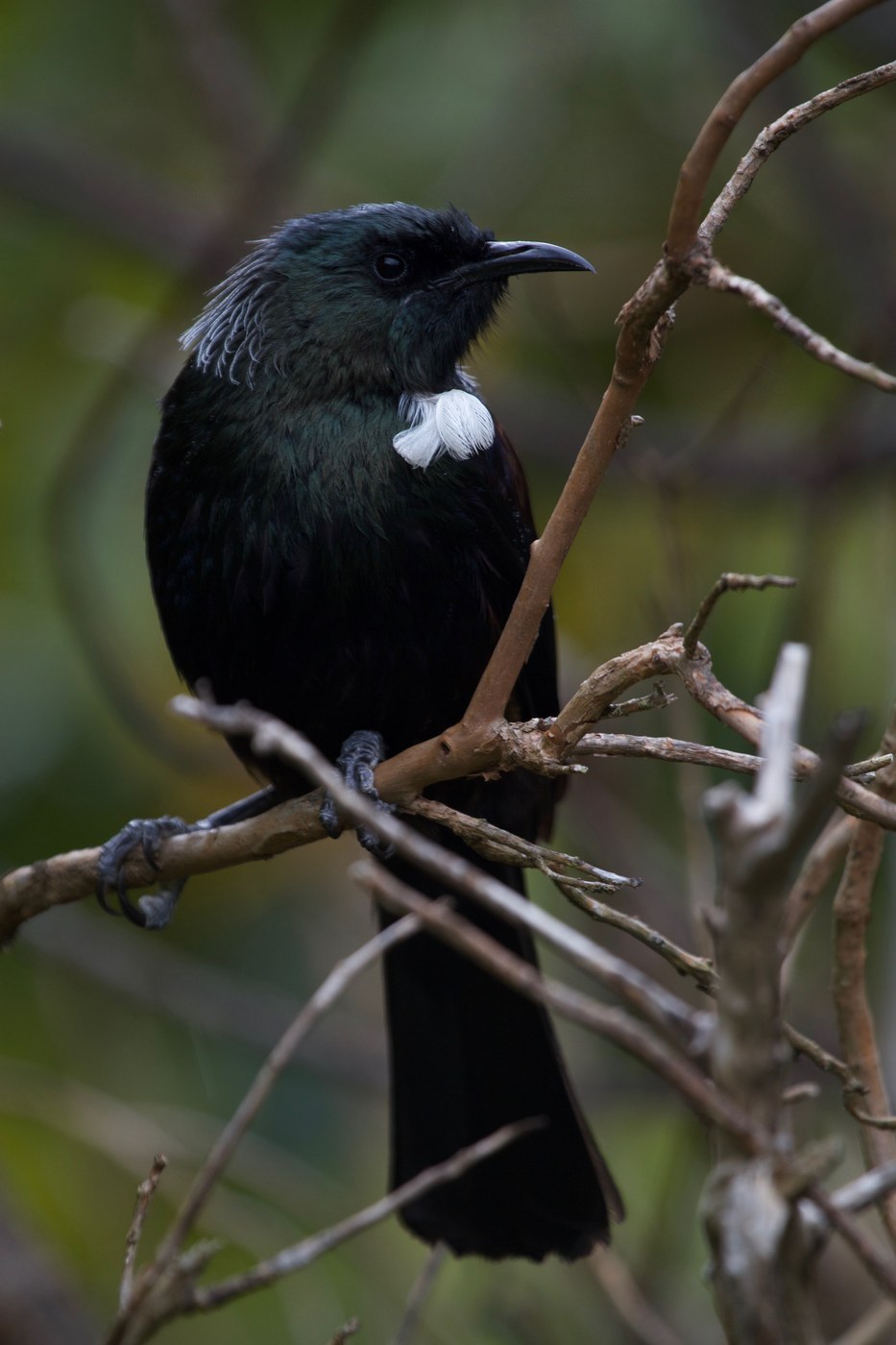
Key Field Marks
- Size & shape: A large, robust honeyeater, noticeably bigger and bulkier than most songbirds, with a fairly long, slightly downcurved bill adapted for probing flowers, and a somewhat hunched, active posture when perched.
- Plumage: Appears black at a distance but is actually richly iridescent, showing glossy blue, green, and bronze sheens across the head, back, and breast in good light; a distinctive tuft of curled, filamentous white feathers at the throat ("parson-bird" collar) is diagnostic and gives rise to its old colonial name.
- Wings & nape: Shows a subtle lacy or scaly pale pattern on the nape and upper back, and a narrow white wingbar/wing patch visible in flight.
- Behavior: Highly active, often aggressive and territorial around flowering and fruiting trees, chasing off other birds (including other Tui) from favored nectar sources; flight is fast and direct with audible whirring wingbeats produced by specially shaped wing feathers.
Separating Tui from Similar Species
- New Zealand Bellbird (Korimako): Smaller, olive-green overall (not glossy black) with a plainer face and no white throat tuft; its song is a pure, bell-like chime rather than Tui's varied mix of melodic and mechanical sounds.
- Common Myna / Blackbird (introduced species): Both can look dark at a distance but lack any iridescence, the white throat tuft, or the honeyeater's characteristic downcurved bill; behavior and voice are also very different.
- No other New Zealand bird shares the combination of glossy black-appearing iridescent plumage and a curled white throat tuft, making adult Tui essentially unmistakable once seen well; juveniles are duller and browner with a less developed throat tuft, requiring more care.
Where & When to See It
Endemic to New Zealand, found throughout the North Island, South Island, Stewart Island, and outlying islands, in native forest, scrub, parks, and increasingly in well-vegetated urban gardens, especially where flowering native plants such as flax, kowhai, and pohutukawa provide nectar. Largely sedentary, though some populations move seasonally or altitudinally to track flowering and fruiting resources; visible and vocal year-round, with peak song activity in spring.
Voice
One of the most complex and unusual songs of any bird, combining beautiful, liquid, bell-like and flute-like notes with sudden bursts of harsh coughs, clicks, wheezes, and grunts — many of the lower and higher-frequency components are at the edge of or beyond human hearing range. Tui are also skilled vocal mimics, capable of learning and reproducing sounds from other birds and even human speech in captivity.
Frequently asked questions
What is the most distinctive feature of a Tui?
The curled tuft of white feathers at the throat, combined with plumage that looks black at a distance but shows rich iridescent blue-green-bronze sheen in good light.
How is Tui different from New Zealand Bellbird?
Bellbird is smaller, plain olive-green without any iridescence or throat tuft, and gives a pure, bell-like song, while Tui is larger, glossier, shows the white throat tuft, and produces a much more varied, mechanical-sounding song mixed with melodic notes.
Can Tui mimic other sounds?
Yes, Tui are accomplished vocal mimics capable of learning and reproducing other birds' calls and, in captivity, even human speech.
Where in New Zealand can Tui be found?
Throughout the North and South Islands and outlying islands, in native forest, scrub, and increasingly in gardens and parks with flowering native plants like kowhai, flax, and pohutukawa.