
Tropical Kingbird
Tyrannus melancholicus
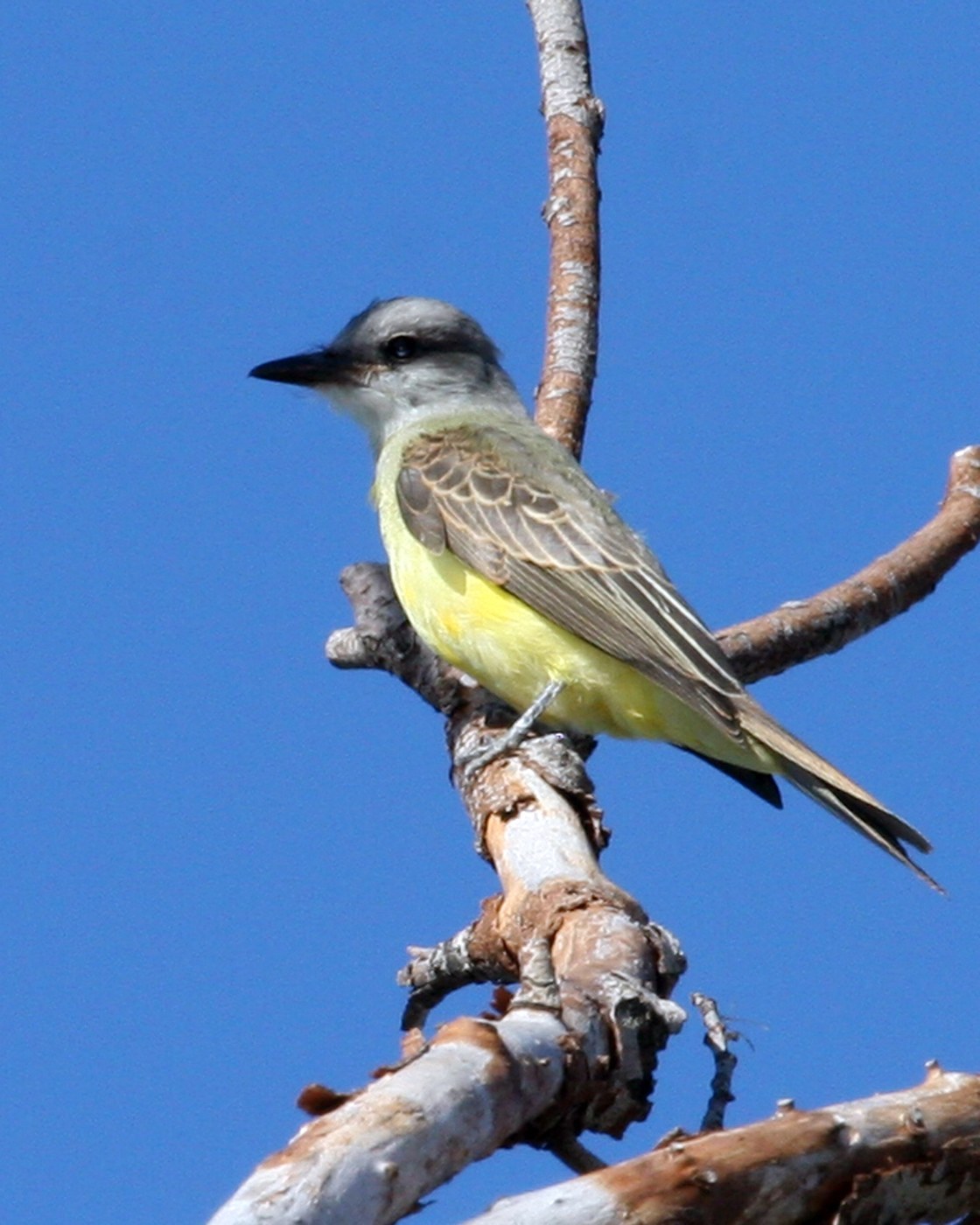
A common, widespread tropical flycatcher with a gray head, olive back, lemon-yellow belly, and a rapid twittering call, nearly identical to Couch's Kingbird.
- Size
- 22 cm (8.5 in) long, 38 cm wingspan
- Habitat
- open country with scattered trees, edges, and clearings from south Texas and Arizona through Mexico, Central America, and South America
- Type
- songbird
Spotted a bird like this?
Identify any bird from a photo, free.
Overview
The Tropical Kingbird is one of the most familiar and widespread flycatchers of the American tropics, ranging from the southernmost United States all the way to Argentina. It has a pale gray head with a darker mask through the eye, an olive-green back, and a bright lemon-yellow belly. The tail is notably notched (forked) and blackish-brown.
In the US it reaches its northern limit in south Texas and southeastern Arizona, where it perches conspicuously on wires and treetops in open, scrubby habitat, sallying out after insects.
How to identify it
Key field marks
- Gray head with a dusky mask, olive-green back
- Bright yellow belly
- Notched (forked) blackish tail
- Fairly large, heavy bill
Similar species
- Couch's Kingbird: virtually identical in plumage; the two are best separated by voice—Tropical Kingbird gives a rapid, evenly pitched twittering trill, while Couch's gives a sharp "kip" and a burry "breeer."
- Western Kingbird: square-tipped (not notched) tail with white outer edges, paler head.
- Cassin's Kingbird: grayer, less deeply notched tail with only a faint pale tip.
Habitat & range
Range and habitat
Tropical Kingbird breeds from south Texas and southeastern Arizona south through Mexico, Central America, and much of South America to central Argentina—one of the broadest ranges of any New World flycatcher. It favors open habitats with scattered trees or utility lines: farmland edges, savanna, riverine growth, and even town parks and gardens.
Migration
US breeders are migratory, wintering in Mexico, but tropical populations are largely resident year-round.
Behavior & voice
Behavior
Tropical Kingbirds perch in the open—often on a wire, dead snag, or treetop—and sally out to catch flying insects, sometimes hovering briefly before returning to a perch.
Voice
The song and calls are a rapid, twittering series of high, thin notes, often rendered as "pip-pip-pip-pip-pipipipip"—an important clue for separating it from the nearly identical Couch's Kingbird.
Feeding
Mainly aerial insects, taken by flycatching sallies; they also eat berries and small fruit, especially outside the breeding season.
Nesting and breeding
The shallow cup nest of twigs and grass is placed on a horizontal branch, often over water or in an isolated tree. The female incubates 2-4 eggs; both parents defend the nest vigorously against intruders.
Frequently asked questions
How can you tell a Tropical Kingbird from a Couch's Kingbird?
Their plumage is nearly identical, so voice is the most reliable clue: Tropical Kingbird gives a rapid twittering trill, while Couch's Kingbird gives a sharp 'kip' and a burry 'breeer.'
Where do Tropical Kingbirds live?
They range from south Texas and southeastern Arizona through Mexico, Central America, and much of South America, in open country with scattered trees.
What does a Tropical Kingbird eat?
Mostly flying insects caught on the wing, plus berries and small fruit.
Is the Tropical Kingbird the same as the Western Kingbird?
No—Western Kingbird has a squared, white-edged tail and a paler head, while Tropical Kingbird has a notched blackish tail and a brighter, more extensively yellow belly.
Tropical Kingbird guides
In-depth guides for identifying, finding, and understanding Tropical Kingbird.
Other birds you may enjoy

Black Redstart
13-14.5 cm (5.1-5.7 in) long, 23-26 cm wingspan

Black-throated Sparrow
12-14 cm (4.7-5.5 in) long, about 19-20 cm (7.5-8 in) wingspan

Greater Bird-of-paradise
Body about 43 cm; males with additional flank plumes up to 50 cm and long tail wires

Blue Tit
11-12 cm (4.3-4.7 in) long, 17-20 cm wingspan

Red-billed Quelea
11.5–13 cm long, wingspan about 20–22 cm
White-plumed Antbird
13-14 cm (5-5.5 in) long

Pyrrhuloxia
19-22 cm (7.5-8.7 in) long, 30 cm wingspan

Blue-gray Tanager
16-18 cm (6-7 in) long

Blackburnian Warbler
11-13 cm (4.3-5.1 in) long, 20-22 cm wingspan

Bluethroat
13-14 cm (5.1-5.5 in) long, 20-22 cm wingspan

Eurasian Nuthatch
12-14.5 cm (4.7-5.7 in) long, 22.5-27 cm wingspan

Wood Thrush
19-21 cm (7.5-8.3 in) long, about 33 cm (13 in) wingspan