
Tropical Kingbird Identification Guide
A large, gray-headed, yellow-bellied flycatcher of the American tropics and southern borderlands, best distinguished from look-alike kingbirds by its notched (not white-edged) tail and its distinctive twittering call.
Read the full Tropical Kingbird encyclopedia entry →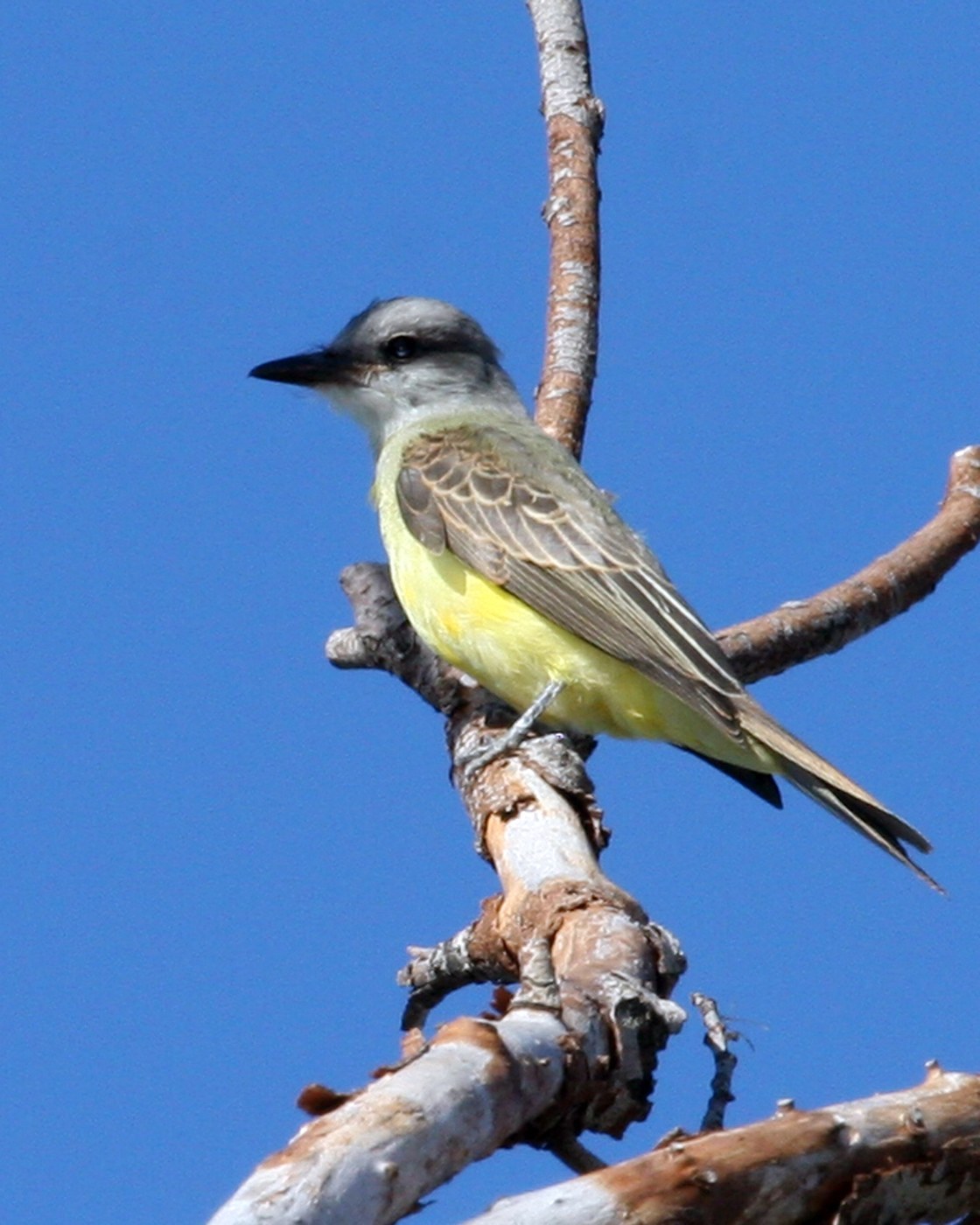
Key Field Marks
- Size & shape: A large flycatcher with a big head, heavy, fairly long bill, and a notably notched (forked-looking) tail — bulkier and larger-billed than most other kingbirds.
- Plumage: Pale gray head with a darker gray mask through the eye, olive-gray back, dark wings, and a bright lemon-yellow belly and undertail that contrasts with a pale grayish throat and upper breast.
- Tail: Brownish-black and distinctly notched, without white outer edges — an important mark separating it from Western Kingbird and Cassin's Kingbird, which show pale or white tail edges/corners.
- Bill: Notably large and heavy, longer than the head is deep — one of the best structural clues among yellow-bellied kingbirds.
- Behavior: A conspicuous perch hunter, sitting upright on wires, fence posts, and bare treetops in open country, sallying out to catch flying insects and returning to the same or a nearby perch; also eats berries and small fruit outside the breeding season.
Separating Tropical Kingbird from Similar Species
- Couch's Kingbird: Virtually identical in plumage and structure — the two are best told apart by voice: Tropical Kingbird gives a rapid, twittering "pip-pip-pip-pip-pip-ip-ip-ip" trill, while Couch's Kingbird gives a shorter, more explosive "kip-kip-kideer" or "breeer" call. Range and habitat overlap only narrowly (south Texas), so voice is essential there.
- Western Kingbird: Shows a white-edged tail (obvious in flight or when the tail is spread) and a smaller bill; Western Kingbird's tail is squared-off with clean white outer edges, unlike Tropical Kingbird's plain notched brownish-black tail.
- Cassin's Kingbird: Has a darker, more contrasting gray "bandit mask" and chest, a whiter chin patch, and a tail with a thin whitish terminal band rather than white edges — bill is also noticeably smaller than Tropical Kingbird's.
- Great Kiskadee: Superficially similar yellow-and-brown pattern but has a bold black-and-white striped head, rufous in the wings and tail, and a much different, loud "kis-ka-dee" call — easily separated once seen well.
Where & When to See It
Widespread from the extreme southern U.S. borderlands (southeastern Arizona, southern Texas) south through Mexico, Central America, and much of South America. Favors open country with scattered trees, edges, riparian corridors, ranchland, and towns — often the most numerous kingbird in Central and South American lowlands. Largely resident in the tropics; U.S. birds are found mainly in the breeding season, with individuals occasionally wandering well north as vagrants along both coasts in fall.
Voice
The call is the most reliable identification feature where Tropical and Couch's Kingbirds overlap: a high, rapid, twittering series of thin notes, often rendered as "pip-pip-pip-pip-pip-ip-ip-ip-ip," quite unlike the shorter, sharper calls of other kingbird species.
Frequently asked questions
How do you tell Tropical Kingbird from Couch's Kingbird?
The two are nearly identical in appearance, so voice is the key: Tropical Kingbird gives a rapid, twittering trill, while Couch's Kingbird gives a shorter, more explosive "kip-kideer" call. Overlap zones (chiefly south Texas) require a good listen to confirm identification.
What separates Tropical Kingbird from Western Kingbird?
Tail pattern is the quickest check: Western Kingbird has white outer edges on a squared tail, while Tropical Kingbird's notched tail is plain brownish-black with no white edging. Tropical Kingbird also has a noticeably larger bill.
Where is Tropical Kingbird found in the United States?
It reaches the U.S. only along the southern borderlands, chiefly southeastern Arizona and southern Texas, with occasional vagrants elsewhere; it is far more common and widespread throughout Mexico, Central America, and South America.
What kind of habitat does Tropical Kingbird prefer?
Open country with scattered trees for perching — ranchland, riverine edges, plantations, parks, and towns — where it can sally from an exposed perch to catch flying insects.